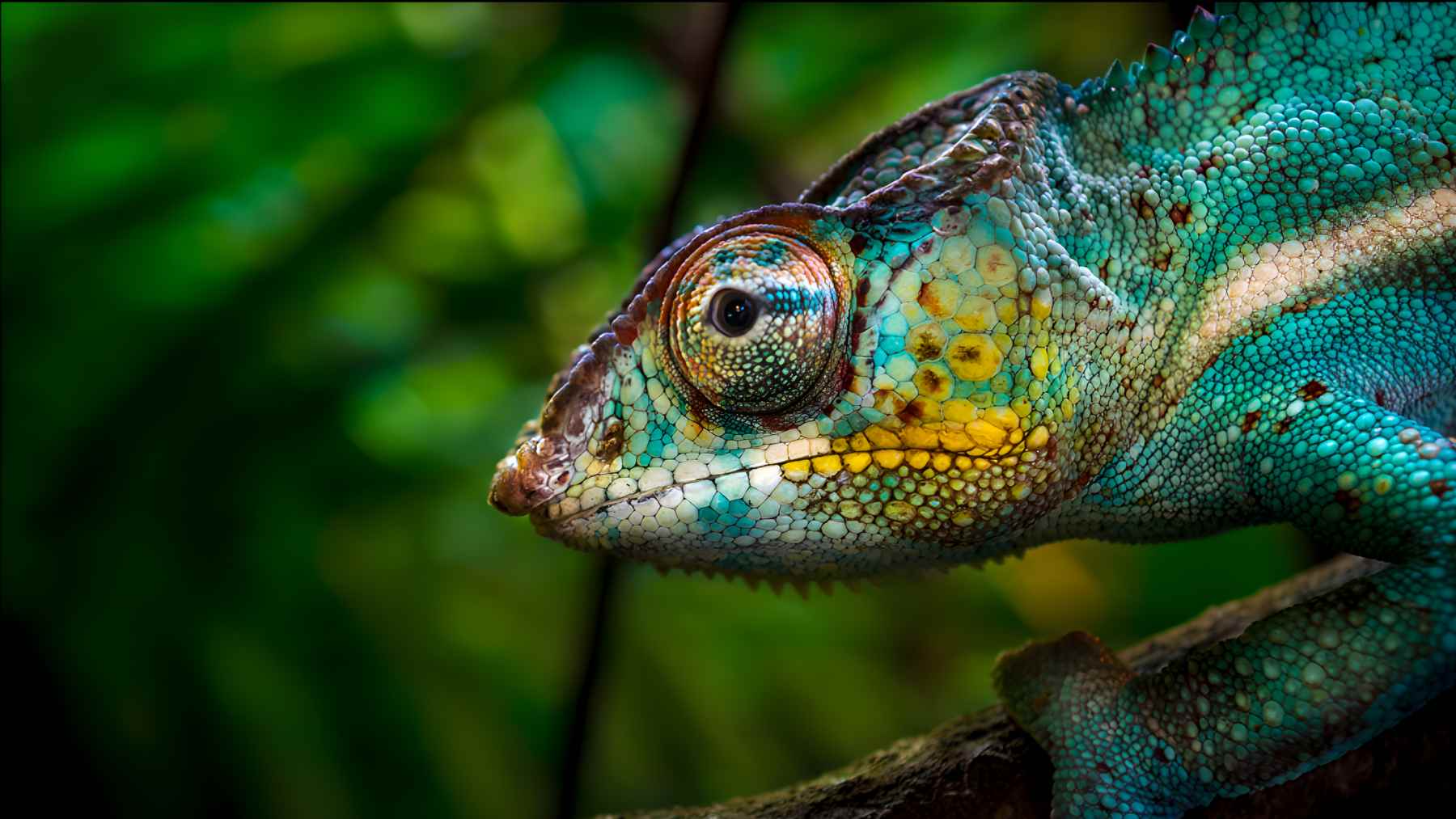
Have you ever watched a chameleon in a nature video and wondered how each eye seems to ignore the other, as if two animals were sharing one head? A new study has finally shown what is hiding inside the skull. Coiled optic nerves, curled up like tiny telephone cords, give chameleons the slack they need to swivel their eyes almost all the way around without turning their necks.
Researchers used high-resolution CT scans to peer into preserved specimens and found something no one had clearly described before. Behind each bulging eye sit two unusually long optic nerves that loop and twist instead of running in a straight line to the brain. This configuration does not appear in other lizards that were scanned, even in species that also rely heavily on vision.
Security camera vision in the treetops
Juan Daza, a coauthor of the work, likes to compare chameleon eyes to security cameras that can sweep in every direction. Each eye can rotate on its own while the animal slowly patrols branches, searching for insects and watching for predators. When a target appears, the eyes suddenly lock onto the same point so the brain can judge distance and line up a tongue shot.
That tongue is not gentle. Earlier studies show that it can go from still to roughly sixty miles per hour in about one hundredth of a second and reach prey at more than twice the chameleon body length. For a small arboreal hunter that often inches along like a slow wind up toy, being able to scan nearly a full circle without shifting its body is a major ecological advantage in crowded forest canopies.
CT scans reveal a coiled cable
The first hint of the coils appeared in 2017, when Edward Stanley from the Florida Museum of Natural History noticed a strange spiral in a CT scan of a tiny leaf chameleon. The nerves looked far longer than the straight distance from eye to brain, then doubled back on themselves multiple times.
To figure out whether this was a one off quirk or a real pattern, the team turned too Vert, a large open access library of three dimensional scans of vertebrate skeletons and soft tissue. They examined adults from thirty four species of lizards and snakes, including three chameleon species that represent distant branches of the family tree. Only the chameleons had optic nerves that were both strongly coiled and much longer than the direct path between eye and brain.
The researchers interpret the coils as built-in slack. When the eye rotates far to one side, the twists can stretch and straighten a bit instead of pulling directly on the nerve. Other animals solve similar mechanical problems in different ways. Humans and some mammals rely on slightly wavy nerve fibers, while owls increase their field of view mainly by twisting their necks. Chameleons, whose neck joints are relatively stiff, seem to have taken the phone cord route instead.
A puzzle that fooled centuries of anatomists
If the coils are so dramatic, why did no one describe them clearly before now? Part of the answer appears to be technique. For most of history, anatomists studied chameleons by dissecting fresh or preserved bodies. Cutting open the skull and removing tissue tends to tug on delicate nerves and straighten out loops. That means the very process of looking destroyed the shape that needed to be seen.
Historical records show that famous figures grappled with the same question about roaming eyes. Aristotle even suggested that chameleons might not have conventional optic nerves at all. Later, early modern anatomists drew more accurate diagrams that hinted at bends or partial loops but did not capture the full coiled pathway. Only with modern CT scanning, which can image soft tissue inside intact skulls, could scientists finally trace the nerves as they sit in life.
Built for roaming eyes before hatching
The team also looked at embryos of the veiled chameleon at several stages of development. In early eggs, the optic nerves run fairly straight. As the embryo grows, the nerves lengthen faster than the space they occupy, fold into loops and eventually form the full telephone cord pattern by the time the baby is close to hatching. Hatchlings are already able to swing their eyes independently, so the system seems ready from day one.
In practical terms, that means this extreme visual trick is not a late bonus for adults. It is baked into the species blueprint and likely helps young chameleons survive their first weeks in complex habitats where every extra degree of vision can matter.
Why this matters beyond cool trivia
At first glance, coiled optic nerves might sound like a neat bit of animal trivia to file next to color changing skin. Yet the discovery adds another piece to a broader story about how animals adapt to the physical limits of their bodies. Instead of evolving flexible necks, chameleons appear to have reshaped the wiring between eye and brain to fit a life spent clinging to branches and making precision strikes at fast moving prey.
The work also shows the value of museum collections and open digital data for understanding biodiversity. Many of the animals in the study have been sitting on shelves for decades. With modern imaging, they are suddenly offering fresh clues about how vision, movement and environment fit together. At the end of the day, learning how a single lizard family sees the world deepens our sense of what could be lost if those habitats disappear.
The study was published in Scientific Reports.