For centuries, the giant moai statues of Rapa Nui (Easter Island) have stood as silent witnesses to a mystery.
How did a small island community move multi‑ton stone figures across rough volcanic ground, and at what cost to their environment? A new peer‑reviewed study has now confirmed that the statues were designed to “walk” upright using ropes and careful rocking.
That simple insight does more than solve an engineering puzzle. It also chips away at the popular story that the Rapa Nui people destroyed their own forests to drag the moai on wooden sleds.
How the moai really moved
In the new research, archaeologists Carl Lipo and Terry Hunt analyzed 962 statues across the island, paying special attention to 62 moai abandoned along ancient roads. These “road moai” are not random leftovers.
They share distinctive traits that only make sense if the statues traveled upright. Their bases are wider and D‑shaped, their bodies lean slightly forward, and they lack the final finishing touches seen on statues that reached ceremonial platforms.
The island’s roads tell the same story. More than 15 miles of routes radiate from the main quarry at Rano Raraku, averaging about 4.5 meters wide with a gently-cupped cross‑section that helps stabilize a tall object as it rocks from side to side. Too narrow and awkward for rolling huge logs under a prone statue. Ideal for guiding a standing megalith.
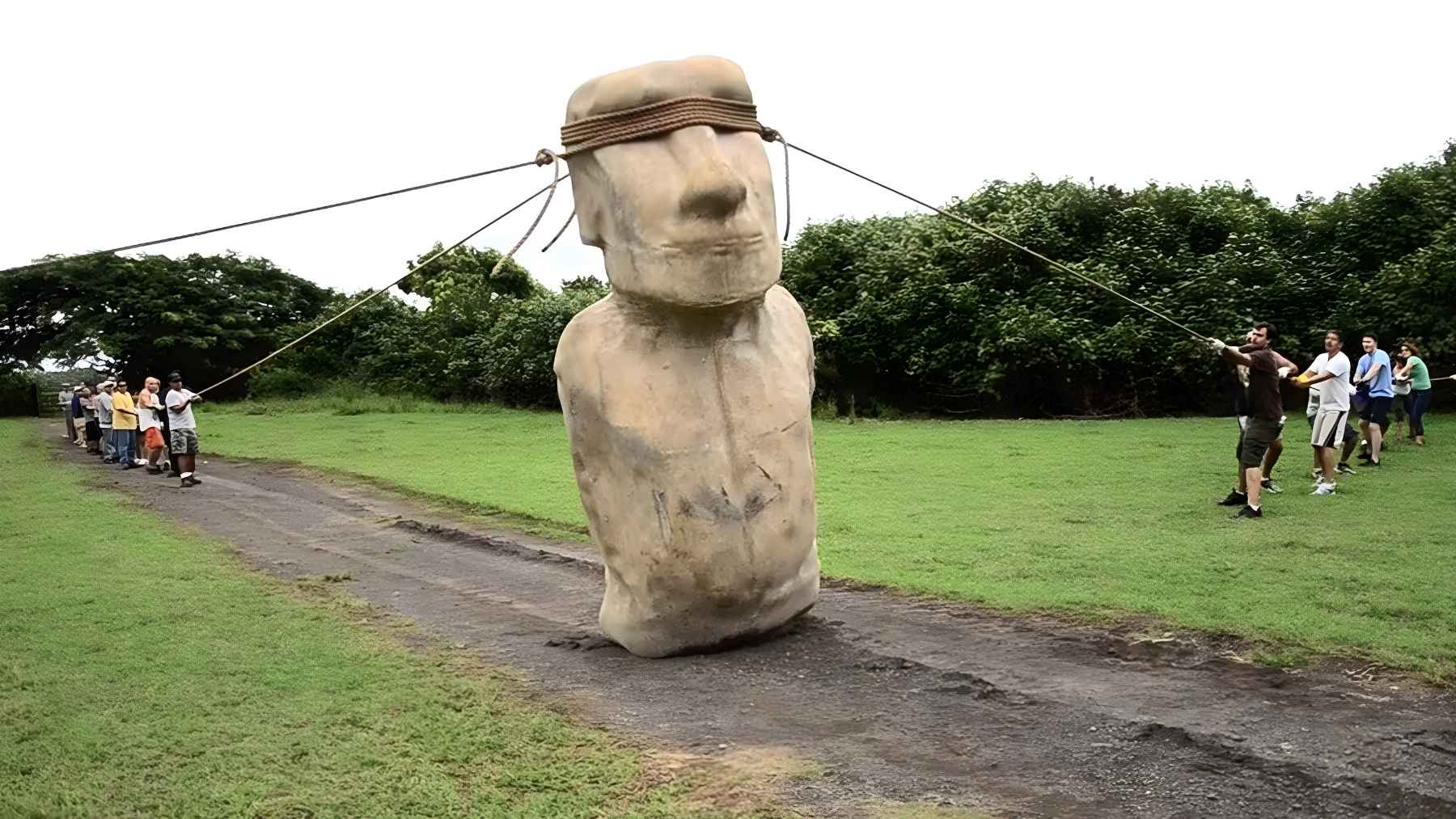
To test the idea, the team built a 4.35‑ton concrete replica whose shape was precisely scaled from a real road moai. With three ropes and only 18 people, they “walked” it 100 meters in 40 minutes by rhythmically pulling from alternating sides while a rear team kept it from tipping.
Once the motion starts, Lipo notes that “people are pulling with one arm” and the statue moves surprisingly fast.
If you have ever shuffled a heavy fridge across the kitchen by wiggling it instead of lifting it, you already know the basic trick. The moai act like inverted pendulums. Each controlled tilt stores a little energy and turns sideways rocking into forward steps. Physics models and field trials show that even larger statues could move efficiently this way, and that the bigger they get, the better the method works.
Breakage patterns fit the picture too. Many road moai lie face down on downhill stretches and on their backs on upslopes, with fractures that match impacts from a standing fall rather than dragging scars along their sides.
Most of these abandoned statues cluster within two kilometers of the quarry, following the failure pattern you would expect if some toppled early in the journey and never got back up.
What this means for the “ecocide” myth
For years, schoolbooks and documentaries treated Rapa Nui as a warning. In that version, thousands of people cut down the last palm trees to feed a statue‑building obsession, using massive log rollers to haul moai and triggering a catastrophic collapse.
That story, popularized by Jared Diamond’s work, framed the island as a miniature model of global environmental suicide.
The walking hypothesis points in another direction. Lipo and Hunt’s measurements and experiments show that upright transport needed surprisingly few people and very little wood. The Journal of Archaeological Science paper concludes that this method “required minimal resources and labor” and better fits the archaeological record than heavy log‑based schemes.
At the same time, other recent studies have re‑examined what actually happened to Rapa Nui’s forests.
Work by the same research group suggests that introduced Polynesian rats, arriving with the first settlers around the 13th century, could have reached populations in the millions and eaten up to 95% of tree seeds, blocking natural regrowth. People did clear land for gardens, but rats made it almost impossible for the palms to come back.
Instead of collapsing immediately, the Rapa Nui appear to have adapted. Archaeological and ecological evidence points to rock‑mulch farming systems that protected thin soils, along with a diet that still relied heavily on seafood long after the last big trees were gone.
Ancient DNA now backs up that picture. A 2024 Nature study of 15 individuals finds no genetic sign of a dramatic population crash before Europeans arrived. Genetic diversity remains stable from the 13th century through the early 18th century, contradicting the idea of a huge pre‑contact die‑off.
Researchers instead highlight the “resilience” of the Rapa Nui community up to the moment when disease, slavery, and colonial disruption hit after 1722.
A different kind of environmental lesson
So did the statues really walk? To a large extent, the physics, the roads, the broken moai beside them, and the islanders’ own oral histories all pull in the same direction. Experts still debate details, but the new work gives the walking model stronger footing than any rival explanation on offer.
The environmental story is shifting too. Rapa Nui still tells a climate‑era cautionary tale, just not the tidy one where a “reckless” Indigenous community cuts down its last tree and pays the price.
The emerging evidence describes something more familiar from modern ecology. A fragile island forest meets an introduced species, human activity amplifies the pressure, and the landscape transforms in ways no one intended.
At the end of the day, that may be the more important message. Small societies can innovate, adapt, and engineer remarkable things with limited means.
The way we choose to tell their story shapes how we think about our own responsibility, whether we are deciding how to manage invasive species or how many resources we burn through at home.
And yes, somewhere on Rapa Nui, people still remember songs about statues that walk in time with a steady work rhythm. Science has not only taken that idea seriously. It has now shown how it could have worked.
The study was published in the Journal of Archaeological Science.