On the rainforest floor near Manaus in northern Brazil, small clay chimneys stick up like tiny smokestacks. For a long time, scientists could describe these “cicada towers” but could not say, with confidence, what they were for.
A new peer-reviewed study suggests the answer is surprisingly practical. The towers help young Amazonian cicadas breathe and also cut down their chances of running into ants, and the researchers backed it up with simple field experiments that pushed the structures to fail. Why would a cicada bother building a mud tower at all?
The tower moment
The towers are built by the Amazon “architect cicada” Guyalna chlorogena while it is still a nymph, the underground juvenile stage before adulthood. When the time is right, the nymph climbs out and molts, shedding its old skin and emerging as a winged adult.
That change happens fast, but it is risky. During those hours, the insect is exposed at the surface and cannot easily dig back down if a predator appears.
Who did the study
The research was led by Marina Méga at the Federal University of Rio de Janeiro, and it was first published on February 23, 2026. Coauthors include Izadora Gonzalez, Maria Luiza Busato, Sara Feitosa, Rodrigo Fadini, and Pedro Pequeno. The full publication details and abstract are available on the official study page.
The main idea is that the tower is not just leftover dirt from digging. It acts like a built-on “life support” feature at the exact moment the nymph is most exposed, both to attackers and to poor air in wet soil.
Ant patrols
To test the predator angle, the team put identical bait on top of towers and on the nearby forest floor, then counted how many ants showed up. The bait was intentionally basic, small “pizzas” made from flour, water, and sardines, because ants in the area reliably swarmed it.
The difference was hard to ignore. The researchers reported that “there were eight times fewer ants on the towers than on the ground,” suggesting that even a modest bit of height can buy time when a cicada is trying to finish metamorphosis.
Field improvisation
This work did not start as a long, equipment-heavy lab project. It grew out of a short field course run through the Serrapilheira Institute’s training program, where long trails, dense vegetation, and humid heat forced the team to keep the tests simple and repeatable.
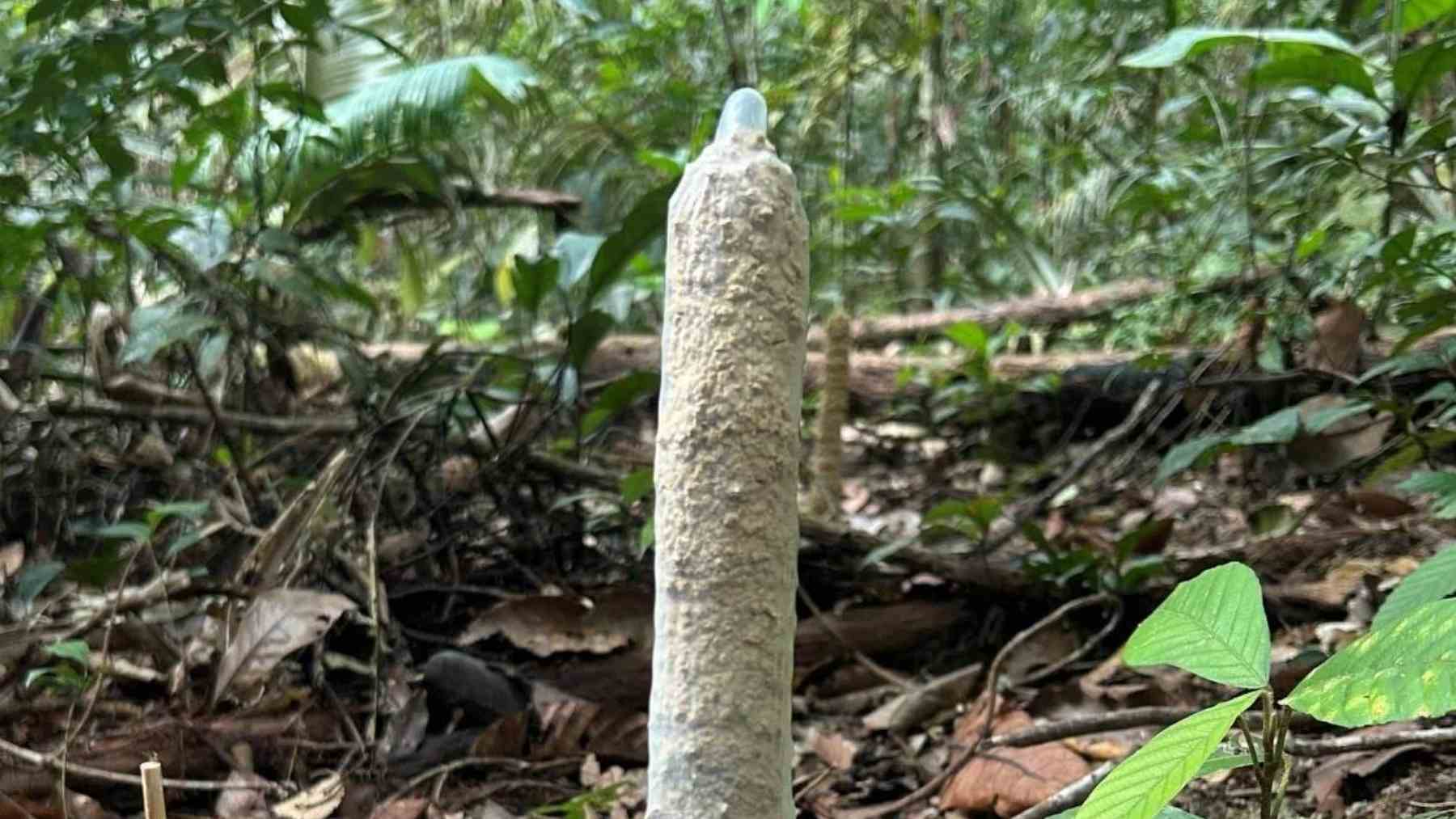
That context helps explain a detail that has grabbed attention far outside ecology circles. The researchers ended up carrying 40 latex condoms in their kit, not as a joke, but because the shape and stretch of the material made it a quick way to seal a tower in the field.
Sealing the chimney
The airflow test asked a straightforward question. If the tower helps with ventilation, what happens when that exchange is blocked and the nymph is stuck breathing whatever air is left inside?
In the experiment described by the team, condoms were slipped over the tops of towers and sealed so outside air could not move normally through the clay. It is a bit like shutting every window in a stuffy room, then noticing what changes when the room is finally opened up again, except here the key gases are oxygen going in and carbon dioxide going out.
Size matters
Once the seals were removed, tower size started to matter in a way earlier observation alone only hinted at. Larger towers tended to show a stronger rebound, with faster rebuilding or growth after the blockage was lifted, while smaller towers often rebuilt less by the next morning.
One possible explanation is plain geometry. More clay and more internal space may buffer stale air for longer, and one outlier tower reached around 18 inches tall, showing just how far the size range can stretch in the Amazon.
An extended body
The study describes the tower as an “extended phenotype,” which is a trait expressed outside the body through something an organism builds. A beaver dam or a spider web fits the same idea because the structure changes survival even though it is not skin or muscle.
Put simply, the cicada turns mud into biology. The tower becomes a tool it maintains and adjusts so its body can stay stable until it is ready to emerge.
Old clues, new tests
Earlier research had already suggested these towers were more than decoration. In a 2017 paper, Claude François Béguin of Museu da Amazônia reported that each tower is occupied by a single nymph and can be repaired or reopened when conditions change.
That work also described the basic architecture, including a turret up to about 16 inches tall above a vertical well a little more than 3 feet deep, and noted the turret can grow by about 1 inch per night during its active building phase. The newer experiments add a stronger cause-and-effect test by showing what happens when towers face ant pressure and when airflow is deliberately obstructed.
Why it matters
At the end of the day, this research sharpens the picture of how an insect you rarely see engineers a safer path to adulthood. The same structure that shifts ant encounters can also help with the basic problem of getting enough oxygen in wet tropical soil, especially after heavy rains.
It also points to the next questions scientists can tackle, including how soil type, rainfall, and tower size combine to shape survival from year to year. Not bad for a structure most people would step over without noticing.
The main study has been published in Biotropica.