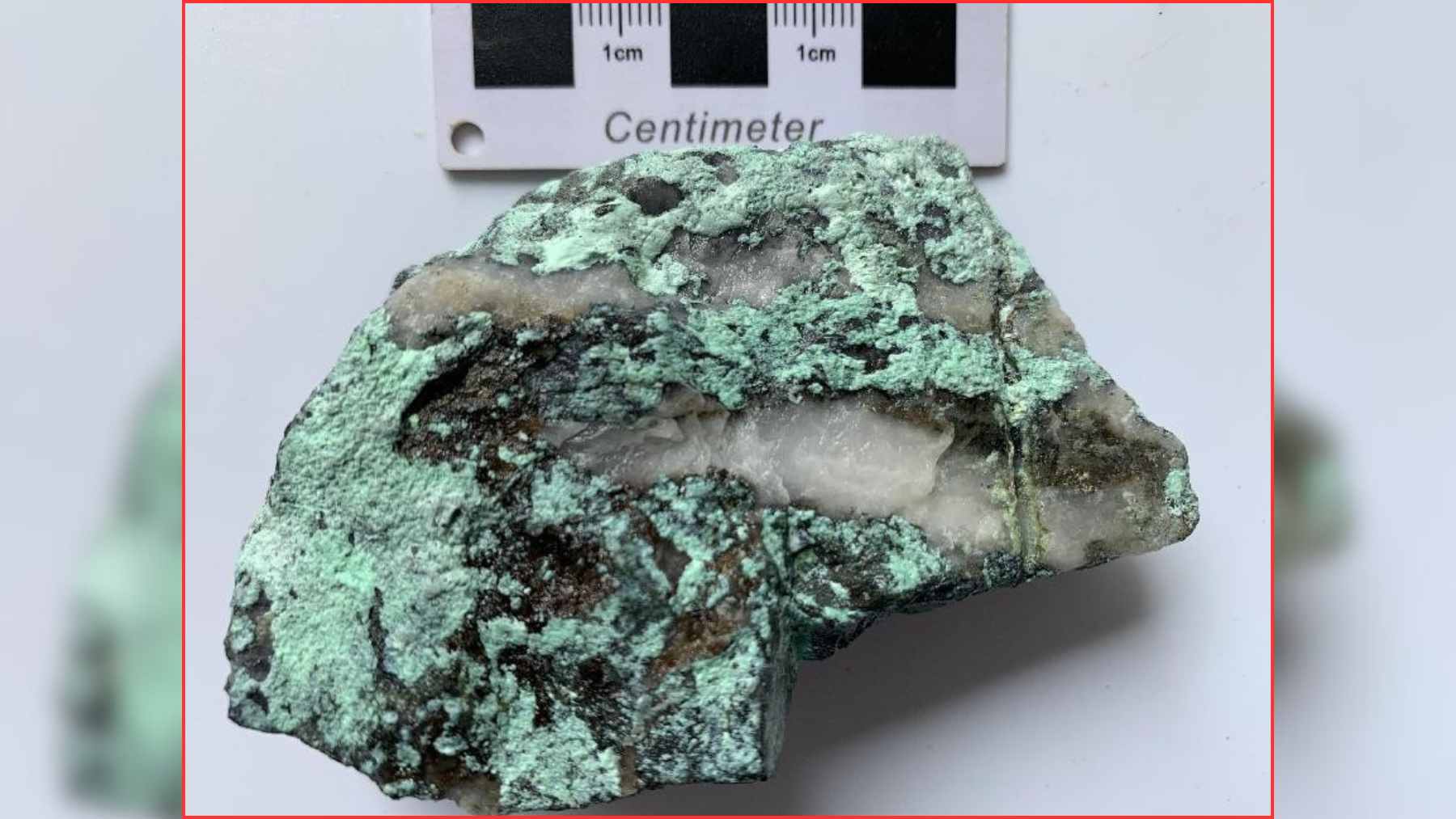
Chinese geologists have confirmed a new mineral species named Jinxiuite, found in a high-grade nickel-cobalt deposit in South China’s Guangxi Zhuang Autonomous Region. The mineral was identified by researchers at the Chinese Academy of Geological Sciences and has now been approved by the International Mineralogical Association’s Commission on New Minerals, Nomenclature and Classification.
Jinxiuite is a sulfide mineral made of nickel, bismuth, antimony, arsenic, and sulfur, and it comes from the Longhua nickel-cobalt deposit in Jinxiu Yao Autonomous County. Scientists say this tiny mineral could become an important guide for finding hidden metal-rich deposits and may even offer clues about how Earth has evolved over billions of years.
What is the new mineral Jinxiuite
Jinxiuite is officially classified as a new mineral species in the global mineral database after a formal review and vote by the International Mineralogical Association’s commission. That process checks the mineral’s chemistry, crystal structure, and how it differs from anything already known before the name is accepted.
The mineral’s name comes from its discovery site in Jinxiu Yao Autonomous County, a mountainous area in Guangxi in southern China. The China Geological Survey notes that the mineral was first identified there in June 2025 and later submitted for international approval.
Chemically, Jinxiuite is a sulfide that contains nickel, bismuth, antimony, arsenic, and sulfur. In simple terms, that means metallic elements are locked together with sulfur in a solid crystal, much like the way common sulfide minerals such as pyrite are formed, but with a rare and valuable mix of metals.
How Jinxiuite forms deep in the Longhua deposit
According to geophysicist Yan Jiayong from the Chinese Academy of Geological Sciences, Jinxiuite forms when earlier nickel-bearing minerals are gradually replaced by new material carried by hot, metal-rich fluids. As this happens, the atoms inside the rock shift around and settle into a fresh and stable crystal arrangement that qualifies as a completely new mineral.
These fluids move through cracks and veins in the rock, a process geologists call hydrothermal activity. When the hot fluids cool, the metals they carry start to crystallize and build up along those fractures, eventually forming the dense veins of nickel and cobalt that miners and geologists now study at Longhua.
A remarkably rich nickel-cobalt deposit in Guangxi
The Longhua nickel-cobalt deposit, where Jinxiuite was discovered, is considered exceptionally rich by global standards. Reports from Chinese authorities and state media say the ore contains about 17.5 percent nickel and 1.5 percent cobalt, roughly 80 times higher than conventional cutoffs of 0.2 percent for nickel and 0.02 percent for cobalt. That is a huge jump for any mining project.
Geologists describe Longhua as a rare type of hydrothermal nickel-cobalt deposit, meaning it was built over time by hot underground fluids rather than by slow settling of sediments. Recent research on the Longhua veins in the journal Ore Geology Reviews points to low-temperature fluids rich in arsenic that were able to carry large amounts of nickel and cobalt before dropping them out as solid minerals.
For China, this combination of unusual geology and sky-high metal content matters a lot in everyday economic terms. Nickel and cobalt are used in jet engines, chemical plants, and the rechargeable batteries inside phones, laptops, and electric cars, all of which influence everything from factory output to the price of that next smartphone upgrade.
Why the discovery matters for critical minerals
Senior engineer Tang Hejun, who led the discovery team at the Chinese Academy of Geological Sciences, stresses that Jinxiuite contains several valuable metals that could be recovered if extraction processes prove efficient. He adds that understanding how easily these metals can be separated from the ore will decide whether deposits like Longhua can be fully used in the future.
China still depends heavily on imported cobalt to feed its battery and high-tech industries, even as demand grows with the shift to electric vehicles and large energy storage systems. That is why experts from outlets such as Global Times and other regional media describe the Longhua deposit as a strategically important resource that could ease some of this pressure.
Researchers also suggest that Jinxiuite could act as an indicator mineral during future exploration work. If geologists find this mineral in rock samples from a new area, it may signal that more extensive nickel and cobalt rich bodies lie nearby, in the same way a small patch of rust on a pipe hints at deeper corrosion.
Clues to Earth’s history and to future materials
Scientists involved in the project say Jinxiuite is more than just a new entry in a mineral catalog. Chinese state science media describe it as a record of how elements behaved under specific temperatures, pressures, and fluid conditions, offering a small but valuable window into Earth’s 4.6 billion years of geological change.
Yan Jiayong notes that new minerals like Jinxiuite can serve as a natural blueprint for materials science, inspiring researchers to design man-made compounds with similar structures that might have special magnetic, electrical, or corrosion-resistant properties.
In practical terms, that could one day feed into better battery materials or more resilient alloys, though experts caution that such applications are still at the research stage rather than something ready for the next product launch.
At the end of the day, the discovery of Jinxiuite links a remote mining district in Guangxi to big global questions about energy, technology, and how Earth works deep below our feet.
The main official press release has been published by the China Geological Survey.