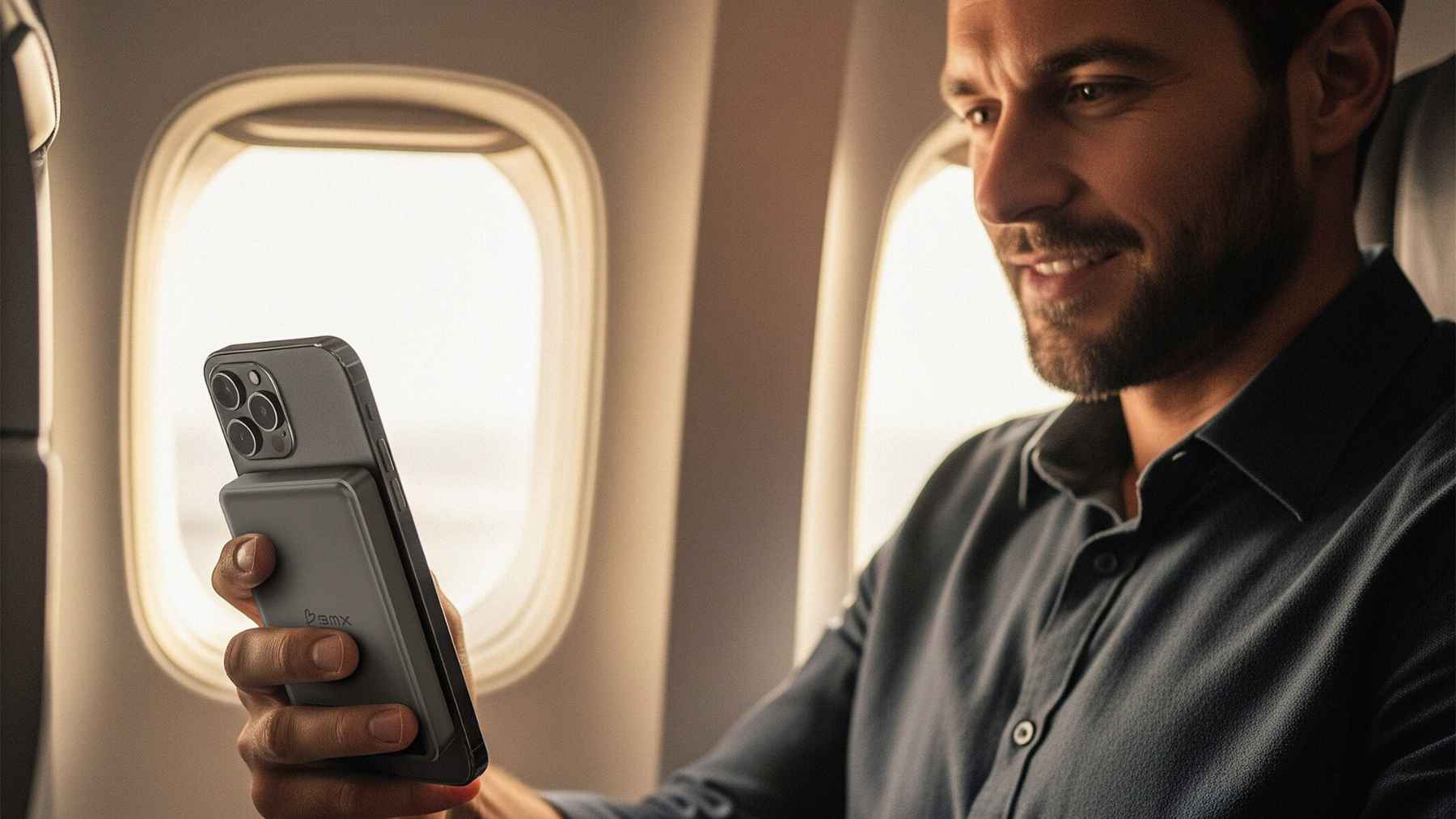
How many batteries are sitting in your bag right now? A phone, wireless earbuds, maybe a laptop and a chunky power bank that lives in your backpack or carry on. For most of us, all that stored energy feels invisible… right up until a battery overheats on a flight or a viral recall hits the news.
That growing unease is exactly what a new wave of solid-state power banks is trying to answer. One of the first to reach ordinary users is BMX’s SolidSafe line, which swaps most of the flammable liquid found in classic lithium ion packs for a solid electrolyte in a slim magnetic power bank. The idea is simple. Less flammable liquid means less chance of fire.
Why solid state feels different in your hand
Traditional lithium-ion batteries rely on a liquid or gel electrolyte that helps ions move between the electrodes. That liquid carries energy well, but it also helps fuel a chain reaction called thermal runaway when things go wrong. The cell heats up, the liquid breaks down, more heat is released and suddenly you have smoke, fire or even an explosion.
Solid-state designs replace that flammable liquid with a solid material that can still conduct ions. Lab studies find these cells tend to be more stable at high temperatures and less prone to leakage and runaway reactions, although researchers are careful to say they are safer rather than completely risk free.
In the case of BMX, the SolidSafe 5K and 10K packs use a hybrid or semi-solid electrolyte that mixes solid and liquid components. Independent reviewers and the company itself highlight torture tests where a charged pack is pierced and only emits small puffs of smoke instead of erupting into flames. For anyone who has ever worried about a hot power bank in a stuffed backpack on a summer train, that is not a minor detail.
Safety is not just a tech spec
Battery fires are still rare compared with the billions of devices in circulation, but the numbers are moving in the wrong direction. The US National Fire Protection Association estimates that fire departments responded to about 1,500 home fires per year involving batteries in the second half of the last decade.
The US Consumer Product Safety Commission has logged at least 25,000 incidents of lithium-powered devices overheating or catching fire over a recent five year period, an average of roughly 5,000 cases a year.
The problem does not stop at the front door. Aviation authorities verified 89 lithium battery incidents involving smoke, fire or extreme heat on passenger and cargo aircraft in 2024. A spare power bank is even being investigated as a possible cause of a 2025 aircraft cabin fire in South Korea.
At the same time, more than 1.7 million conventional power banks and battery packs have been recalled globally since March 2025 because of safety defects. That is the backdrop for BMX’s co-founder Daniel Chin when he says that “power banks should not be the riskiest thing in your bag.”
For emergency workers, cyclists, or anyone who flies often, a chemistry that is far less likely to flare in a hot car or overhead bin has obvious benefits. Fewer fires also mean less toxic smoke, less damaged luggage and fewer gadgets heading straight to the trash.
What this means for the environment
From a climate and resource perspective, the story is more nuanced. Solid-state batteries tend to offer higher energy density and longer life than many classic lithium-ion designs, which means more watt hours delivered for every cell that is manufactured. BMX claims up to twice the lifespan for its SolidSafe packs compared with standard chemistries.
If those numbers hold in real life, users could need fewer replacement power banks over the years. That would ease demand for raw materials and reduce e-waste, at least to a large extent.
Academic reviews, however, warn that manufacturing solid-state cells is currently energy intensive and often relies on many of the same metals as lithium ion devices, including lithium, nickel and cobalt. One recent life-cycle study even found that some all solid-lithium batteries can have a higher production phase footprint than conventional cells because of their complex electrolytes, although their longer lifetimes help balance part of that impact.
In other words, safer does not automatically mean greener. The environmental benefit depends on how long the pack lasts, how it is used and whether it is recycled at the end of its life. Recycling matters here, because recovering metals from old batteries can cut environmental impacts by more than half compared with mining new material.
A small device that hints at a bigger shift
Look closely at the SolidSafe 5K and you are still looking at a familiar object. It is a 5,000-milliamp-hour magnetic power bank designed around Qi2 wireless charging for iPhones, with up to 15-watt wireless output, up to 20-watt USB C charging, a bright color display and a lanyard that doubles as a cable.
The price, around $80 for the 5K and $100 for the 10K model, is noticeably higher than for many conventional packs, which means it currently targets travelers and professionals who put a premium on safety.
Yet this small rectangle in your hand points toward a trend that reaches far beyond phone charging. The same solid or semi-solid electrolytes that make a pocket power bank more resistant to fire could help improve the safety of electric vehicles,home-storage batteries and the grid systems that will carry more wind and solar energy.
For now, consumers can do three simple things. Choose reputable brands that take battery safety seriously. Treat any power bank with respect, keeping it out of extreme heat and replacing it if it swells or smells odd. And whenever possible, support products and policies that pair safer chemistries with serious recycling programs rather than simply adding more battery waste to the pile.
The press release was published on GlobeNewswire.