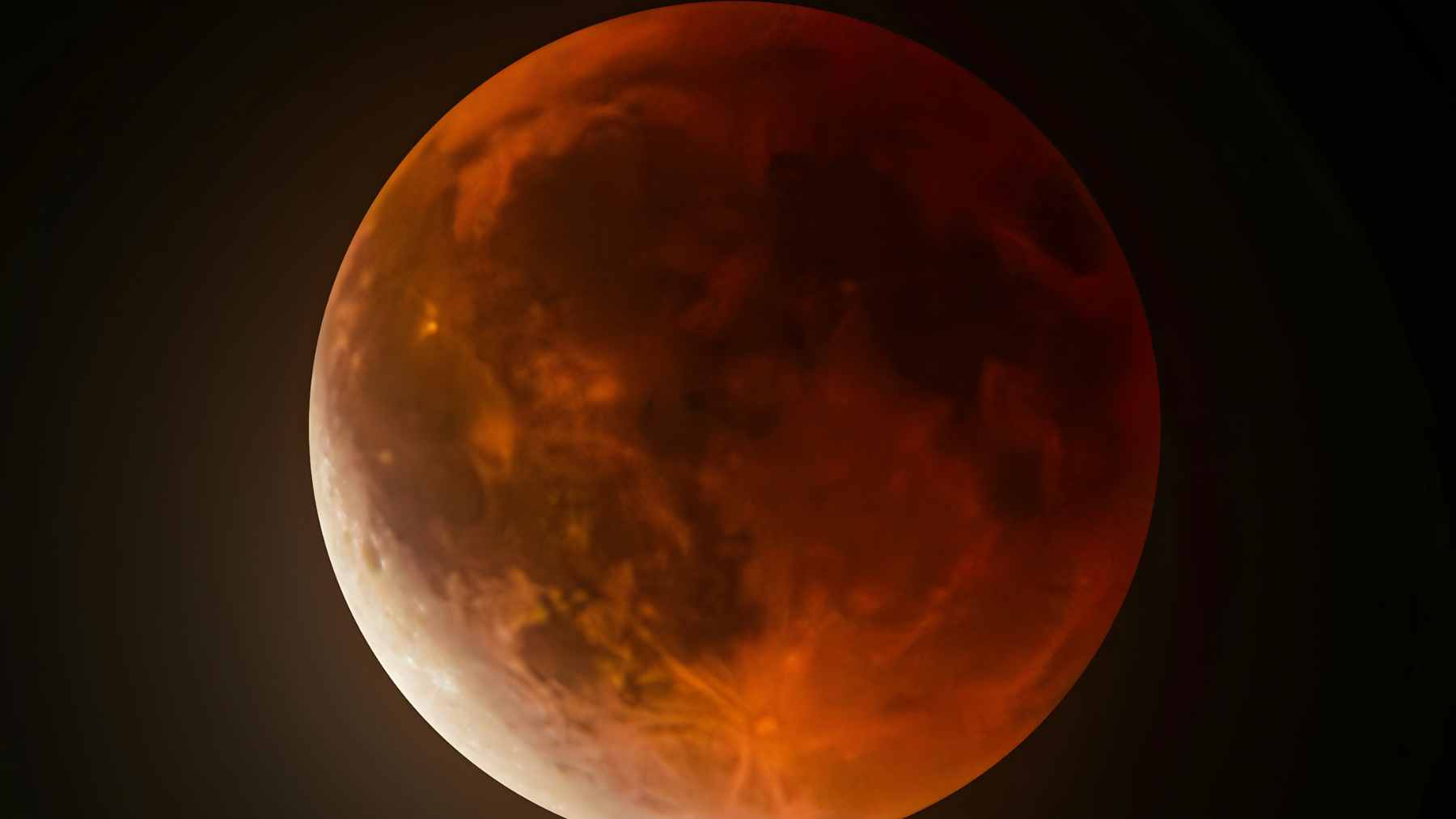
Every night, the Moon looks steady and familiar. Yet, on a scale too slow for any human eye, it is slipping away. Careful measurements show that the Moon is moving outward from Earth by about 3.8 centimeters (roughly 1.5 inches) per year, a pace similar to the growth of a fingernail.
This tiny shift is enough to stretch our days, soften our tides, and eventually bring an end to total solar eclipses.
So if the calendar still works and the tide tables are on time, why does this matter? Because over millions of years, these small changes add up and reshape the way our planet spins, breathes, and even hosts life in the oceans.
How we know the Moon is on the move
The story of the Moon’s slow retreat is written in laser light. During the Apollo missions, astronauts placed mirrored panels on the lunar surface. Today, observatories fire short laser pulses at those reflectors, then measure how long the light takes to return.
That round trip lasts about two and a half seconds and reveals the Earth Moon distance with millimeter precision.
Decades of these measurements tell a clear story. The gap between Earth and its satellite grows by about 38 millimeters each year. The current average distance is roughly 385,000 kilometers.
This rate has not been constant throughout history. Geological records hint that there were times when the Moon receded more slowly and times when the pace picked up. Ancient tidal sediments and fossil reefs act like natural logbooks that track how quickly our planet once spun.
A tidal tug of war that slows our planet
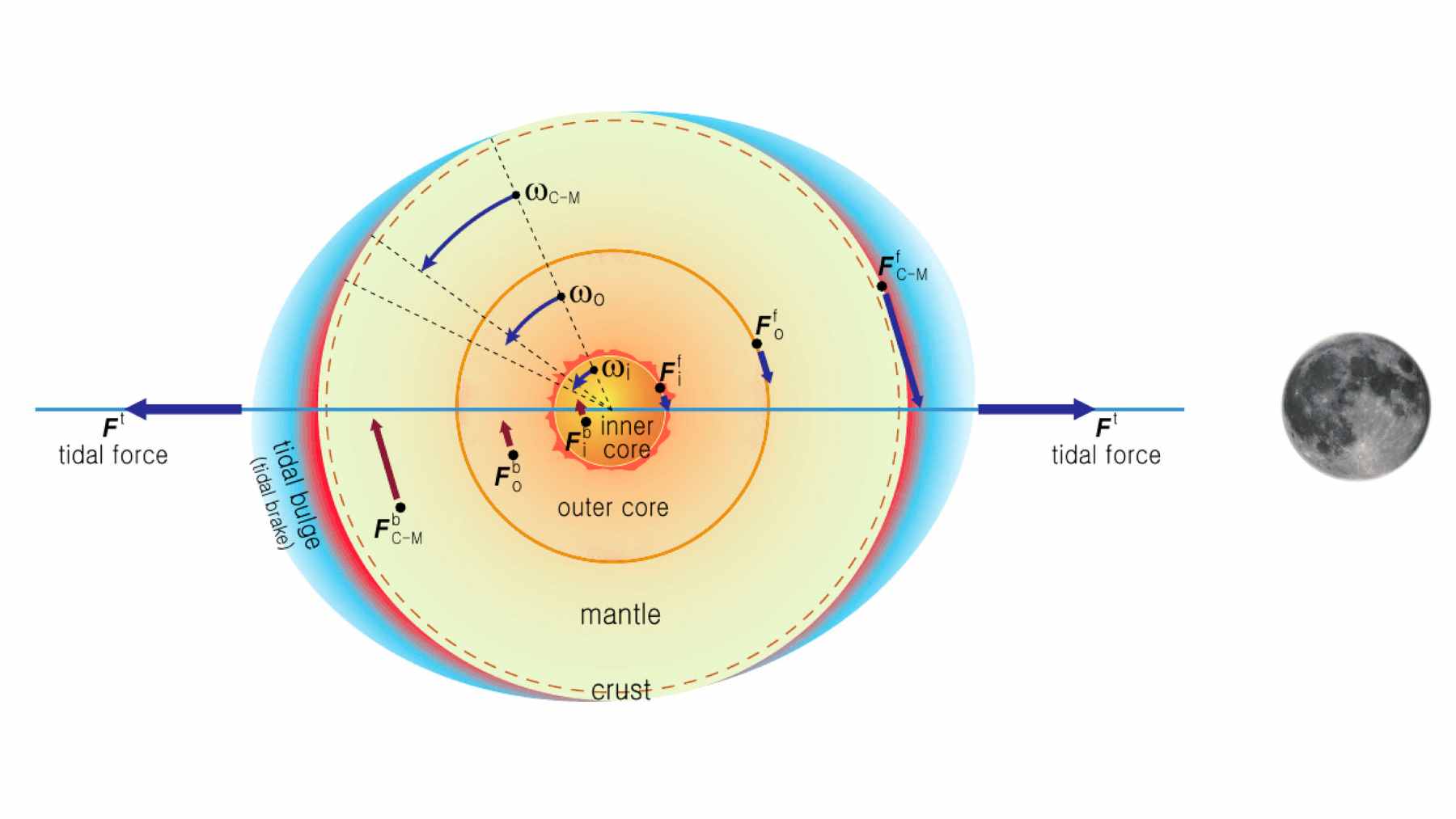
The engine behind this drift is something very familiar. Tides. The Moon’s gravity pulls more strongly on the near side of Earth than on the far side. That difference raises two broad tidal bulges in the oceans. Because Earth rotates faster than the Moon orbits, those bulges are carried slightly ahead of the line that connects both worlds.
The offset is small but crucial. It creates a gravitational “handle” that tugs the Moon forward in its orbit and robs a little energy from Earth’s rotation.
In practical terms, the Moon climbs to a slightly higher orbit while our planet spins ever so slightly more slowly. On average, the length of the day grows by about two milliseconds per century. That is far too small to feel when you rush through a workday or glance at a clock, yet over geological time it becomes significant.
Fossil shells that remember shorter days
To see how different Earth once was, scientists have turned to some unlikely timekeepers. Fossil shells from an extinct group of clams that lived about 70 million years ago preserve daily growth lines, a bit like ultra-fine tree rings. By counting those layers, researchers found that a year in the late Cretaceous had roughly 372 days, which means each day lasted about 23 and a half hours.
The only way to fit more days into a year is to shorten the length of a single day. That points to a faster spinning Earth and a Moon that orbited closer than it does now. Similar evidence from even older corals suggests that hundreds of millions of years ago, days were shorter still.
What it means for tides, eclipses and life
As the Moon drifts outward, its grip on our oceans slowly weakens. Over very long timescales, that means less dramatic tides. Coastal ecosystems, estuaries, and mudflats that depend on strong tidal flushing would experience gentler rises and falls of sea level.
The change in any single century is tiny compared with sea level rise from global warming, yet across hundreds of millions of years it alters how coasts evolve and how nutrients move through the oceans.
The sky will change too. Today, we live in a fortunate era where the apparent size of the Moon and the Sun almost perfectly match, which allows total solar eclipses that briefly turn day into night.
As the Moon recedes and appears smaller in our sky, those perfect alignments will become rarer. By some estimates, roughly 600 million years from now the last true total solar eclipse will occur. After that, future observers would see only partial or annular events, with a bright ring of sunlight around a too-small Moon.
Long before the Earth Moon system ever reaches a perfectly balanced “double tidal lock,” in which one Earth day equals one lunar month, the Sun itself will change. As it brightens over the next billion years or so, our oceans are expected to shrink and eventually vanish, which would greatly reduce tidal friction.
Much later, during the red giant phase, the inner planets may be engulfed altogether.
Climate change reaches all the way to the Moon
You might assume that this whole story unfolds independently of what humans do. Recent work suggests that is not entirely true.
A new study led by geophysicist Mostafa Kiani Shahvandi finds that ongoing climate change is already nudging the Earth-Moon dance. As ice sheets melt and oceans warm, water redistributes across the planet and ocean layers become more strongly stratified.
That alters tidal friction and slightly increases the rate at which the Moon recedes.
According to this research, about 30% of the recent change in the recession rate comes from sea level rise, while roughly 70% stems from shifts in ocean stratification.
The effect is modest, on the order of an extra millimeter per year, but it matters for ultra-precise timekeeping and spacecraft navigation. It also underscores an important idea. Our emissions do not only warm the air, raise the sea, and affect the electric bill. They even leave a measurable fingerprint on the orbit of our nearest celestial neighbor.
For most of us, everyday life will never reveal the difference between a 24-hour day and one that is a few milliseconds longer.
The high tide that interrupts a beach walk will still feel driven more by storms and sea walls than by far future orbital mechanics. Yet the slow retreat of the Moon offers a powerful reminder that Earth’s climate, oceans, rocks, and skies are part of one connected system.
Next time you see the Moon rising over a city skyline or a quiet stretch of coast, you are watching a companion that steps away from us a tiny distance every year.
The study was published in Astronomy & Astrophysics.