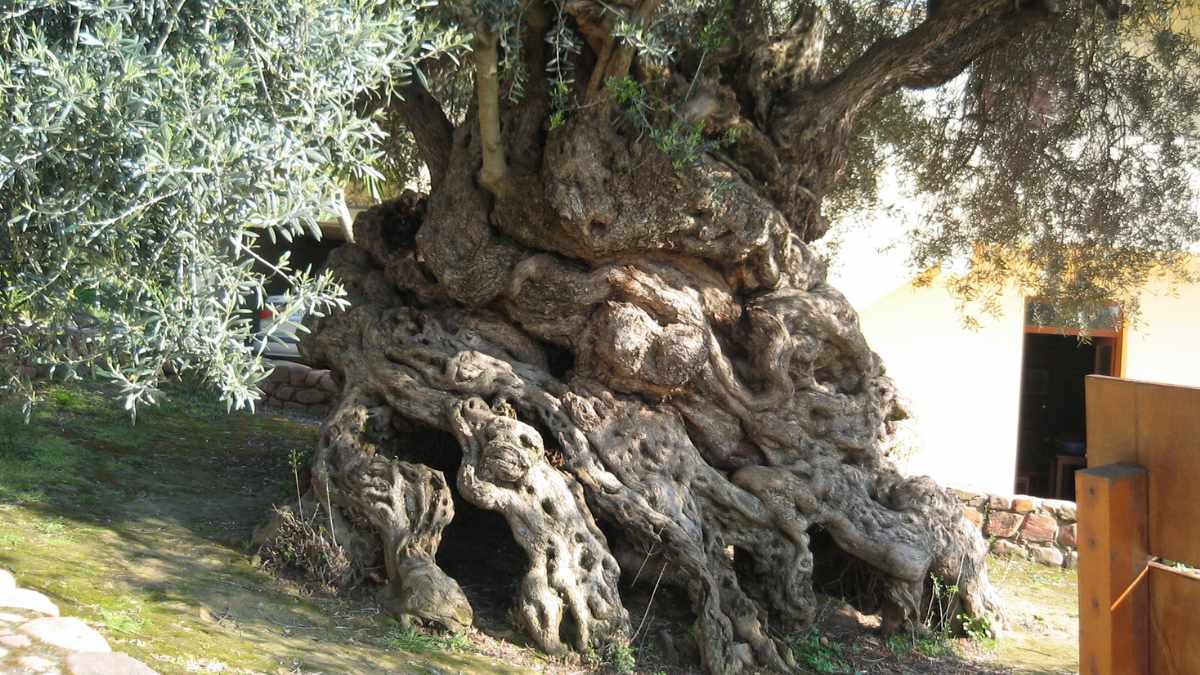
In a quiet village on the Greek island of Crete, an olive tree older than many empires is still pushing out new leaves and small green fruits. The Vouves olive tree, as locals call it, has watched caravans, warships, and now rental cars pass by, yet it continues its slow, steady life.
Scientists estimate this tree in Ano Vouves to be between 2,000 and 4,000 years old, and some local authorities stretch that range up to 5,000 years. What most experts agree on is simpler: it is one of the oldest producing olive trees in the world, still giving olives and drawing around 20,000 visitors a year to this hillside corner of western Crete.
A 4,000-year-old tree that still gives olives
The Vouves olive tree belongs to the same species that fills supermarket bottles today, Olea europaea. Its trunk is thick, twisted, and full of hollows, but the crown stays green, and it continues to flower and fruit almost every year, offering modest but regular harvests.
Measured at the base, the trunk has a circumference of about 41 feet and a diameter of roughly 15 feet, while the tree rises to around 40 feet in height. Up close, the wood looks almost like a natural sculpture, with spirals and faces that visitors like to point out as they circle the trunk.
Because of its age and beauty, the Region of Crete declared the tree a natural heritage monument in 1997, giving it formal protection. Local officials say at least ten other ancient olive trees in the area also qualify as “monumental,” but the Vouves tree is the star of the grove.
Scientists search for the true age of the Vouves olive
You might expect experts to simply count rings to find the tree’s age, like with a felled pine. That is not possible here, because the heartwood at the center of the trunk rotted away long ago, taking the oldest rings with it. Instead, researchers rely on trunk size and nearby archaeological finds, which show the tree is at least two millennia old and quite possibly closer to 4,000 years.
In 2021, a team led by plant geneticist Aureliano Bombarely used DNA sequencing to learn more about the Vouves tree’s origin. Working with colleagues at institutions including the Hellenic Agricultural Organization ELGO DIMITRA in Chania and the Cyprus Institute, they sampled wood from the top and bottom of the tree.
Their work showed that the tree is actually a graft: a wild olive trunk at the base with a cultivated variety known as Mastoidis or Tsounati growing above. In everyday terms, grafting means farmers joined a branch from a productive olive onto a tough, older trunk to get the best of both worlds.
The study suggests the Vouves tree is a living record of the moment when people in the Mediterranean were turning wild olives into reliable crops, making it a useful reference for other research on how and where the olive was domesticated.
A small village, a museum, and thousands of visitors
Ano Vouves lies about 19 miles west of the city of Chania, surrounded by hills, stone houses, and long rows of olive groves. Drivers leave the main coastal road and climb a series of narrow turns, passing small farms and roadside shrines before they reach the village square. It is not a flashy destination, but that is part of its charm.
Next to the tree stands the Olive Tree Museum of Vouves, set in a traditional 19th century house donated to the Municipality of Platanias. Inside, visitors see old wooden plows, oil presses, and hand tools that Cretan farmers used until the middle of the last century, when tractors and modern mills took over. It feels a bit like stepping into your great-grandparents’ workshop, only with the smell of olive oil in the air.
Entrance to the museum is free, and the site is open daily for most of the tourist season. Families wander between the exhibits and the tree, stopping for photos, a coffee, or a tasting of local Kolymbari olive oil at nearby cafes. Many guides suggest coming early in the morning or near sunset, when the light deepens the shadows in the gnarled bark and the heat is easier to handle than at midday.
From Olympic wreaths to everyday olive oil
The Vouves olive tree is not just a local curiosity; it has also played a role on the world’s biggest sports stage. Branches from the tree were used to weave the wreath that crowned the marathon winner at the Athens 2004 Olympic Games, and again for a victor in Beijing in 2008, reminding viewers that the ancient Olympic prize was a simple ring of olive leaves.
Crete is one of the most densely planted olive regions in the world, with some estimates saying olive groves cover roughly a quarter of the island’s surface. Greece as a whole leads the world in olive oil consumption per person, far ahead of Spain and Italy, which means the oil in Greek kitchens is not a luxury product but part of daily life, from salads to the pan used to fry an egg.
Around Ano Vouves, many families still harvest their olives by hand or with small mechanical tools, bringing them to local mills that press the fruit into oil within hours. Visitors can often taste different oils, join a symbolic harvest, or buy a small bottle to take home, connecting that ancient tree on the hill to the bottle that ends up by the stove or next to the bread basket.
Why an old olive tree matters in a warming world
The Vouves olive tree has already survived wars, invasions, and earlier shifts in climate, which makes it a symbol of resilience for many visitors. At the same time, scientists warn that rising temperatures and worsening droughts are putting modern Mediterranean olive groves under heavy stress, reducing yields and increasing the need for irrigation.
Recent heatwaves and wildfires on Crete and across Greece have also damaged forests and younger olive plantations, showing how quickly extreme weather can undo years of patient cultivation. Seeing a tree that has endured for millennia can make people think about what kind of landscapes they hope their own grandchildren will inherit, and how fragile that hope can be if the environment keeps heating up.
The main official study on the Vouves olive tree has been published in the journal Plants.