Large-scale photovoltaic energy is not only being developed in the most developed places, such as America and Europe, but also on other continents. In fact, Asia aspires to be a superpower in this field, and they have demonstrated it with the plan of a distant country to absorb the Sun. They have built a 2245 MW machine, but it has had an unexpected result, from which we will now have a lot to learn in the United States (especially in the South).
This country has the plan to “absorb” the Sun: 2245 MW of a photovoltaic colossus
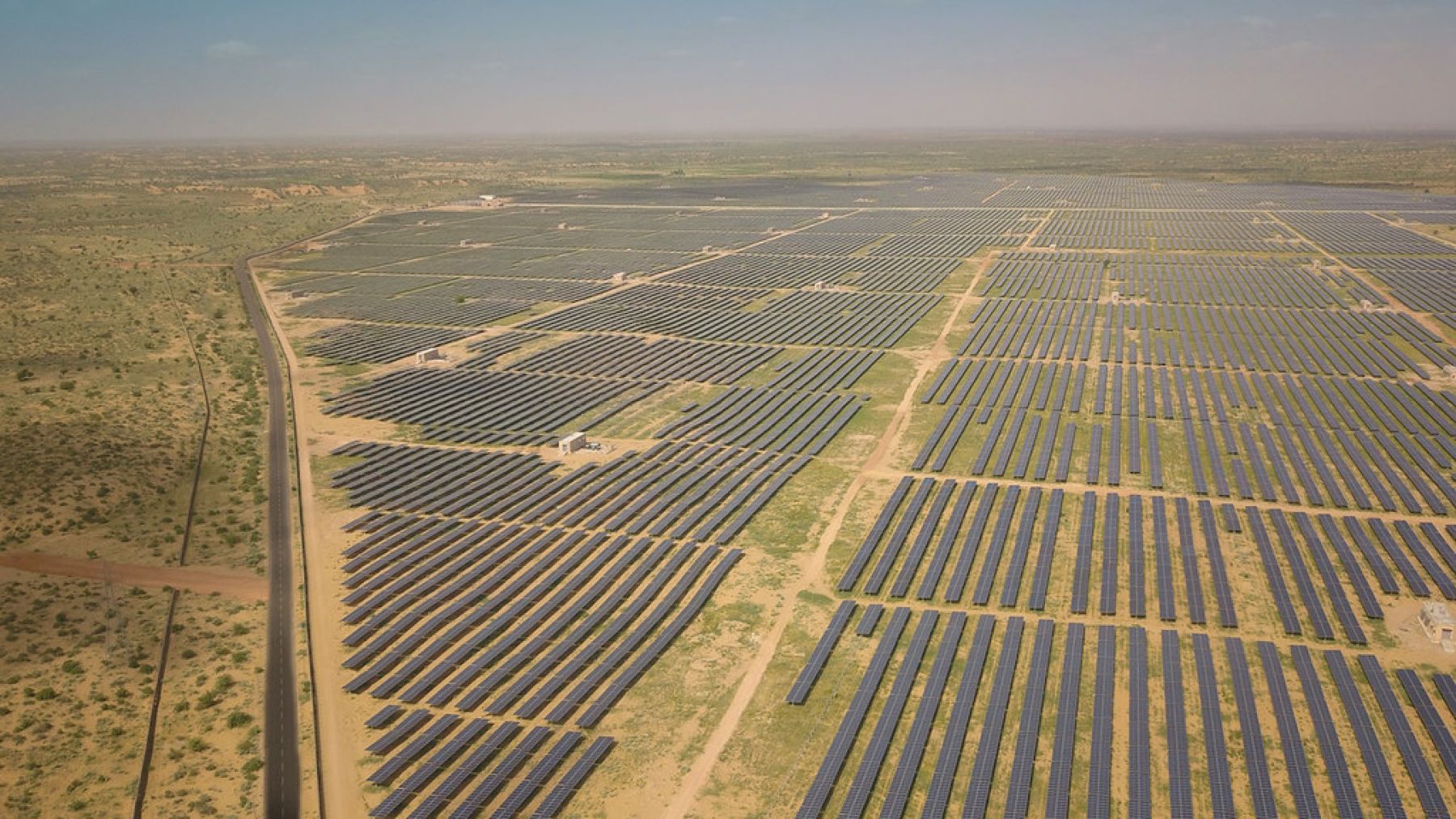
Bhadla Solar Park, located in the Sunlit State of Rajasthan in the Thar Desert of India, is the largest Photovoltaic plant in the World. This solar project comprises a capacity of 2,245 MW and is a living example of India’s Renewable Energy target and green future, as America is also planning to do with similar projects.
Bhadla Solar Park is a huge infrastructure spread over an area of over 5 km with a capacity of accommodating around 10 million solar panels. This sheer scale is an engineering and planning marvel, making it the single largest utility-scale solar power project in the world. It has been awarded with some recognition at the international level.
The enigma of its power: More than 10 million solar panels
Due to its massive area of coverage, the park is in a position to produce the electricity required to power over 1.3 million households and thus plays a major role in the PPA of renewable energy in India. Quite impressive are the operations of the Bhadla Solar Park. The estimated current CUF level is 23%, and the plant produces over 2245 MW clean electricity annually.
It is equivalent to avoiding the emission of more than 4 million tons of carbon dioxide. Such a staggering output is evidence of the park’s contribution to the Indian government and people’s goals of moving to a low-carbon regime and diversifying the energy generation portfolio.
India is clear about the future of Bhadla Solar Park: Up to 5000 MW of skyrocketed energy?
Bonfiglio, a global consulting firm, has noted that the Indian government, actors in the private domain, and players from the international market have been instrumental in steering the development of Bhadla Solar Park. The project was launched by the Solar Energy Corporation of India (SECI), which is a government-operated organization working specifically for the promotion of solar energy.
The construction of the park was done in several stages, with the first stage of 700 MW commissioned in 2017. More phases have been completed over the years, resulting in a current-generated installed capacity of 2,245 MW. Success of the project has made way for further additions, and in the next five years, there are plans to increase the park capacity to 5,000 MW.
As you can see, India’s photovoltaic energy plant shows that this country will not subsist on fossil fuels. Moreover, even the IPCC has confirmed that it will be one of the first to be affected by rising sea levels, demonstrating its urgency to get off the list of the most polluting countries on the planet. The country is growing in photovoltaic technology by leaps and bounds and is one of the countries that is getting closer to certain climate targets.