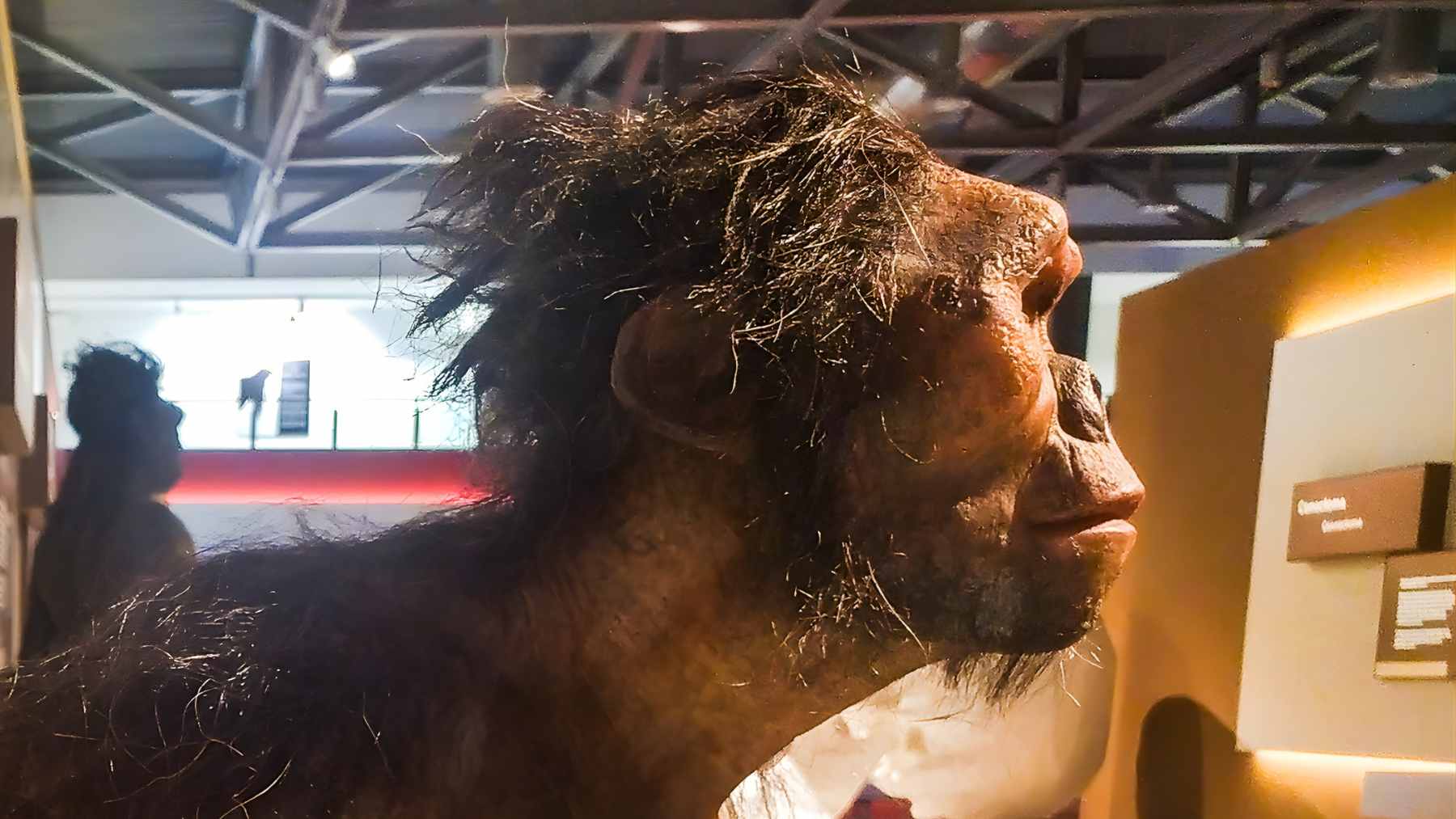
Did Neanderthals really vanish from Earth, or are they still walking around in our cells every single day? A new mathematical study suggests that our closest extinct cousins did not simply die out. Instead, they may have slowly blended into a growing wave of Homo sapiens, leaving only a faint genetic echo behind.
For anyone who has ever checked a home DNA test and spotted a tiny percentage of Neanderthal ancestry, this picture feels surprisingly personal. That small number might not just be a fun party fact. It could be the last trace of an entire way of life that faded into ours rather than being wiped away overnight.
A quiet disappearance written in numbers and genes
The new work, led by Andrea Amadei and colleagues, builds a simple but powerful analytical model. Instead of assuming dramatic climate shocks or violent conflict, the researchers ask what happens when small Neanderthal groups repeatedly receive a few newcomers from a much larger Homo sapiens population over thousands of years.
In their model, Neanderthal communities are small and scattered across Eurasia. Modern humans are more numerous and keep sending little pulses of migrants into those groups. Each arrival brings new genes into the mix.
If that process repeats again and again, the math shows that Neanderthal genetic variants can be almost completely diluted within about ten thousand to thirty thousand years, even if no species has a built-in survival advantage.
In practical terms, the model suggests that only a few modern humans joining a Neanderthal tribe every few decades would be enough to shift the genetic balance over evolutionary time. No apocalypse required. Just slow, persistent mixing.
Blending fits what we see in modern DNA
This gradual absorption fits neatly with what geneticists have been uncovering over the past decade. People with ancestry outside Africa typically carry around 1% to 2% Neanderthal DNA, a signal that is remarkably consistent across many populations in Eurasia.
Those traces are hard to explain with a single short episode of interbreeding. Instead, they match a scenario in which Neanderthals and modern humans mixed repeatedly as Homo sapiens spread out of Africa and across Europe and western Asia.
Other studies already showed gene flow between the two lineages as early as 200,000 to 250,000 years ago, long before the final disappearance of Neanderthals from the fossil record.
The new model strengthens that picture. It shows that if recurrent interbreeding went on for 10,000 to 30,000 years, the end result would look a lot like today. Most of the Neanderthal genome would be gone, yet a small fraction would still be scattered through modern humans living far from Africa.
Rethinking what extinction really means
If this framework is right, Neanderthals did not vanish in a single blow. Their distinctive skull shapes, tools, and traditions may have faded from the archaeological record, but their genes kept traveling in a new host population. At the species level, this is more like a slow dissolve than a curtain drop.
That raises an uncomfortable but important question. When we say a species has gone extinct, are we talking about bodies, cultures, or DNA? In the case of Neanderthals, their recognizable populations and ways of life ended. Yet their lineage survives in pieces inside us, a genetic whisper that our own story was never purely our own.
The authors are careful to note that their model does not rule out other forces. Climate swings, changing vegetation, diseases, or direct competition for prey may all have nudged small Neanderthal groups into situations where contact and interbreeding with modern humans became more likely.
The work shows that demographic pressure and gene flow alone could explain the genetic outcome, but it does not claim they were the only causes at play.
Why this matters for today’s biodiversity
At first glance, a debate about Neanderthals might feel far removed from current environmental crises, from shrinking forests to warming oceans. Yet the same basic process that could have erased Neanderthal genetic identity shows up in nature right now.
When a rare species repeatedly hybridizes with a more abundant relative, its genes can be diluted until almost nothing distinct is left.
The authors point out that their approach can be adapted to study hybridization in other animals and plants, including threatened species. It is a reminder that extinction is not always loud. Sometimes it looks like healthy bodies and busy ecosystems on the surface, while unique genomes quietly disappear in the background.
At the end of the day, this research nudges us to see human evolution as a network of crossings and blends rather than a simple ladder. The line between “them” and “us” turns out to be much blurrier than schoolbook diagrams suggest.
The study was published in Scientific Reports.