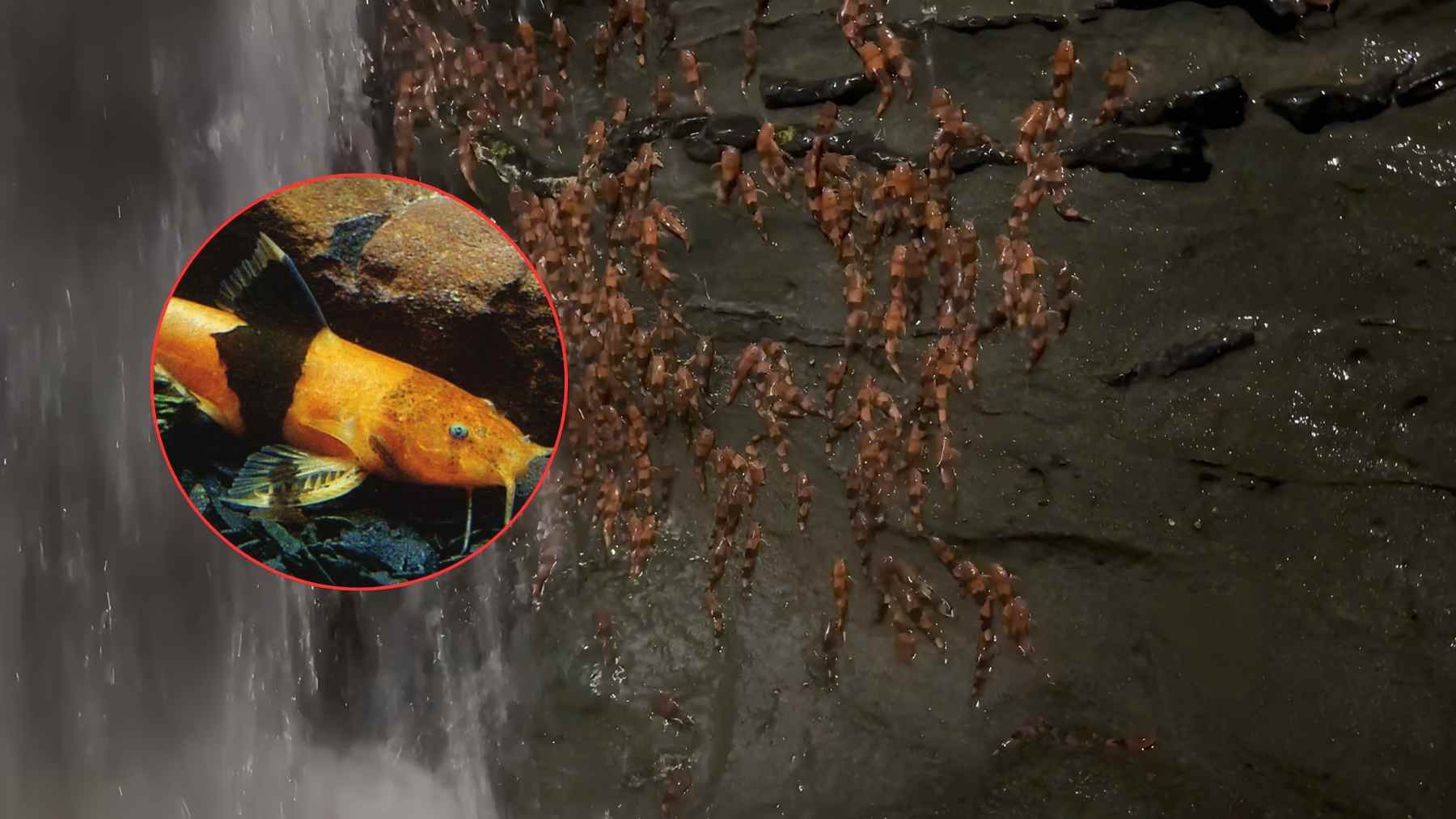
A routine observation near a police headquarters in Brazil has turned into one of those nature moments that feels almost unreal. Thousands of tiny, orange-and-black catfish gathered at the base of a waterfall and then began inching up wet rock, even along steep, near-vertical edges.
Researchers say this is the first documented case of this bumblebee catfish species forming a huge group like this and showing clear waterfall-climbing behavior. The footage is striking, but the bigger story is what it reveals about a fish that scientists rarely get to see in action.
A police report leads to a scientific first
The event was first noticed by Brazil’s Environmental Military Police in Mato Grosso do Sul State, who contacted scientists after seeing the river “packed” with small fish moving upstream. According to a report based on the study, the sighting happened in November 2024, right as the rainy season was beginning, and researchers arrived about a week later to document it.
When the team reached the Aquidauana River, they found thousands of bumblebee catfish clustered together at the margins of a waterfall and slowly pushing upstream. They observed the scene for about 20 hours, watching fish climb in dense layers, sometimes sliding over one another like a living traffic jam on a slick on-ramp.
The research was led by Manoela Marinho with Eris de Paula, Francisco Severo-Neto, Yasmim Santos and Heriberto Gimênes-Junior, working with teams linked to the Universidade Federal de Mato Grosso do Sul and Bioparque Pantanal.
How a small catfish climbs wet rock
These bumblebee catfish are small freshwater fish, and the species observed was Rhyacoglanis paranensis. Scientists describe the broader group as relatively rare and “virtually unknown” in day-to-day behavior, partly because they live in fast-flowing waters where brief events are easy to miss.
So how do they climb? Observers reported that the fish spread their fins and use side-to-side body and tail movements to push forward, especially as the light drops toward evening. Scientists also suggest the fish may use a suction-like grip against flatter rock surfaces, which would help them hold on in rushing water.
It’s not the first time biologists have studied “climbing” fish, but it is unusual to see it in such a massive group. Earlier work on climbing catfish in the Andes looked at how some species combine movement, adhesion, and even breathing strategies to cope in fast water, a useful comparison point for what might be happening in Brazil.
Why the fish were moving upstream
The study does not claim a single proven reason for the climb, but the strongest interpretation is spawning migration. In simple terms, that means the fish were likely traveling upriver to reproduce, timed to conditions that improve survival for eggs and young fish.
Researchers dissected a small number of fish and, combined with the timing of the event, concluded the catfish were probably not feeding during the push upstream. That matches what biologists often see in migration, where animals “focus on the trip,” even when it costs energy.
There’s also a broader context that matters. Reports tied to the study note the region had faced a long, severe drought before water levels rose, and the start of rains may have acted like a natural “go” signal. It’s the kind of trigger that can make a hidden behavior suddenly show up in plain sight.
Why this rare footage matters for rivers
For the most part, fish migration stories focus on big, economically important species. This case is a reminder that smaller fish make up a huge share of South America’s freshwater biodiversity, yet their movements can be largely undocumented because they happen quickly and under specific conditions.
That knowledge gap matters when river schange. The authors highlight concerns about habitat fragmentation and river damming, which can break up the fast-flowing stretches these fish rely on, making migration routes harder or impossible. One official information hub for the state’s environmental policing structure is available through the Mato Grosso do Sul public safety portal at PMA.
And there’s a simple takeaway that lands with anyone who has watched a creek after heavy rain. Small waterways can look ordinary until, suddenly, they become the stage for something essential. Blink, and you miss it.
The main study has been published in the Journal of Fish Biology.