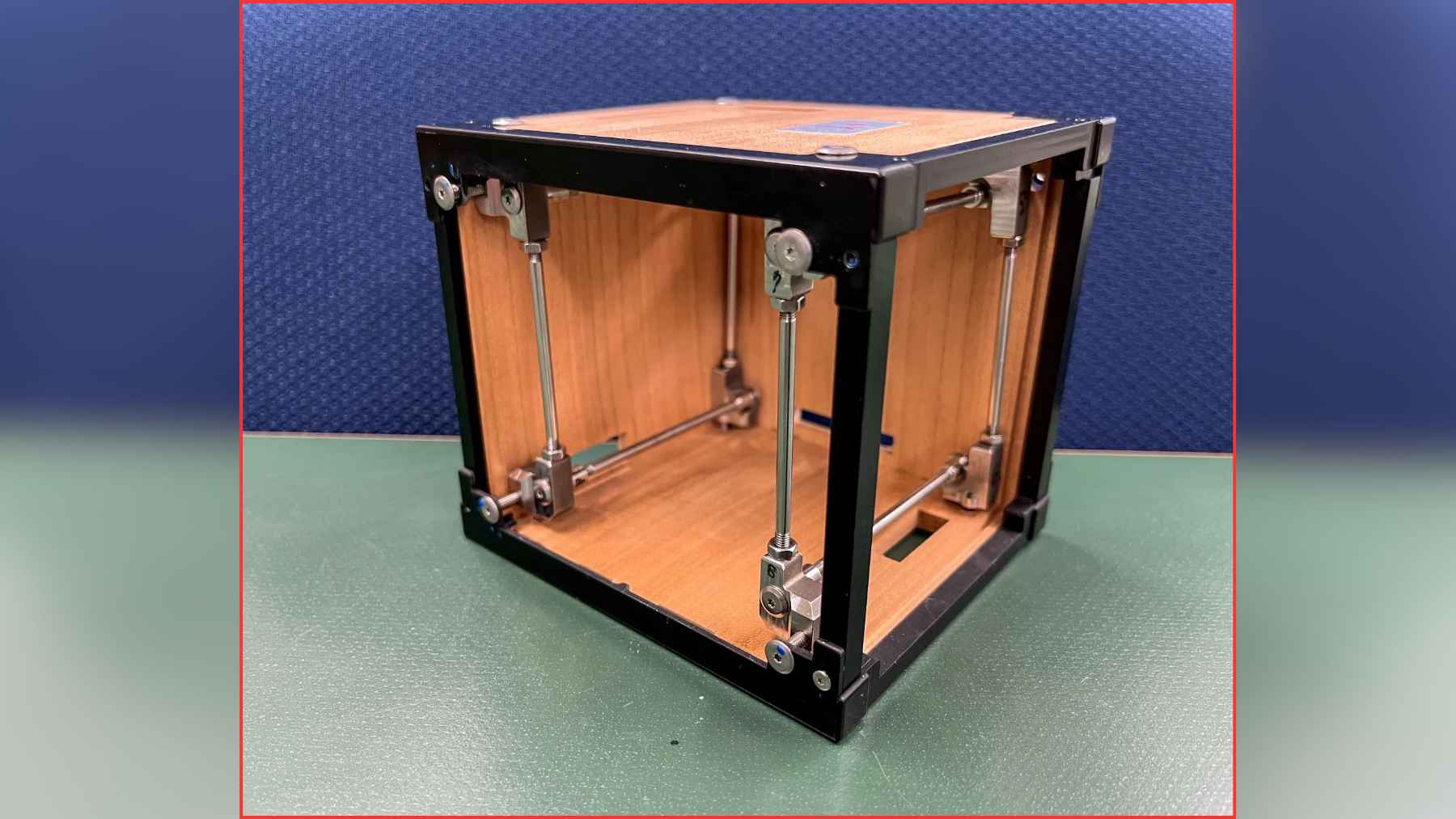
Japan has just sent a tiny wooden cube into orbit, and it could help solve one of the biggest headaches of the space age. The satellite, called LignoSat, is made of magnolia wood and was built to test whether wood can replace some metal parts in future spacecraft and cut the pollution they leave behind. It sounds simple, almost like a classroom project, yet it sits at the center of a serious scientific experiment.
Behind this unusual spacecraft is a team from Kyoto University and Sumitomo Forestry working with Japan’s space agency to push the idea of sustainable hardware beyond Earth. They want to know if a wooden shell can survive the harsh vacuum and wild temperature swings of orbit while leaving far less debris when it finally burns up.
For people who already pay attention to supermoons and strange visitor asteroids, this small box is another sign that our skies are getting busier every year.
Space Junk And Why Materials Matter
Earth’s orbits are already crowded with satellites, old rocket stages and shards from past collisions. More than a million fragments are thought to be circling the planet, and European space officials warn the space debris problem is getting worse as more constellations go up. Every new launch adds to the risk of collisions that threaten weather forecasts, navigation systems and even crewed missions.
Right now, the usual way to clean up an old spacecraft is to steer it down into the atmosphere so it burns up instead of drifting for decades. Research presented in 2025 found that aluminum satellites leave behind clouds of aluminum oxide dust that can linger in the stratosphere for years and make up about a tenth of the metal particles there.
Wooden satellites like LignoSat are designed to burn up into water vapor and a small amount of carbon dioxide instead of long-lived metallic haze.
How A Wooden Cube Survived Space Tests
Before anyone risked sending a whole satellite made of wood into orbit, the team ran a long test on the International Space Station. Three species of wood were mounted outside the Kibo laboratory module for about ten months, facing radiation, vacuum and sharp temperature swings, then brought back to Earth for inspection.
A later technical report on that exposure experiment found no cracks, warping or loss of mass, which pointed to magnolia as the most stable choice.
That is why LignoSat ended up as a one unit CubeSat, roughly ten centimeters on a side, with outer panels made of honoki magnolia joined using a traditional carpentry technique instead of screws or glue. Inside, metal frames and standard electronics still do the usual job, while the wooden shell is there to be stressed, heated and cooled.
Sensors track strain, temperature and the local magnetic field so engineers can see how the wood behaves in real conditions.
Why Wood Handles Orbit Better Than You Might Think
At first glance, wood sounds like the last material you would trust in orbit. In low Earth orbit a satellite can swing from sunlit heat to deep shadow every ninety minutes, with temperatures climbing to around one hundred twenty degrees Celsius on the sun facing side and dropping well below minus one hundred twenty in darkness. That constant stress is tough on metals that expand and contract with every lap.
Tests so far suggest magnolia wood stays dimensionally stable through those cycles and does not crack or rot in the airless environment. In orbit there is no oxygen to feed a fire, so the wooden panels do not burn even though they are flammable here on Earth.
When the mission ends and the satellite is guided back down into thicker air, the wood is expected to burn away completely and turn mostly into water vapor and carbon dioxide instead of metallic particles.
According to an image article from NASA, LignoSat was deployed from the International Space Station in December 2024 so scientists could measure how its wooden panels respond to radiation, temperature swings and the surrounding magnetic field. Those readings will help confirm if the material stays strong and whether it interferes with sensitive instruments in any way. It is a small, very low-power satellite, yet its data speaks directly to the future of larger missions.
What Comes Next For Wooden Satellites
LignoSat’s time in orbit will be short, likely just a few months before atmospheric drag pulls it down, but the experiment is part of a broader push to rethink how we build small spacecraft. Follow up designs, including a planned LignoSat2 and other wooden structures, aim to carry more instruments and test whether wood can play a role in parts of future lunar or Martian habitats.
Coverage in Scientific American has already framed the project as a test case for greener space exploration rather than a one-off stunt.
At the same time, other missions are working on different parts of the problem, from new ways to deorbit satellites to climate monitoring spacecraft that keep an eye on rising seas. Readers who follow stories about crowded orbits, quasi moon companions and other odd visitors know that our sky now feels as busy as a rush hour highway. At the end of the day, the tools we send up to study Earth and its environment will also need to respect it.
The main press release was published on Kyoto University’s official website.