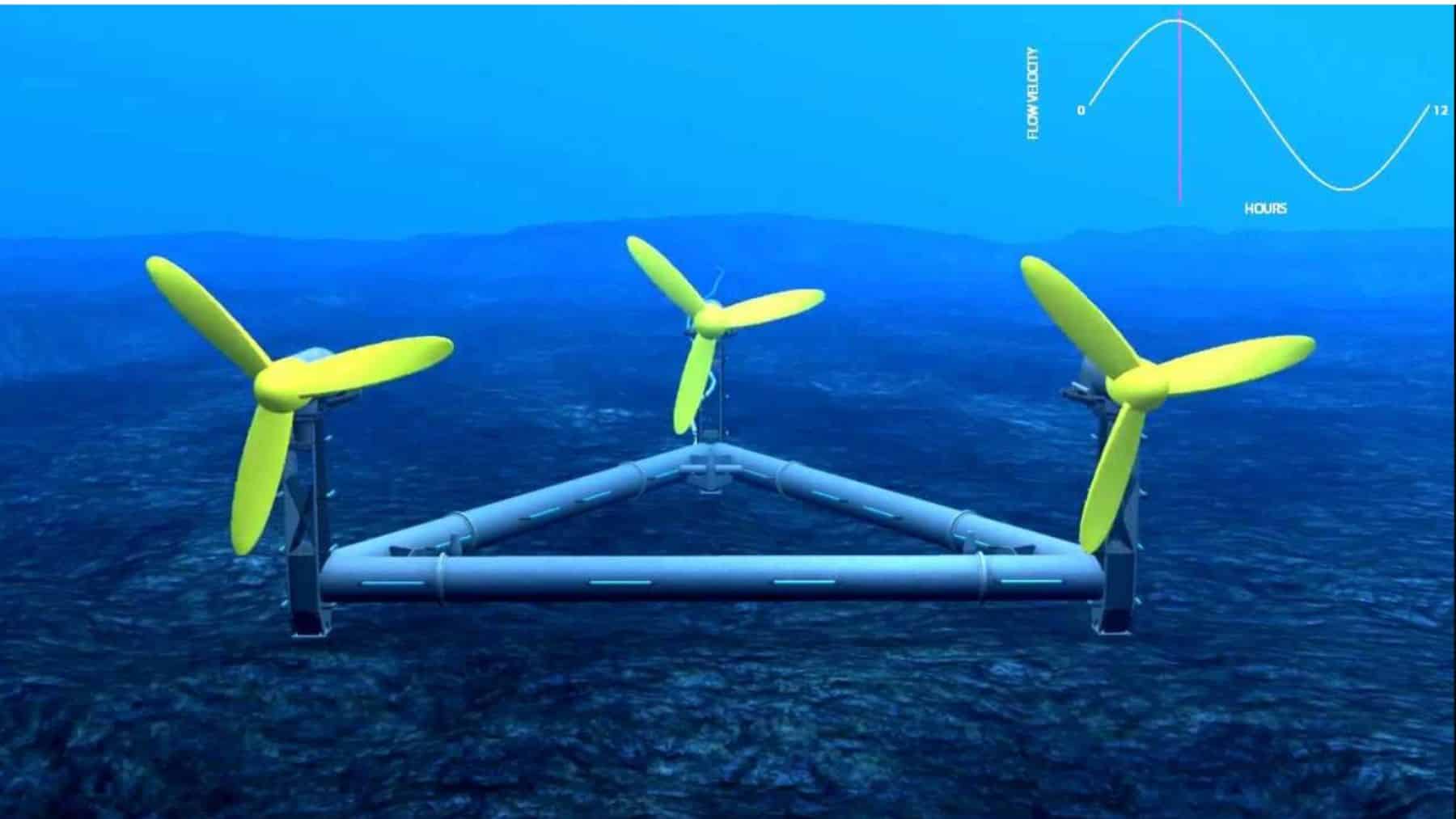
Ramsey Sound in Wales was the chosen location for a project with a capacity of 400 kW called DeltaStream. With DeltaStream, sustainable energy was given a new meaning, which looked at power that can rise from 100 meters below. DeltaStream was one generator that was developed by Tidal Energy Ltd (TEL) in an attempt to harness power from ocean currents. Tidal Energy Ltd (TEL) looked at sustainable innovation by relying on nature to provide the clean power that we most desperately need.
The purpose of DeltaStream further explored in detail
DeltaStream could be called an energy conversion system as it sought to convert tidal energy into electricity. The way that the system worked was by having the DeltaStream unit, which is a triangular steel base, rest on a seabed. The structure required a penetrating tip that embedded directly into the sea floor. Ultimately, no environmental upsets were caused by the installation of DeltaStream.
The horizontal turbines were housed in an encasement made of fibre-reinforced plastic (FRP) and were mounted to the base. The casing contained an automated hydraulic yaw system, making it possible for the turbines to align with the direction of the tide. Energy was captured from all sides. Each DeltaStream unit was able to generate more or less 1,2 MW. For Ramsey Sound, a 400 kW turbine was used to show the full capacities of this generator.
Electricity generated was then transferred to the grid via a submarine cable and a SCADA (Supervisory Control and Data Acquisition) system. DeltaStream could thus track the efficiency of the grid and monitor how much power was being generated from tidal waves.
Considering the strategic placement of the 400 kW turbine
Ramsey Sound was strategically selected following an intense evaluation process. 24 potential locations throughout the U.K. were considered, but Ramsey Sound was chosen for a variety of reasons. Some of the reasons included:
- Ramsey Sound featured one of the fastest tidal flows in the U.K., whereby the Spring tides reached up to 6 knots (3 m/s).
- Water exceeded 60 meters in depth, making installation almost effortless.
- Ramsey Sound saw no undersea obstructions.
- The region had a well-documented ecological environment, making it better in terms of tracking the project’s impacts on the ecological environment.
Ramsey Sound was also chosen particularly because it remained sheltered from prevailing wind and wave conditions and because it offered reliable grid connections.
Considering the environment, a key focus of Tidal Energy Ltd.
When Tidal Energy Ltd created DeltaStream, the idea was not to simply generate cleaner power. It was a way to assess the environmental impact of such a generator. As such, an entire Environmental Impact Assessment (EIA) was completed.
As per the findings, minimal impact on marine mammals was found.The findings also revealed barely any change in habitat use. Along with assessing the impact of the system on marine life, the impact on the local bird population was also taken into consideration, with findings reflecting minimal impact on the local bird populations.
While findings were positive and installation was effortless, the project was not without technical and financial challenges. The turbine’s early decommissioning resulted from a flaw in the sonar-based mammal detection system and several other mechanical flaws. To date, however, wind turbines continue to be installed underwater thanks to Tidal Energy Ltd.
DeltaStream’s story is worth looking back on
While DeltaStream’s story faced challenges and was only operational from December 2015 to March 2016, the turbine signified a strong pathway towards a reliable and renewable marine energy source. The 400 kW contribution to the Welsh grid may not seem like much, but it bears testament to the potential on offer if we tap into ocean currents. Now, underwater turbines are ready to sail the oceans.
The design underwent testing at Cranfield University, and its real-world testing showed that marine technology is advancing to meet the demand for cleaner power. With lessons gained from Ramsey Sound, it is clear that potential exists 100 meters below the surface, and it’s time for us to progress with the tide.
Disclaimer: Our coverage of events affecting companies is purely informative and descriptive. Under no circumstances does it seek to promote an opinion or create a trend, nor can it be taken as investment advice or a recommendation of any kind.