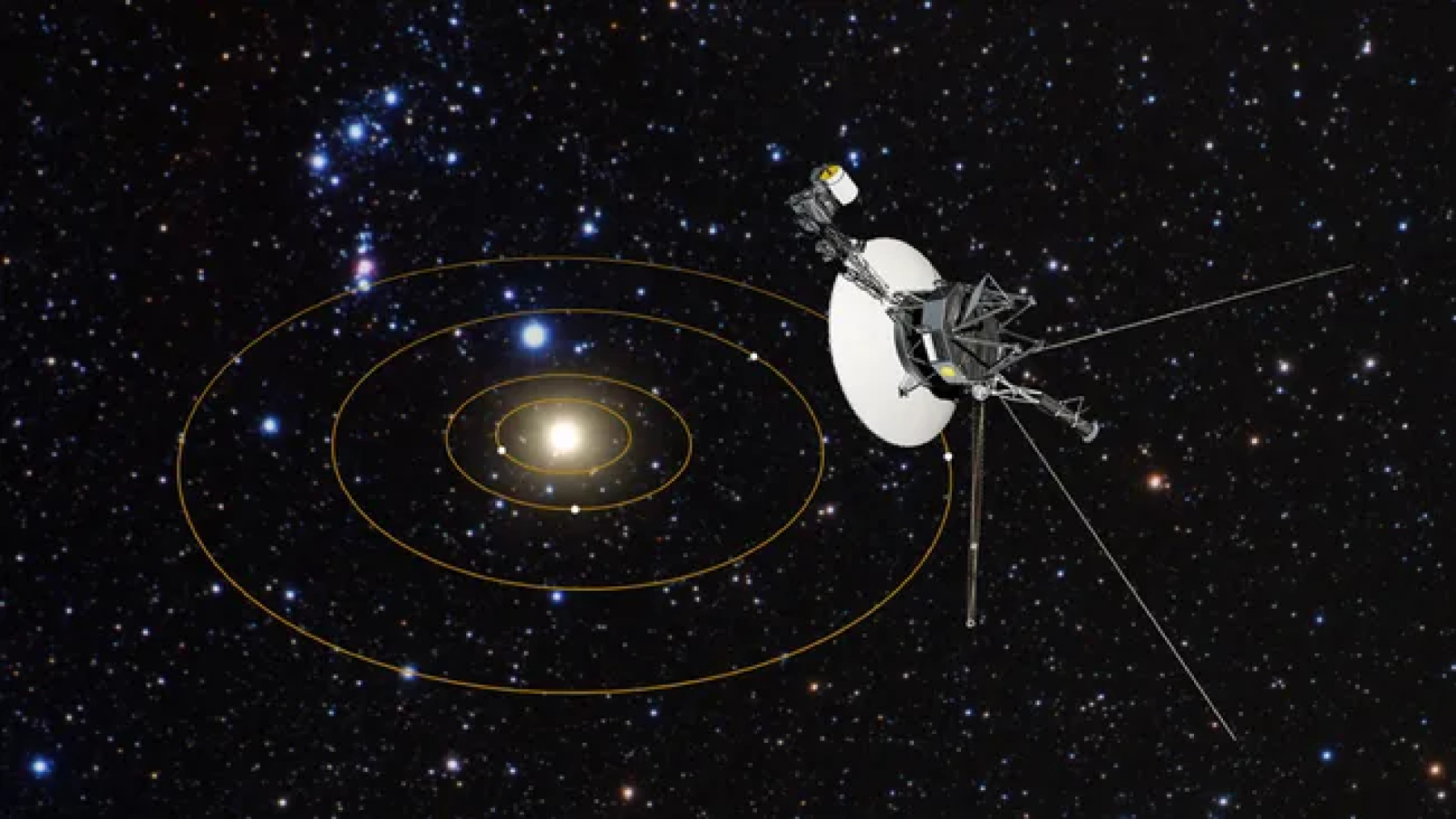
Launched on September 5, 1977, Voyager 1 has become a symbol of the desire of man to explore the unknown. Voyager 1, along with its twin, Voyager 2, has ventured farther from Earth than any other human-made object and has been able to tell much of the history of the new spaces he has opened in the eternal cosmos and of what lies beyond the solar system.
An uncommon chance: How Voyager 1 made use of planetary alignment
Voyager 1 was conceived as an ambitious space mission dedicated to studying the outer planets. Intended for Jupiter and Saturn, the spacecraft used a rare alignment of planets that occurs once every 176 years, allowing it to “slingshot” between planets with their gravitational pull.
By March 1979, Voyager 1 completed its closest approach to Jupiter, revealing astonishing features, including its thin ring system and the volcanic activity on its moon. The spacecraft also captured beautiful images of Europa, suggesting the possibility of an enormous subsurface ocean beneath its icy surface.
A year later, Voyager 1 arrived at Saturn and discovered new moons, among them Prometheus and Pandora, and provided never-before-seen pictures of the wonderful complexity of the ring system. Its studies of Titan, Saturn’s biggest moon, established the orange haze that would later inspire years of speculation about the mystery locked in its atmosphere.
The golden record: The time capsule of mankind for the universe
One of the cultural artifacts that Voyager 1 has, apart from scientific instruments, is the Golden Record. It is a gold-plated twelve-inch copper disk which has music, greetings in 55 languages, nature sounds, and images from our earth.
This Golden Record, intended as an exhortation to non-Earth creatures, places within it the entire panorama of humanity’s essence, to some future discoverers in the stars an open time capsule. In August 2012, Voyager 1 went down in history as the first spacecraft to enter interstellar space.
This milestone was even confirmed in the following year. Crossing the heliopause-the line beyond which normal influence from the sun wanes-it furnished groundbreaking data about this uncharted region. Its instruments showed a sharp drop in solar particles and an increase in cosmic rays from other stars.
Voyager 1: Still unlocking the secrets of interstellar space
Voyager 1’s expedition still brings forth scientific treasures. The spacecraft sent data on the harsh cosmic radiation that is in interstellar space and on how solar particles interact with those coming from other stars. These observations bring implications of the theories on the boundaries of the solar system, as well as important new guidance for further missions to investigate the stars.
Voyager 1, however, operates under billions of miles, around 14.6 billion miles (23.5 billion kilometers) as of 2022. It relies on radio signals, which take over 21 hours to travel in each direction. The spacecraft has three radioisotope thermoelectric generators, which convert heat from radioactive decay to electricity.
Yet, because of the dwindling power supply, many scientific instruments have been turned off for energy conservation. NASA predicts that by 2025 the rest will cease function, ending what many have described as an extraordinary era.
As Voyager 1 continues its course, it evokes wonder and possibility far into the future-from roughly 40,000 years hence, it will be only 1.7 light-years from the star AC +79 3888, taking with it the history of its creators. Its power will be depleted by that time, but its legacy will inspire generations yet to come as an icon beckoning them to the stars.
What Voyager 1 accomplished with its own resources is a testimony to human ingenuity and curiosity? With the ground-breaking discoveries made with it and the cultural symbolism of the Golden Record, it seems to have gone far beyond the mission it was originally intended for-depicting an enduring message of discovery and an avenue to some unexplored unknowns.