Rain means puddles, wet shoes, and a sky that makes solar panels less useful. But every raindrop also carries kinetic energy, energy from motion, and scientists keep asking the same question, can we capture some of it?
A new study from China suggests the answer is yes, at least on a small scale. The researchers built a lightweight, floating generator that turns the impact of raindrops into short electrical pulses, aimed at powering low-power electronics rather than homes.
A generator that floats
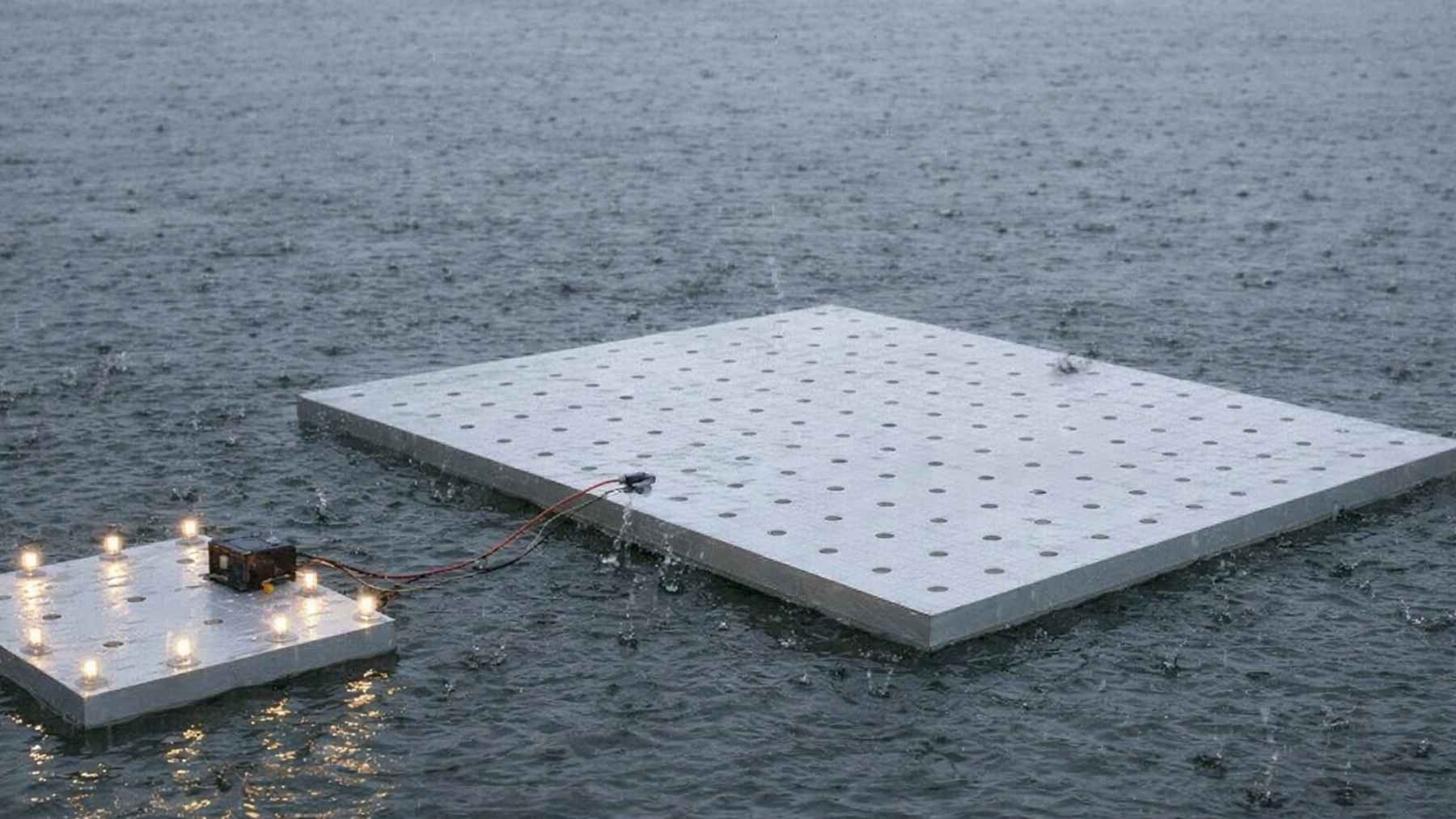
In a study led by Wei Deng with corresponding author Wanlin Guo at Nanjing University of Aeronautics and Astronautics, researchers describe a water-integrated droplet electricity generator that floats on a water surface.
Guo said, “By letting water itself play both structural and electrical roles, we’ve unlocked a new strategy for droplet electricity generation,” and he described it as a complement to other renewables.
The basic goal is straightforward. Instead of putting a raindrop device on land, the generator is designed to sit where water already is, like reservoirs and coastal areas.
It also hints at a different way to think about renewable energy. Could a stormy day help run the monitoring equipment that keeps tabs on water quality and flooding risk?
Water as the hardware
Most raindrop generators rely on a rigid base and a metal plate underneath an insulating layer. This new approach still uses an insulating film on top, but it replaces much of the hard structure with the water surface itself.
In practical terms, the water acts like both the floor and part of the wiring. It supports the device mechanically, and it also works as the lower electrode, the part that helps complete an electrical circuit.
That shift has an obvious advantage for deployment. A floating unit can be carried, placed, and rearranged more like a buoy than a heavy piece of equipment bolted to the ground.
How a raindrop makes a pulse
Researchers group many water-to-electricity ideas under “hydrovoltaics”, a field that aims to pull usable electricity from the way water moves and interacts with materials. The physics is not magic, even if it sounds like it. When a droplet hits an insulating “dielectric” film, charges inside the materials shift around, creating a voltage, which is basically an electrical push.
The setup is a simple sandwich with a top electrode, an insulating film, and water below. As a droplet spreads on the film and makes contact in the right way, that charge imbalance produces a brief electrical pulse.
Water chemistry helps, too. Natural water contains ions, tiny charged particles from dissolved salts and minerals, and those ions make the water a better conductor than pure water.
What the experiments showed
The researchers say the floating setup can reach electrical output similar to conventional designs that rely on rigid supports. They also report that keeping the surface from accumulating water during rain is crucial for stable performance.
In the paper, published August 4, 2025, the team reports peak voltages around 250 volts per droplet, along with an 87 percent reduction in material weight and a 50 percent reduction in materials cost compared with a metal-based setup.
They also built an integrated version covering about 3.2 square feet that could light 50 LED lights at once, charge small capacitors to a few volts within minutes, and use drainage holes to avoid pooling water on the film.
High voltage can sound dramatic, especially when a typical U.S. wall outlet is 120 volts. But voltage is only part of the story, and devices like this are mainly designed for tiny bursts of energy that add up over time.
Why this matters on rainy days
The team does not present this as a technology that would run your fridge or lower your electric bill next month. The focus is on small devices that need modest, steady energy, especially in places where batteries are hard to replace.
That includes sensors that track salinity, pollution, or changes in water level, and small communication units that send data in short bursts. If those systems can harvest power locally, maintenance becomes less frequent and more predictable.
It also fills a familiar gap in the renewable mix. When it is dark and rainy, solar output drops, and having another way to collect small amounts of energy could help keep essential monitoring running.
Not the first raindrop power idea
Scientists have been chasing raindrop electricity for years, often using “triboelectric” effects, a kind of static electricity created when materials touch and separate. A widely cited 2020 Nature paper showed how a droplet-based generator could deliver strong bursts of power when a falling drop connects electrodes during impact and spreading.
Other teams have pushed the voltage even higher under controlled conditions. A 2023 Science Advances study reported sparks at more than 1,200 volts from a falling water droplet, highlighting how much charge can build up in these fast, tiny events.
What is different here is the emphasis on scalable deployment over open water. By making the water body itself the bottom electrode and support, the design aims to reduce materials while expanding where droplet generators can realistically operate.
What still needs to be solved
Real rain is messy. Droplets vary in size and speed, wind changes the angle of impact, and natural water surfaces come with waves, spray, dirt, and biological growth that can foul exposed materials.
There is also the question of endurance. The insulating films must survive sun, salt, abrasion, and repeated impacts, and the electronics have to manage a pulse-like output and store it for later use.
The next step is proving the concept outside the lab and showing that many small units can work together reliably. If that happens, rainy days could become a little more useful, not just a reason to grab an umbrella.
The main study has been published in National Science Review.