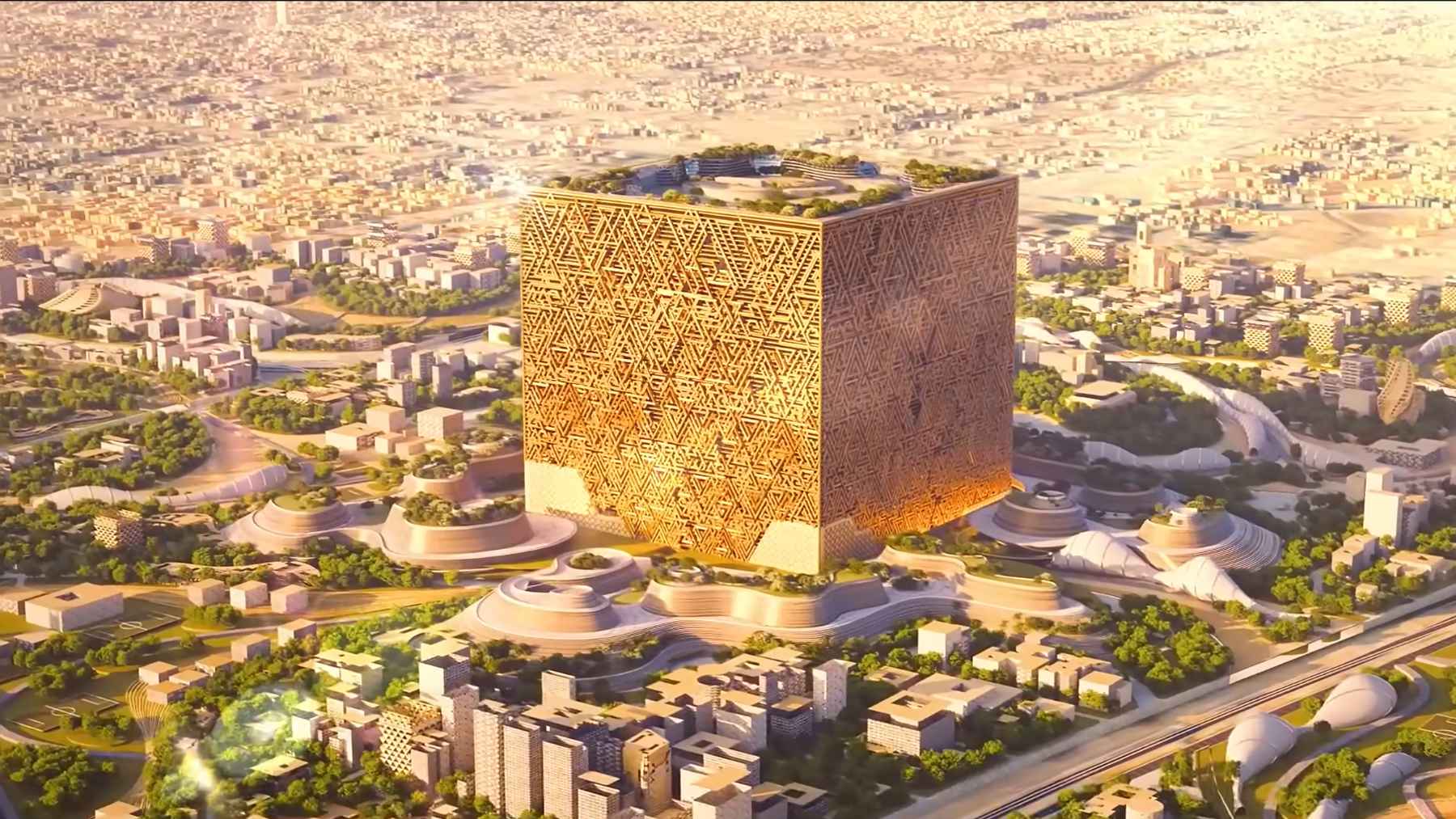
For a while, it looked like Saudi Arabia wanted to put a science fiction cube right in the middle of its capital. Now that dream is on ice.
Officials have suspended work on the planned 400 meter by 400 meter skyscraper known as The Mukaab, a metal cube large enough to swallow around twenty Empire State Buildings inside its shell.
The structure was meant to anchor the new downtown district of New Murabba in Riyadh, with a spiraling tower, hotels, apartments and an enormous immersive digital dome at its core. Work beyond basic excavation and pilings has now been halted while its backers reassess financing and feasibility.
On paper, the numbers were staggering. New Murabba was priced at around 50 billion dollars and was expected to host 104,000 homes, add about 180 billion riyals to national GDP and create more than 330 thousand direct and indirect jobs in the process.
The cube itself would have offered roughly 2 million square meters of interior floor space and ranked among the largest single buildings anywhere on Earth. So why pull the plug now, and what does this have to do with climate and sustainability?
A futuristic cube that clashed with climate promises
The decision does not come in a vacuum. Saudi leaders have spent years promoting Vision 2030 as a blueprint that mixes economic diversification with cleaner growth, including a pledge to reach net-zero emissions around 2060 and a push to expand renewable power.
Urban scholars had already warned that a windowless mega cube in one of the world’s hottest regions sat awkwardly with those climate goals.
An analysis from the Arab Gulf States Institute in Washington noted that megaprojects like the Mukaab could drive up resource use, emissions and habitat loss, and pointed out that a fully-enclosed entertainment space would demand year round cooling and artificial lighting in a city that is trying to add more green, open areas.
Then there is the simple question of materials. Globally, buildings and construction account for about one third of energy-related carbon dioxide emissions, with cement and steel alone responsible for roughly 18 percent. Every extra ton of concrete poured into a mega cube shows up somewhere in the climate ledger, even if the lights inside run on solar power.
Add water to the list. A cube of this size in a desert city would require huge amounts of water for cooling, amenities and maintenance. In the Gulf, most drinking water already comes from energy-intensive desalination plants that return salty brine to the sea and stress marine ecosystems.
For many residents who are already dealing with rising summer heat and higher electric bills, the idea of a glowing indoor city that must be cooled day and night felt like the opposite of climate smart design.
From sci fi skylines to servers and stadiums
Behind the scenes, something else is changing. The kingdom’s sovereign wealth fund, the 925 billion dollar Public Investment Fund, is preparing a new strategy that tilts away from spectacular real estate gigaprojects toward sectors like industry, mining, artificial intelligence and tourism.
Flagship schemes such as Neom and its linear city concept The Line are being scaled back and reimagined. Reporting suggests Neom may evolve into more of a data center and green hydrogen hub than a 170-kilometer-long glass corridor in the sand. Other projects, like the planned ski resort of Trojena, are also under review.
On one hand, this shift can reduce the most glaring examples of resource hungry architecture that had started to look like monuments to oil wealth rather than models of sustainable living. On the other hand, the new focus is not automatically green.
Data centers consume enormous amounts of electricity and often require significant cooling water, while mining and heavy industry come with their own environmental footprints.
At the end of the day, shelving one flashy cube does not guarantee a low-carbon path. It simply opens a window to choose differently.
Chance for a different kind of desert city
The pause at New Murabba arrives just as global construction is under pressure to change. International agencies stress that making buildings more efficient and slashing the carbon footprint of materials is one of the fastest ways to keep the climate targets within reach.
For Saudi planners, that could mean redirecting some of the ambition poured into the Mukaab into projects that cut everyday emissions and improve quality of life. Think shaded streets instead of sealed boxes, public transit that reduces traffic jams and exhaust fumes, and housing that stays cooler without needing air conditioning running around the clock.
The kingdom has already announced tree planting drives and green-space programs under the Saudi Green Initiative. The suspended cube could become a symbol that the era of building first and worrying about the climate later is coming to an end, at least in its most extreme form.
Whether that happens will depend on what actually gets built next in Riyadh. A downsized commercial tower wrapped in solar panels would tell one story. A genuine green heart for the city, with parks, low-energy buildings and better public transport, would tell another.
For now, the mega cube is a hole in the ground rather than a new indoor world. How the government fills that space will say a lot about how seriously it takes its own climate promises.