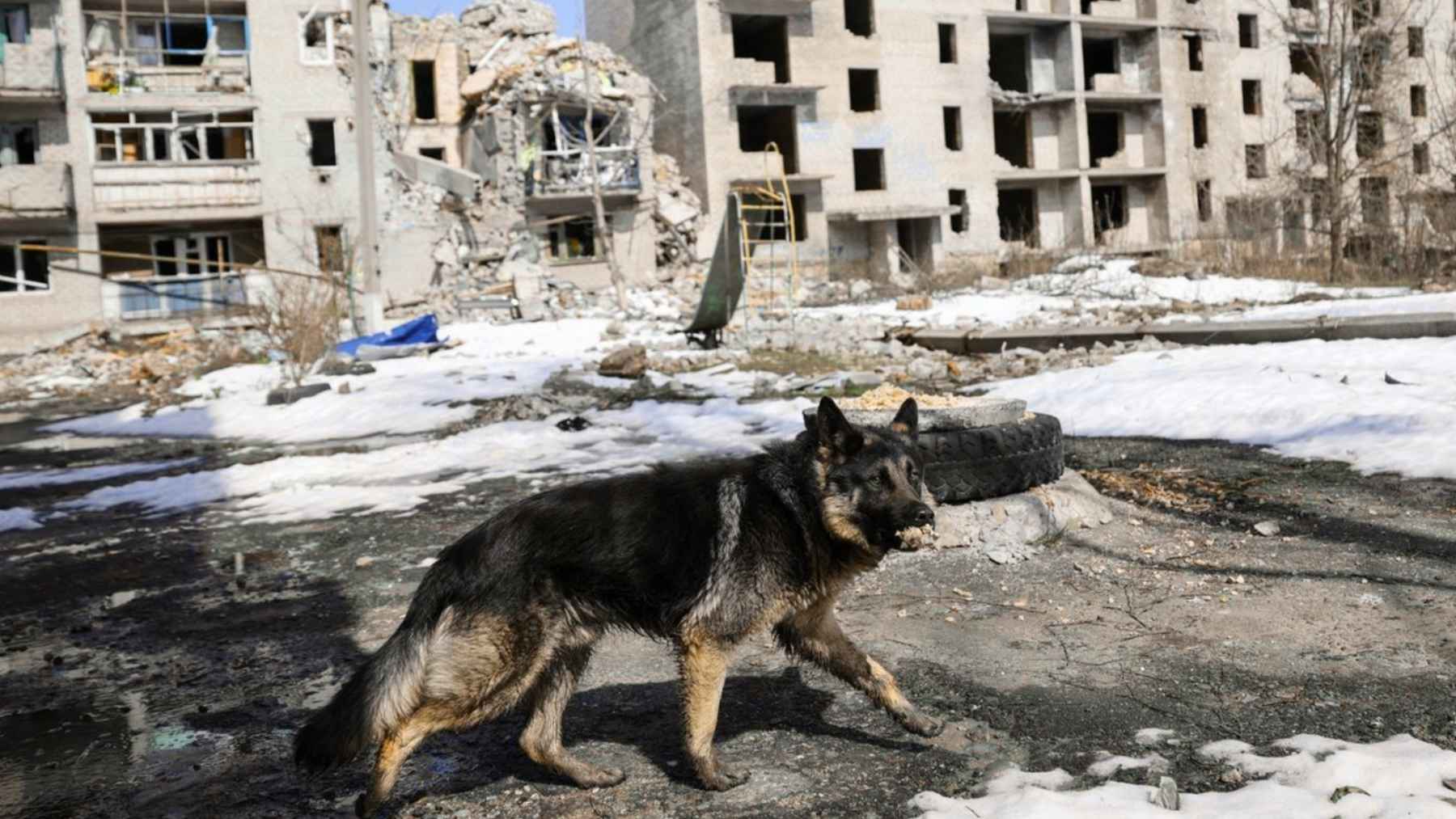
War in Ukraine has filled screens with images of ruined cities and displaced families. What we rarely see is how the same conflict is silently reshaping the dogs that share those streets, pushing many former pets toward a tougher, more wild look and way of life.
A new scientific study of free roaming dogs across Ukraine suggests that war is acting like a powerful form of natural selection, favoring animals that can survive hunger, explosions, and chaos. The research, published in Evolutionary Applications in December 2025, finds that dogs living near the front line are smaller, thinner and more similar to wolves, dingoes or coyotes than dogs in safer regions.
What the scientists did in a war zone
Between March 2023 and January 2024, an international team led by zoologist Mariia Martsiv at Ivan Franko National University of Lviv collected data on 763 dogs from nine regions of Ukraine. Shelter workers, veterinarians, volunteers and soldiers recorded basic measurements, health problems and behavior and took simple photos and hair samples. Nobody was sent into danger just for science, which matters when artillery can change the map overnight.
Co author Małgorzata Pilot, an evolutionary biologist at Wageningen University & Research, says the idea was to treat these unowned or loosely owned dogs as a window into how war reshapes everyday life. The team compared animals in relatively safe western regions, bombed but non front line cities and towns, and villages right on the line of fire. In many places, local people still fed the dogs when they could, but food, shelter and veterinary care had become unpredictable.
Instead of expensive gear, the team relied on a scale, a tape measure and smartphone cameras. They measured height, weight and a simple body mass index, scored obvious diseases and injuries, and classified traits like muzzle shape, ear type and coat color. Hair from the dogs was analyzed in a laboratory to reveal what kind of food they had been living on in recent months.
A “wild look” shaped by survival
Dogs near the front line were usually small, often only 20 to 40 centimeters tall, with regular length legs, straight ears and medium length muzzles. That is very close to the “default” body plan of wild canids such as wolves and dingoes. Short legged or flat faced dogs were much rarer in these high risk areas than in safer regions, which fits the idea that animals with more extreme shapes struggle when every sprint for cover counts.
In simple terms, the war seems to be filtering out bodies that do not cope well with running, breathing or keeping cool under stress. Flat faced dogs are more prone to breathing problems and heat, while very short legs make it harder to escape danger or move through rubble. The pattern is similar to how heavy ivory poaching in Mozambique once favored tuskless elephants in Gorongosa National Park, because poachers targeted animals with large tusks.
Coats also shifted. Near the front, medium length, smooth fur and tan coloring with few white patches became more common, again closer to a typical wild dog. Scientists think mid length fur can balance protection from cold and heat, while very long or very short coats may be a disadvantage when shelter and care are limited.
Hunger, health and what dogs eat near the front
Body mass index told an even harsher story. Dogs in safer western regions and in bombed but non front line areas had average scores around 2 and above on the scale used in the study, while front line animals averaged about 1.5. That means many were not literally starving but were chronically underweight, the kind of thinness you would notice at a glance.
To understand what these dogs were eating, the team used stable isotope analysis on hair samples. The chemical signatures pointed to diets with more plant based food and less meat than dogs from other countries or historical periods. Dogs near the front line had a slightly different pattern that could reflect both severe hunger and occasional hunting or scavenging, yet their overall “trophic level” was still low, which argues against large numbers living mainly on carcasses.
Most of the animals that could be sampled were still getting at least part of their food from people, whether from soldiers, volunteers or civilians who stayed behind. Others likely turned more to hunting small animals or eating whatever they could find. At the end of the day, a thin dog with a strong, mobile body has a better chance of squeezing under fences, dodging traffic and surviving that next blast.
From pets to packs
Photos used in the study showed that most free roaming dogs across Ukraine were still seen alone. Near the front line, though, groups became more common, especially pairs or trios of adults and, in some places, larger groups of puppies. Group living can help animals defend scarce food or watch for danger, but it also raises the risk of dog attacks on people and the spread of diseases such as rabies.
Some dogs were taken in by army units, which fed them, gave basic medical care and used them as companions or informal guards. Others avoided soldiers and civilians completely and were seen only by drone or at a distance, their survival no longer tied to a food bowl on someone’s porch. For those animals, biologists say, this looks a lot like the first steps toward a truly feral lifestyle.
Why this matters beyond Ukraine’s dogs
The authors argue that war behaves like an intense, fast moving environmental shock that can reshape animals and ecosystems, much like a massive Antarctic iceberg breakoff or a large scale industrial accident. Their results sit alongside other stories of fragile animals and plants under pressure, whether in deep caves, underwater river systems or crowded cities.
Independent wildlife ecologist Euan Ritchie at Deakin University in Australia notes that species with limited mobility or very narrow diets are likely to be even more vulnerable than dogs. He points out that in peacetime we pour money into solutions like wildlife crossings to help animals cope with roads, while wars destroy habitats outright and create new dangers such as unexploded mines. From an underwater “second Amazon” to the survival of one of the rarest birds on the planet, the same message keeps cropping up that human decisions can quickly push other species toward the edge.
For Ukraine’s dogs, the picture that emerges is sobering. War is selecting for small, tough, alert animals with bodies built for hard work and scarce food, while older, sick and unusually shaped dogs disappear first. It is a reminder that conflict does not only redraw borders on maps, it quietly rewrites the lives and even the bodies of the animals that live beside us.
The main study has been published on The Effect of War Inflicted Environmental Damage on Free Roaming Domestic Dogs.