Earth’s land vegetation does not just grow and die back with the seasons. According to a new international study, the planet’s overall “green center” has been drifting toward the northeast for decades, a quiet shift that suggests ecosystems are reorganizing as CO2 levels rise and the climate warms.
The research team did something clever. They reduced the complexity of global vegetation into one moving point, then measured how fast and in which direction it travels, and the numbers show the motion has sped up since about 2010.
In one long-running leaf area record, the northward drift during the austral peak reached about 8.7 miles per year (14.0 km per year) in the 2010s, which is far faster than earlier decades.
A single balance point for Earth’s vegetation
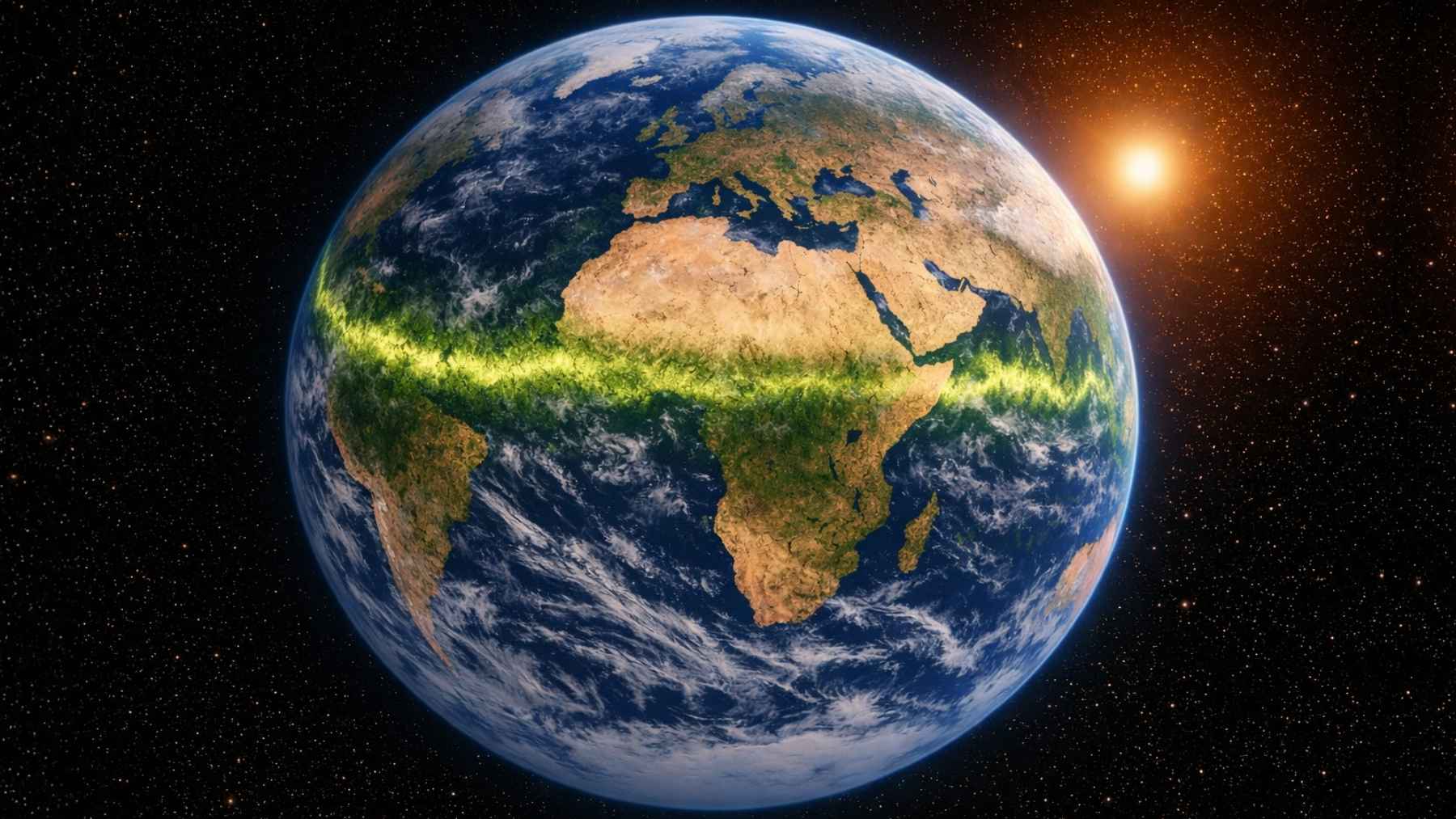
First author Miguel D. Mahecha explains the idea this way, “Imagine holding a perfectly round globe” and attaching tiny weights that represent green leaves around the world. Where that weighted globe would balance is the vegetation center of mass, and tracking its position creates a kind of biosphere compass.
The team calculated that point using decades of satellite observations and model data, relying on measures such as leaf area index and related greenness indicators. Gustau Camps-Valls, who helped develop the framework, put it in plain language, “We’ve essentially compressed the biosphere’s complexity into a single, moving heartbeat”.
The same approach, the researchers argue, could be adapted to track an ocean “blue wave” or a “red wave” of heat anomalies.
The green wave’s yearly swing is easy to picture
In rhythm with the seasons, vegetation greenness moves like a wave from the Northern Hemisphere to the Southern Hemisphere and back again. The researchers found the “green center” oscillating between a northernmost position in mid-July near Iceland and a southernmost position off the coast of Liberia in March.
It is an intuitive pattern because we live it, just on a smaller scale. Spring leaf-out across northern forests and farms can pull the global balance point north, while seasonal changes in the tropics are often less dramatic. Then the cycle repeats, like a slow inhale and exhale you can see from space.
A trend that surprised the researchers
The big twist is that the trajectory is not staying put. When the team analyzed multiple decades, they detected a consistent northward shift across all seasons, and they also picked up a distinct eastward shift.
The northward part challenged their expectations. They anticipated the boreal summer peak would move north quickly, while the austral summer peak would shift moderately south, but they did not observe that southern shift. “This was a huge surprise to us,” Mahecha said in the University of Valencia release.
The northward drift is speeding up in recent years
Using the GIMMS LAI4g record from 1983 to 2021, the study estimated a northward trend of about 1.2 miles per year (2.0 km per year) at the boreal greenness peak and about 1.5 miles per year (2.4 km per year) at the austral greenness peak.
Between 2010 and 2020, those trends accelerated to about 2.1 miles per year (3.3 km per year) and about 8.7 miles per year (14.0 km per year), respectively.
Other datasets reported different magnitudes but the same general story, including especially strong recent movement during the austral peak.
For example, the paper notes post-2010 trends in GLASS-LAI of about 2.8 miles per year (4.5 km per year) for the boreal peak and about 6.2 miles per year (10.02 km per year) for the austral peak.
The authors also found that the austral peak’s northward shift lined up closely with changes in global leaf area, with a correlation of R = 0.84, while the boreal relationship was more moderate at R = 0.66.
That kind of asymmetry is a hint that the underlying drivers are not evenly distributed around the world.
Why northeast, and why now
So what could push the global “green center” north even when the Southern Hemisphere is in its growing season? The team points to longer growing seasons and warmer winters in the Northern Hemisphere, which can keep vegetation slightly greener for longer and shift the global balance toward northern landmasses.
They also emphasize that this is a testable hypothesis, not a settled conclusion. (uv.es)
The eastward piece may be the other half of the answer.
The researchers say the trajectory is likely being pulled by greening hotspots in regions such as India, China, Europe, and Russia, which can tug the global balance point toward Eurasia over time. (uv.es)
Greening is real, but it is not a climate “get out of jail” card
This study sits on top of the broader phenomenon known as global greening, meaning a long-term increase in leaf area in many places.
The IPCC points to satellite and modeling work showing greening across roughly 25% to 50% of global vegetated land from 1982 to 2009, and it notes findings that link about 70% of that signal to CO2 fertilization.
At the same time, extra leaf area does not erase the risks that come with a hotter planet. CO2 can boost photosynthesis and water-use efficiency, but plants still need nutrients and water, and extreme heat and drought can flip greening into browning in a hurry.
For most people, this is not about a dot moving across a map, it is about the shifting timing of spring, changing growing seasons, and the ripple effects on carbon uptake, wildfire fuel, and biodiversity.
It is also a reminder that the biosphere is dynamic, and our “baseline” is not as stable as it once seemed.
The study was published on Proceedings of the National Academy of Sciences, also known as PNAS.