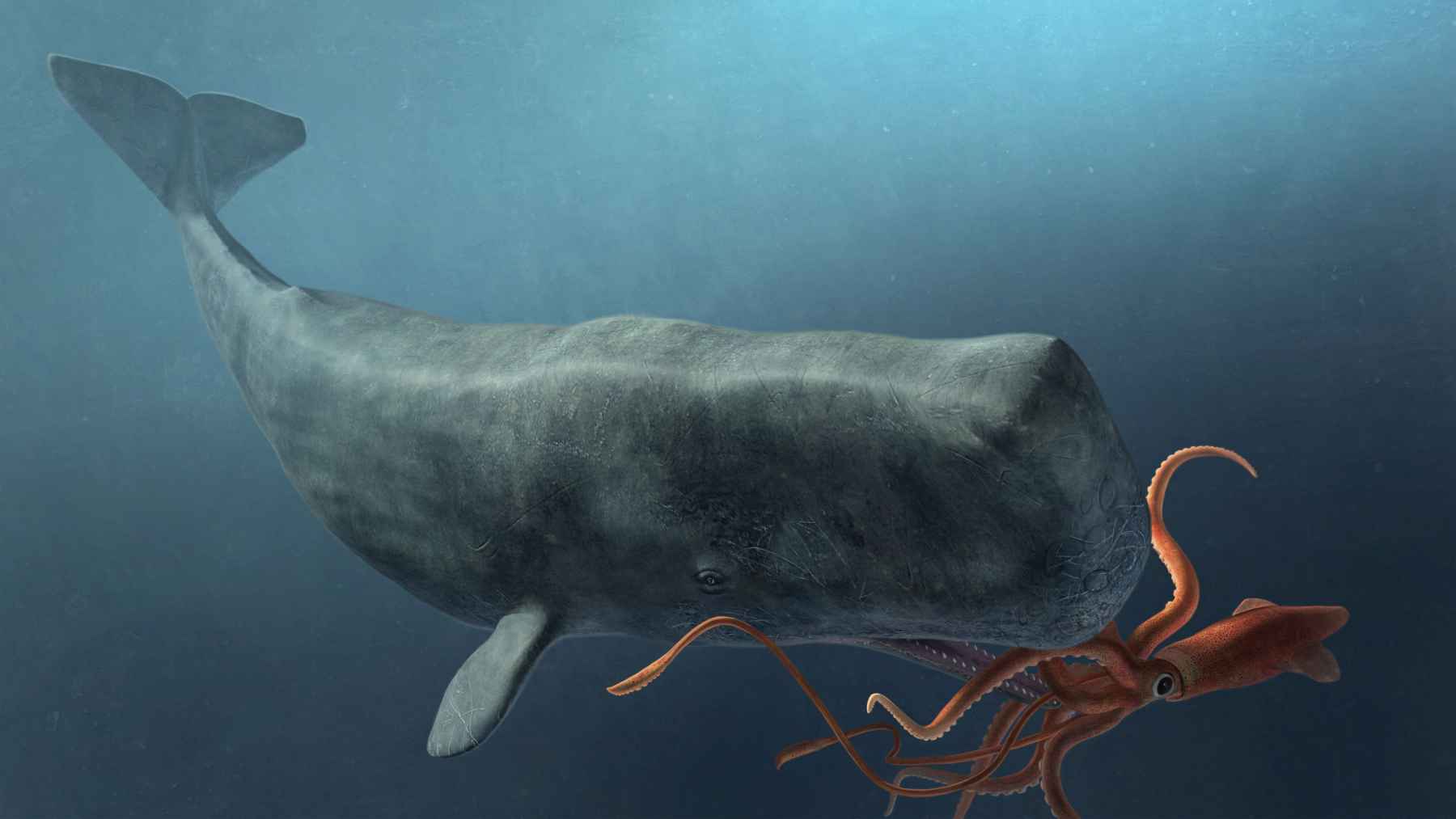
Far below the reach of sunlight, where pressure crushes human submarines and the water feels almost timeless, another story is playing out. Millions of times a day, deep-diving toothed whales close in on squid in what scientists now describe as one of the most intense evolutionary arms races on Earth.
In a new essay in the journal Limnology and Oceanography Letters, marine ecologists Henk-Jan Hoving and Fleur Visser pull together decades of scattered evidence and formalize how this silent conflict works. They highlight scars on the skin of sperm whales and beaked whales, left by ring-shaped sucker marks, and the hard beaks of squid packed inside whale stomachs. Every mark is a data point in a battle we almost never see.
Cephalopods and survival in the deep sea
For most of their 530 million year history, cephalopods evolved to escape fish and other hunters that relied mainly on sight. Camouflage, quick color changes and clever tricks with bioluminescence helped them melt into the background. That balance shifted about 34 million years ago, when toothed whales evolved echolocation and started hunting in the deep water where sunlight fades out. Suddenly the main threat was a mammal that hunts by sound instead of sight.
Whale echolocation and sonar hunting
The authors identify whale echolocation as a new kind of biological weapon, an “unprecedented armament” that lets large whales detect prey hundreds of meters away in total darkness. Squid eyes simply cannot match that detection range. To stay alive, many deep sea squids seem to have changed their bodies and habits.
They adopt elongated, almost stick-like shapes, hold themselves vertically in the water and avoid schooling. All of that likely makes their acoustic profile smaller and harder for a whale’s sonar to pick out.
Squid adaptations and deeper ocean refuge
Another tactic is to move deeper. As many squid grow, they shift to darker layers near the sea floor. There the water is colder and food can be scarcer, but there is one big upside. Whales are mammals. They have to return regularly to the surface to breathe. Every extra meter of depth gives squid a little more breathing room of their own.
Vision still matters in this contest. Giant squid have some of the largest eyes in the animal kingdom, which earlier work showed are tuned to spot the glow of bioluminescent plankton stirred up by an approaching whale. In simple terms, those huge eyes may act like early warning systems that let a squid bolt before the predator gets too close.
Sperm whales and beaked whales in deep diving hunts
The whales have not stayed still either. Deep-diving toothed whales such as sperm whales and many beaked whales have evolved massive sound producing structures in their heads and the ability to hold their breath for long dives that can reach hundreds or even thousands of meters.
Tagged animals show that they often fan out during a dive, each hunting alone yet staying in loose contact, so a pod can sweep a huge volume of water for prey in a single foraging bout. Some individuals capture hundreds of squid-sized animals per day.
Ocean warming and a live-fast life cycle
The authors also argue that constant pressure from these predators may have pushed cephalopods toward a “live fast, die young” lifestyle. Many oceanic squid grow quickly, reproduce once and then die.
That short life can reduce the window of time in which a whale can catch them and, according to the study, may now give cephalopods an edge as oceans warm and change, since species with rapid life cycles often adjust more easily to shifting conditions.
All of this is happening in a part of the planet that feels very far from daily life at street level. Yet this hidden struggle shapes food webs, nutrient flows and even how carbon moves from surface waters into the deep sea. The trouble is, almost none of these whale squid encounters have been seen directly.
For now, scientists work backward from scars, stomach contents, acoustic records and theory to piece together the rules of this underwater arms race.
The study was published on Limnology and Oceanography Letters.