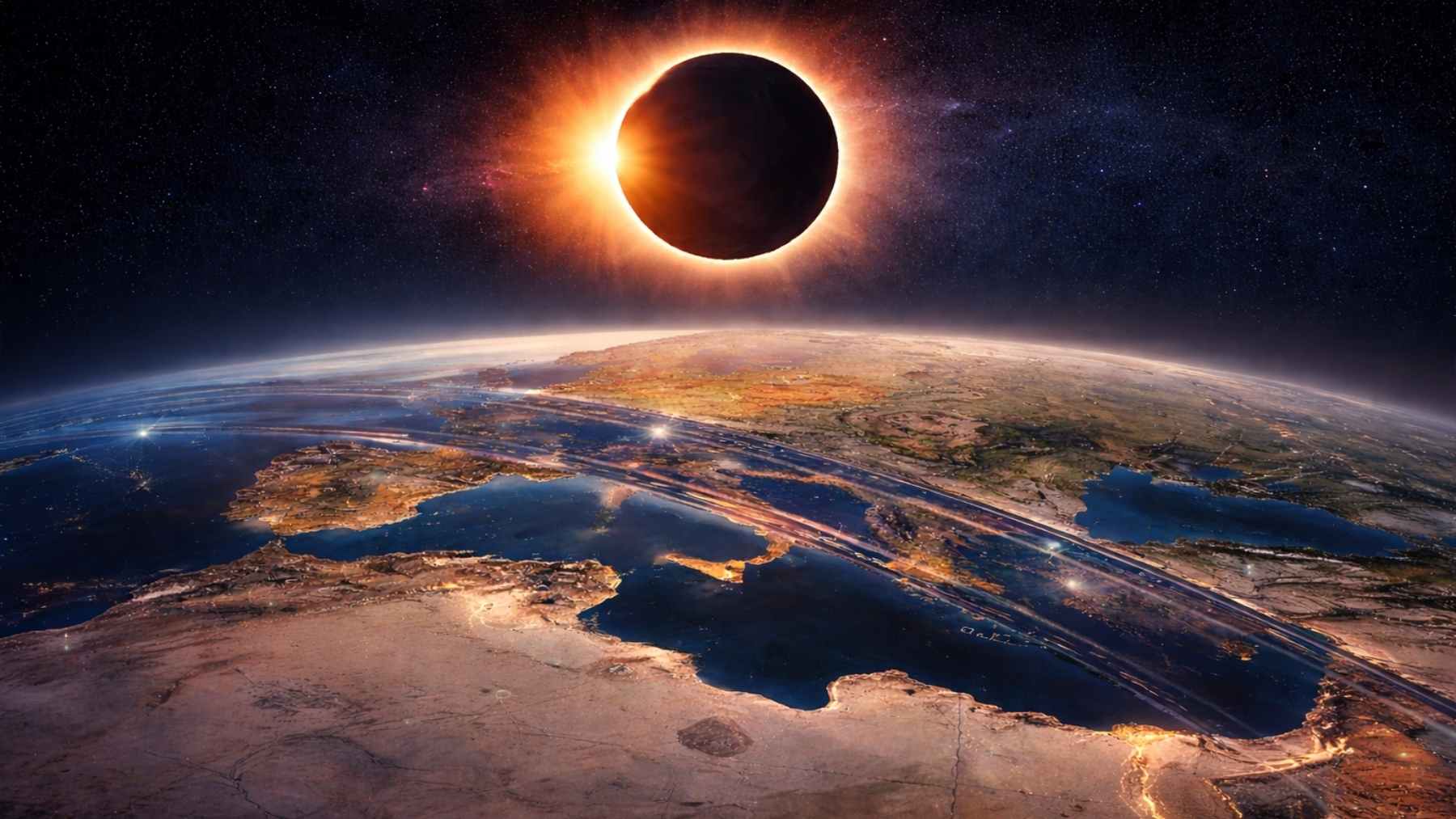
On August 2, 2027, midday will briefly turn to night across parts of southern Europe, North Africa, and the Middle East as a total solar eclipse sweeps across three continents. At its longest, the Moon will block the Sun for about 6 minutes and 23 seconds, making this the longest totality on easily accessible land until at least 2114.
Astronomers estimate that around 89 million people live inside the path of totality, from coastal Spain to the Red Sea and the Horn of Africa. For everyone there, day will fade into an eerie twilight. Stars and planets will pop out, the temperature will drop, and the Sun’s normally hidden corona will glow around a black disk in the sky.
A rare alignment that stretches totality past six minutes
Not every total solar eclipse lasts this long. This one is special because three factors line up almost perfectly. The Moon will be close to perigee, so it appears slightly larger in our sky. Earth, only a few weeks past aphelion, will see the Sun appear a bit smaller.
On top of that, the shadow sweeps low across the globe, near tropical latitudes, where the geometry keeps the lunar shadow moving more slowly across Earth’s surface.
All of that adds up to a very long stretch of darkness. The maximum totality will be reached near Luxor in Egypt, where observers can expect more than six minutes of deep shadow and a spectacular view of the corona arching over the Nile valley.
The path itself begins over the Atlantic, crosses the Strait of Gibraltar, clips southern Spain, then runs through Morocco, Algeria, Tunisia, Libya, Egypt, Saudi Arabia, Yemen, and finally Somalia before heading out over the Indian Ocean. Cities such as Cádiz, Málaga, Tangier, Benghazi, Luxor, Jeddah, and Sana’a will see totality if the skies cooperate.
Italy’s turn under a deep shadow
Italy will not sit inside the central track, yet the country still gets a remarkable show. Across most of the peninsula the event will be a deep partial eclipse, with around three-quarters of the Sun covered in cities such as Rome and Vatican City.
Farther south the spectacle becomes even more dramatic. On Lampedusa and nearby islands, the Moon will hide about 99.5 percent of the solar disk, plunging the island into an almost total dusk for a few brief minutes.
For purists who want the real thing, some Italian reports note that sailing roughly 20 kilometers south of Lampedusa, close to the edge of international waters, would carry observers across the line into true totality while still remaining inside Italy’s wider maritime area.
Wherever you are in Italy, there is one constant. Because no location on land reaches full totality, it is never safe to look at the Sun without proper eclipse glasses or other certified solar filters at any point during the event. NASA stresses that only the brief moments when the Sun is completely covered are safe for unfiltered viewing, and that condition never happens over Italian soil.
A natural experiment for wildlife and clean energy
For ecologists and climate scientists, a long eclipse is more than a sky show. It is a natural experiment that flips the light switch on a whole region in the middle of the day.
During the Great American Eclipse in 2024, researchers measured air temperature drops of several degrees and changes in humidity as the Moon’s shadow crossed North America.
Animals clearly noticed. A large study published in 2025 found that more than half of the wild bird species monitored during the 2024 eclipse changed their behavior during those few minutes of unexpected darkness.
Many species fell quiet as the sky dimmed, then burst into a “dawn chorus” of song when the light returned, as if a new day had started.
Something similar is likely to happen along the 2027 path. In cities and deserts from Spain to Saudi Arabia, people may see swallows heading to roost, insects changing their buzzing patterns, or pets acting unsettled as the environment briefly copies sunset.
For biologists, that moving shadow is a rare chance to test how sensitive different species are to sudden changes in light and temperature.
Energy planners are watching too. When the Moon covered the Sun over the United States in 2017 and again in 2024, grid operators had to manage sharp drops in solar power, measured in gigawatts, and then a rapid surge as sunlight returned. In 2027, countries like Spain and several North African states, where solar plays a growing role in the energy mix, can use the eclipse as a real-world rehearsal for handling fast changes in renewable output without risking blackouts or sudden spikes in the electric bill.
How to watch safely and what to expect
For most people, this eclipse will be a once-in-a-lifetime event. That makes preparation important. Observers in the path of totality should use certified eclipse glasses or solar viewers during all partial phases, taking them off only when the Sun is completely covered and putting them back on the moment even a sliver of light appears again. Outside totality, including all of Italy, protective filters must stay on the whole time.
If the weather cooperates, the scene will feel strangely familiar and alien at the same time. Streetlights may flicker on. The air will cool. Natural life will briefly slip into evening mode while humans stand in the streets, on rooftops, and along beaches, staring up with safe glasses and phones in hand.
Events like this remind us how closely our planet’s rhythms are tied to the Sun, whether through the daily habits of birds or the output of solar panels on a hot afternoon.
The study was published in “Science”.