High above our everyday worries about traffic and the electric bill, a frozen visitor from another star system is rewriting the rulebook on comets.
New observations from the Hubble and James Webb space telescopes show that interstellar come t 3I/ATLAS has a solid core about 2.6 kilometers wide, is tens of times more massive than previous interstellar visitors, and is venting an unusually rich mix of carbon dioxide and methane. Scientists say the more they study it, the more puzzling it becomes.
A hefty traveler from another star
3I/ATLAS is only the third known object to swing through our solar system from interstellar space, after 1I ʻOumuamua and 2I Borisov. It was discovered on July 1, 2025 by the ATLAS survey, which is funded by NASA, and it is racing through the inner solar system on a one-way, hyperbolic path that will never bring it back.
Models of its orbit suggest the comet may be around seven billion years old, so the ice inside it could have formed long before Earth and its oceans existed.
A nucleus the size of a small city
Until recently, astronomers could only guess how big the solid heart of 3I/ATLAS really was because it sits buried inside a bright cloud of dust. A new study using the Hubble Space Telescope finally teased out the nucleus signal. The team finds an effective diameter of about 2.6 kilometers, assuming a dark comet-like surface.
Since mass grows with the cube of diameter, that makes 3I/ATLAS roughly forty times more massive than interstellar comet 2I Borisov and at least twenty thousand times more massive than elongated 1I ʻOumuamua. For an object that slipped into our planetary neighborhood almost unnoticed at first, this is no pebble.
An exotic ice cocktail in its coma
Earlier in its journey toward the Sun, near-infrared observations by Webb and the SPHEREx mission painted a very odd chemical picture. The gas plume around the comet was dominated by carbon dioxide, carrying close to ninety percent of the mass that was escaping as gas, while water contributed only a few percent and most of the remaining fraction came from carbon monoxide.
That carbon dioxide to water ratio is among the highest ever measured in a comet. Typical solar system comets have far more water relative to carbon dioxide, so 3I/ATLAS already looked like it formed in a colder or otherwise unusual region around its original star.
Methane arrives late to the party
The newest twist comes from mid-infrared spectra taken with the James Webb Space Telescope in December 2025, after the comet had swung around the Sun and was heading back out. Webb’s MIRI instrument detected clear signatures of water, carbon dioxide, atomic nickel and, for the first time in any interstellar object, methane at a wavelength of about 7.6 micrometers.
The team behind the methane result reports that the comet’s methane output corresponds to a significant fraction of its water production. In a separate commentary, astrophysicist Avi Loeb writes that the production rates of methane in the two observing windows are “13.7% and 27% of the water molecular production rate, respectively.”
Here is the strange part. Solid methane is even more volatile than carbon dioxide. If methane ice had been present near the surface when 3I/ATLAS first became active, it should have started boiling off early in the inbound leg. Yet pre-perihelion Webb and SPHEREx spectra showed no methane at all.
The most likely explanation is that the outer layers of the comet have already lost their methane during previous heating events, while fresher methane-rich ice survives deeper inside. Only when the comet passed close to the Sun did those inner layers warm up enough to start releasing methane.
That scenario, however, sits uneasily next to the early detection of very volatile carbon monoxide, which should also have been stripped from the surface long ago.
Scarred by billions of years of cosmic rays
Another recent study combines Webb observations with computer simulations and suggests that galactic cosmic rays have hammered 3I/ATLAS for billions of years, turning carbon monoxide into carbon dioxide and creating an “irradiated crust” fifteen to twenty meters deep. As lead author Romain Maggiolo puts it, “It is very slow, but over billions of years, it is a very strong effect.”
If that picture is right, much of what we see venting into space today comes from heavily-processed outer layers that no longer reflect the comet’s original birthplace. The methane puzzle and the extreme carbon dioxide levels might therefore tell us as much about long-term space weathering as about the conditions around its parent star.
How many more giants like this are hiding near us
Using the new size estimate, the Hubble team also revisited how many similar objects might be passing through the inner solar system. Their statistical analysis suggests that, on average, more than one 3I/ATLAS-sized interstellar comet should be inside a sphere about four and a half times the Earth Sun distance at any given moment.
Most of these bodies would be completely invisible without cometary activity. Even bright ones can slip by during solar conjunction or against crowded star fields. In other words, 3I/ATLAS may be only the tip of a much larger, mostly unseen population drifting between the stars.
Why this weird comet matters back on Earth
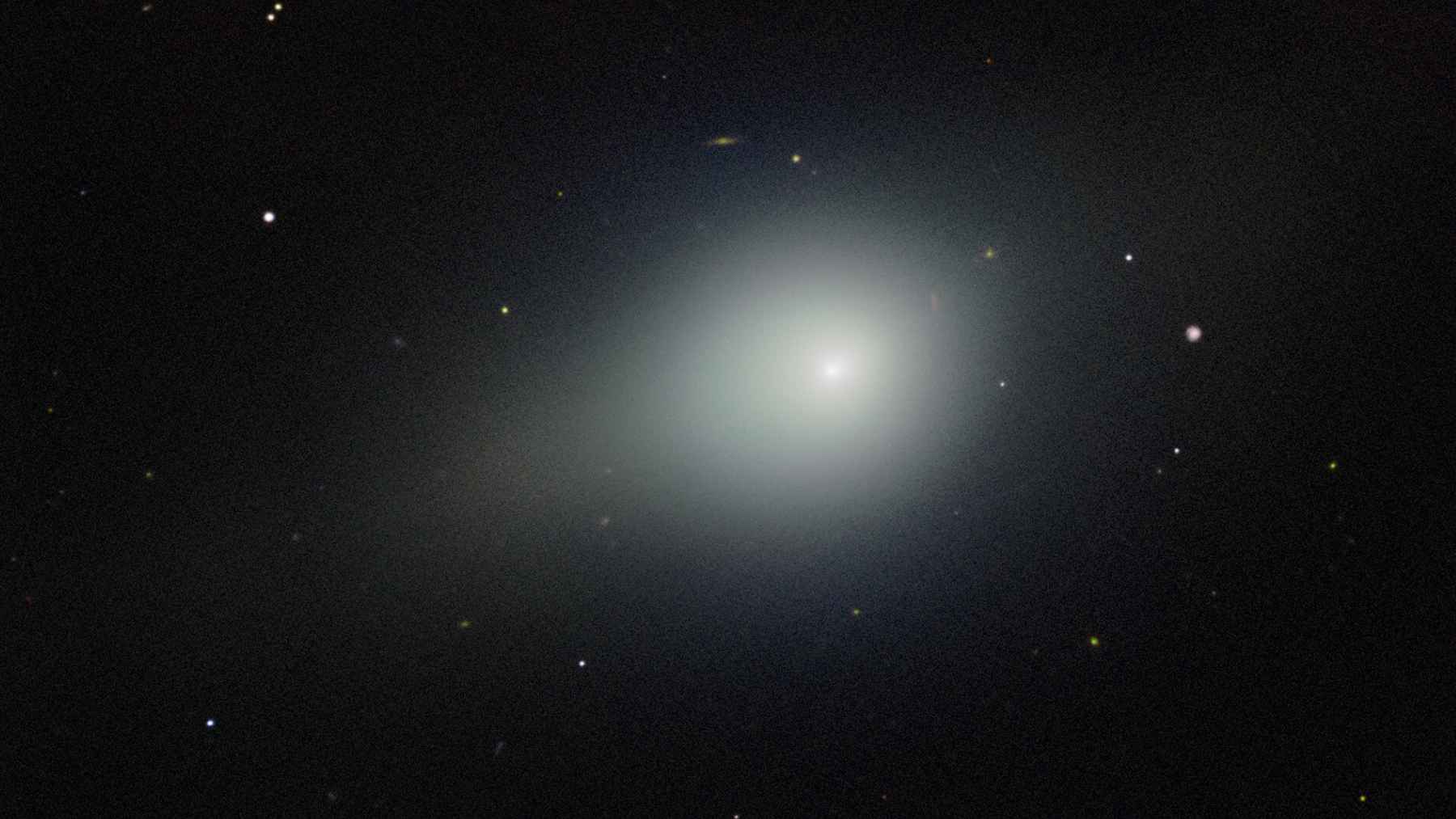
For people on the ground, 3I/ATLAS is just a faint smudge in the pre-dawn sky. For planetary scientists, it is a rare chance to hold up a mirror to other planetary systems and to test how common ingredients like water, carbon dioxide and methane really are in the wider galaxy.
Its water ice may be older than Earth itself, and its processed crust reminds us that time and radiation can radically reshape even the most ancient materials.
Each new dataset also refines our ideas about how many interstellar comets swoop through our neighborhood and whether future missions could ever chase one down for a close up look.
At the end of the day, 3I/ATLAS is turning into a kind of cosmic time capsule, one that carries both the story of its home system and the scars of an incredibly long journey through deep space.
The study was published on arXiv.