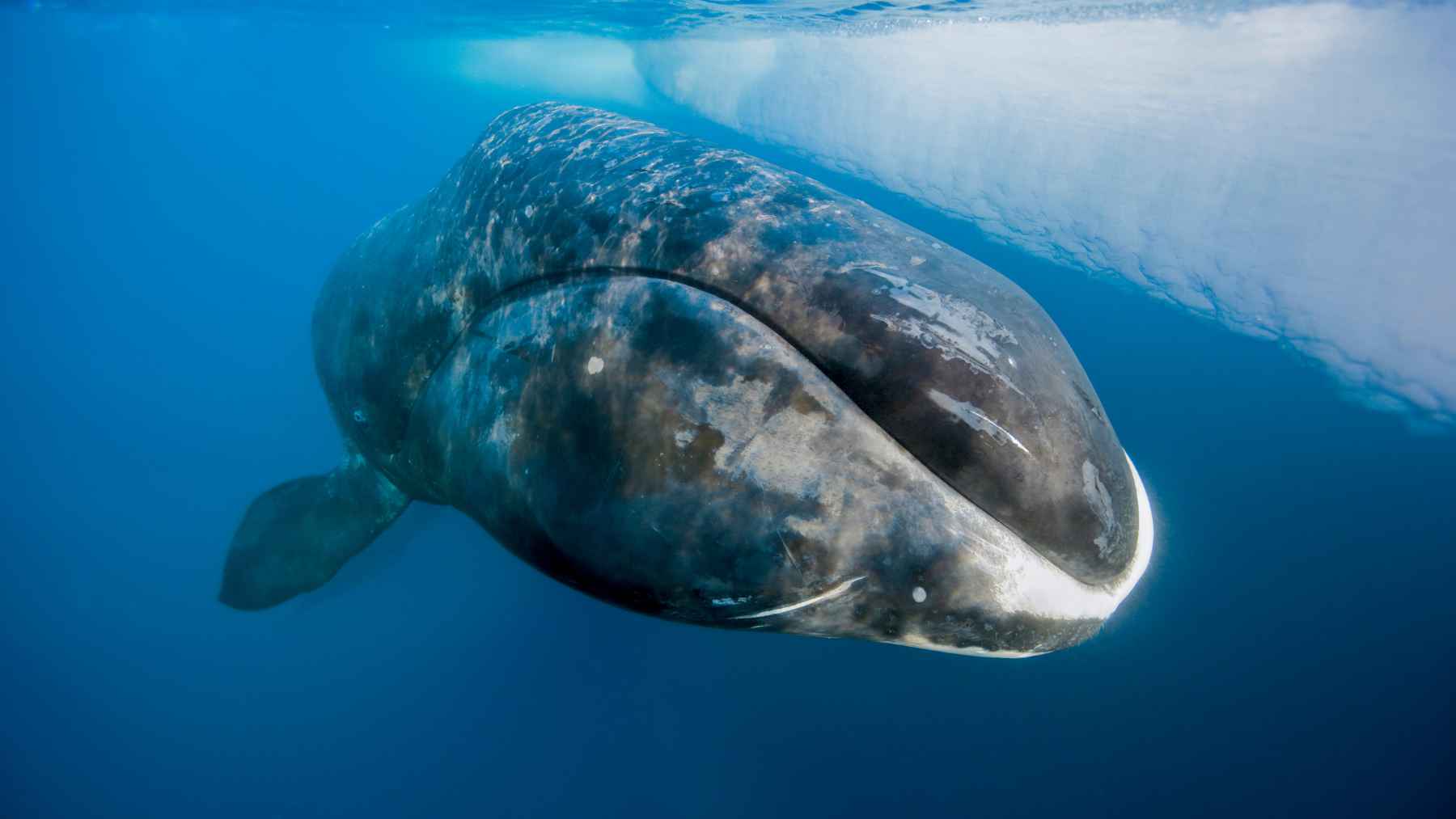
Imagine blowing out birthday candles at 120 and still feeling strong enough to chase grandkids around the yard. That kind of long life sounds like science fiction, yet some animals already come surprisingly close. A new study of the bowhead whale, an Arctic giant that can live for more than 200 years, suggests its unusual DNA repair system could one day help push human aging further back.
Scientists from the University of Rochester and partner institutions found that bowhead whales pack their cells with a protein called CIRBP that helps repair dangerous DNA damage with striking efficiency. When the team boosted this same protein in human cells and in fruit flies, the cells fixed breaks more accurately and the flies lived longer.
Researchers stress that people are nowhere near 200 year lifespans, but they say the work shows biology leaves more room for healthy longevity than we once thought.
A whale that stays healthy for two human lifetimes
Bowhead whales live in icy Arctic waters and still manage to thrive for more than two centuries. For most of that time they show few signs of age-related disease such as cancer. On paper their huge bodies should be perfect breeding grounds for tumors, yet in real life they mostly stay healthy.
That mystery sits at the heart of what biologists call Peto’s paradox, the observation that big, long lived animals do not get cancer nearly as often as math would predict. More cells and more cell divisions should mean more errors in DNA and more chances for a rogue cell to turn into a tumor.
Evolutionary geneticist Alex Cagan from the Wellcome Sanger Institute has even described the bowhead whale as a “superstar of longevity research,” because it shows that long life and low cancer risk can go together.
CIRBP, the bowhead whale protein that boosts DNA repair
To understand how whales pull this off, the Rochester team tested how bowhead cells respond when both strands of the DNA double helix snap, which is one of the most dangerous kinds of damage. In lab dishes, whale cells repaired these breaks more accurately and picked up fewer mutations than cells from other mammals. That extra precision looks like a major reason the animals can stay healthy for so long.
By comparing many proteins across species, the scientists found that bowhead whales produce exceptionally high levels of a molecule called CIRBP, which stands for cold inducible RNA binding protein.
When they pushed human cells to make more of the bowhead version of CIRBP, those cells sealed DNA breaks more cleanly, and fruit flies engineered to produce extra CIRBP not only survived radiation better, but also lived longer, hinting that this repair trick works across very different species.
From Arctic cold to human lifespan
One striking detail is that CIRBP responds to cold. Bowhead whales spend their lives in frigid seas, and lab work suggests that when researchers lower the temperature around cells by just a few degrees, CIRBP levels rise.
Co author Andrei Seluanov notes that if human cells react in a similar way, everyday habits that include short bursts of cold, such as cold showers or winter swims, might nudge our own defenses in the same direction.
Anyone who has gasped under icy water or cranked down the thermostat to tame an electric bill knows that cold is uncomfortable, and scientists are still testing whether frequent cold exposure really lifts CIRBP levels in people or how long any boost might last.
So does this mean people will soon live to 200? Not anytime soon, and maybe not ever in quite that way. According to study leader Vera Gorbunova, the next step is to test mammals closer to us, including mice that make extra CIRBP, and other experts warn that pushing DNA repair too hard could backfire, so even if future treatments add only years or decades, this work still offers a new way to think about aging as something we might gently slow rather than a switch we can simply turn off.
The main study was published in the journal Nature on the website “Nature”.