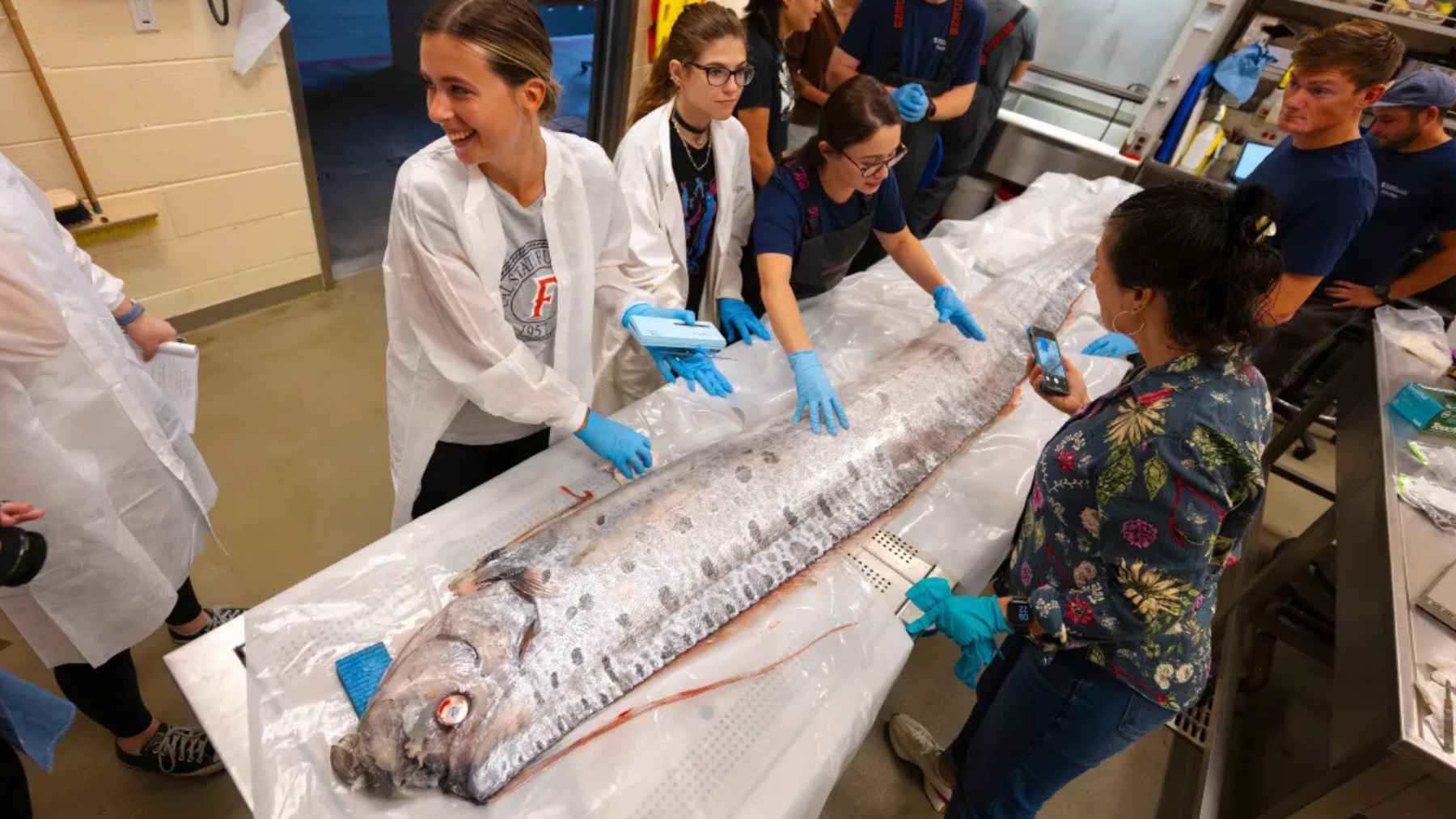
What are people supposed to think when a shining ribbon of silver suddenly wriggles toward a beach? That was the scene on February 9, 2025, at Playa El Quemado in Baja California Sur, where visitor Robert Hayes filmed a live oarfish in shallow water and quickly reignited old fears about the so-called “doomsday fish.”
But the bigger story is less mystical and more biological. The best available research says oarfish sightings do not reliably predict earthquakes, and marine scientists say a fish like this is far more likely to be sick, injured, dying, or disoriented than delivering any warning from the deep.
A rare encounter in Baja California Sur
Hayes told Storyful that “the fish swam straight at us,” lifting its head above the water as people nearby tried to guide it back out. They redirected it three times, but it kept returning to shore, which gave the scene its eerie charge and helped the footage spread fast online.
He later told The Washington Post that the animal appeared distressed and may have had a wound on its face. A fisherman at the scene said he would take it to a marine biologist, which suggests the people on the beach were not looking at a monster, but at a creature that may already have been in trouble.
Why this fish looks like a bad omen
That reaction is easy to understand. Oarfish have long, flat, reflective bodies, vivid red fins, and a shape so strange that the Florida Museum of Natural History says they may have helped inspire sea-serpent legends. No wonder people stare.
They are also enormous by fish standards. The species can reach 36 feet in length, though many observed individuals are much shorter, around 10 feet, and they feed by filtering krill, plankton, and other small crustaceans from the water column.
Most importantly, they live where almost nobody sees them. Oarfish are associated with the mesopelagic zone, roughly 656 to 3,280 feet down, and NOAA describes that part of the ocean as one of the least explored ecosystems on the planet.
The Florida Museum also notes that live encounters are exceptionally rare, with the first filmed example recorded by the U.S. Navy in 2001.
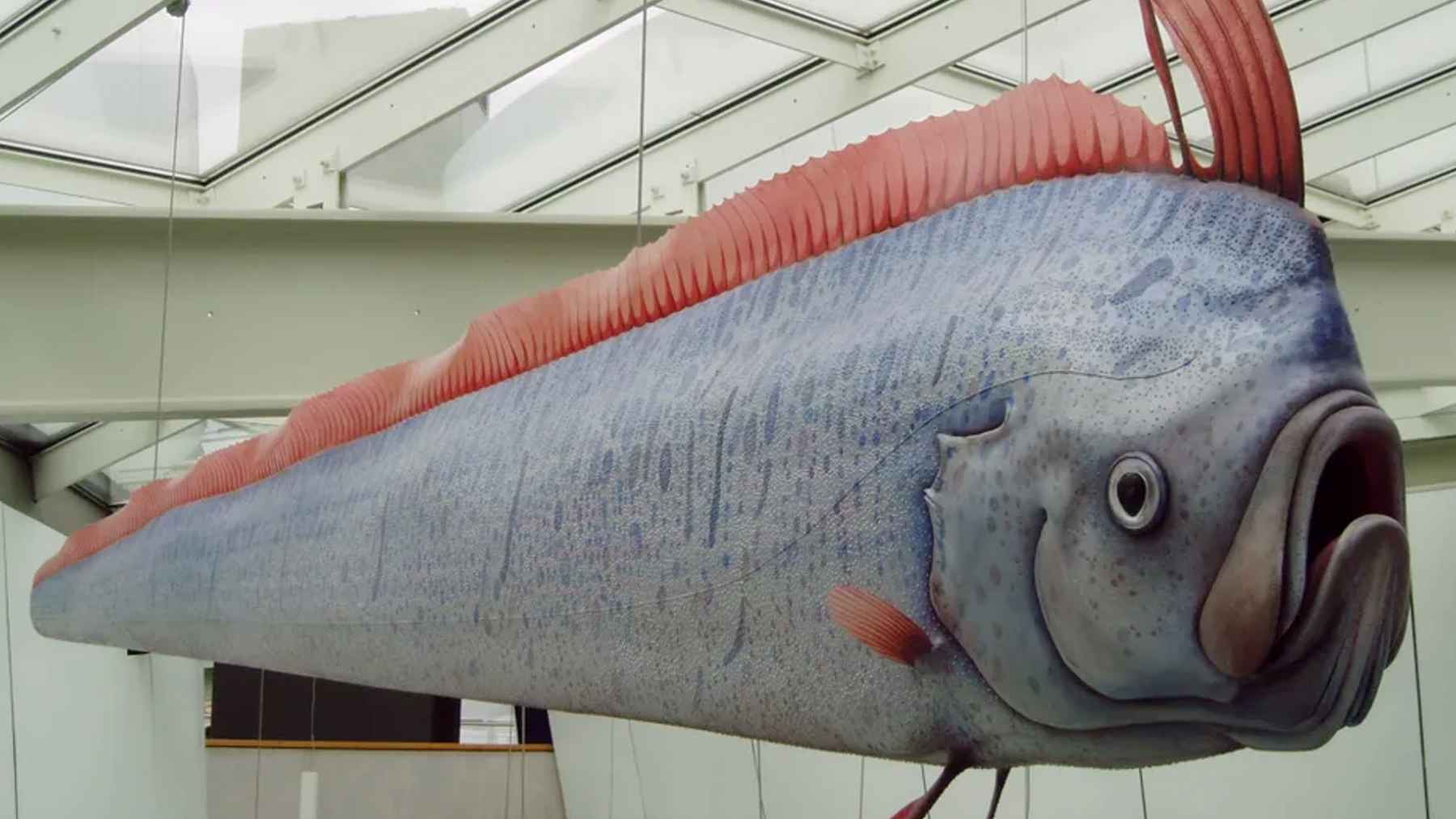
A rare live oarfish appears near the shore in Baja California Sur, drawing attention to one of the ocean’s most elusive deep sea creatures.
What the earthquake myth gets wrong
The “doomsday fish” label comes largely from Japanese folklore, where deep-sea fish appearing near shore have long been treated as possible warnings of earthquakes. That belief gained fresh life after reports of multiple oarfish appearances before the 2011 Tohoku earthquake and tsunami, which made later sightings feel loaded with meaning.
Still, coincidence is not the same thing as evidence. A 2019 study summarized by the Seismological Society of America examined 336 deep-sea fish appearances and 221 earthquakes in Japan from 1928 to 2011, and found only one event that could plausibly match the folklore.
The researchers limited their analysis to earthquakes of magnitude 6.0 or higher and checked whether fish appearances came 10 or 30 days before nearby quakes.
Their conclusion was clear: for the most part, there was no meaningful statistical link. In practical terms, that means one unsettling video is not enough to forecast a disaster.
What the sighting may actually tell us
So why do these animals surface at all? Scientists do not have one neat answer, but the Florida Museum says oarfish are sometimes found near the surface after storms or when injured or dying, and Scripps researchers say illness, injury, and disorientation remain among the most plausible explanations.
There are also local ocean features that can matter. Scripps notes that underwater canyons near La Jolla funnel deep water close to shore, which may help explain why rare deep-sea fish occasionally wash in when something has already gone wrong.
And when a specimen turns up, scientists can learn a lot from it, including its diet, reproductive status, gill structure, contaminants such as microplastics and DDT, and even its genome.
What this Mexico sighting really highlights is how little we still know about life in the deep ocean. There is no solid evidence that an oarfish near a beach predicts an earthquake, and the more grounded takeaway is simpler.
A struggling deep-sea fish at the shoreline is usually bad news for the fish, and a rare chance for science.
The study was published on GeoscienceWorld.