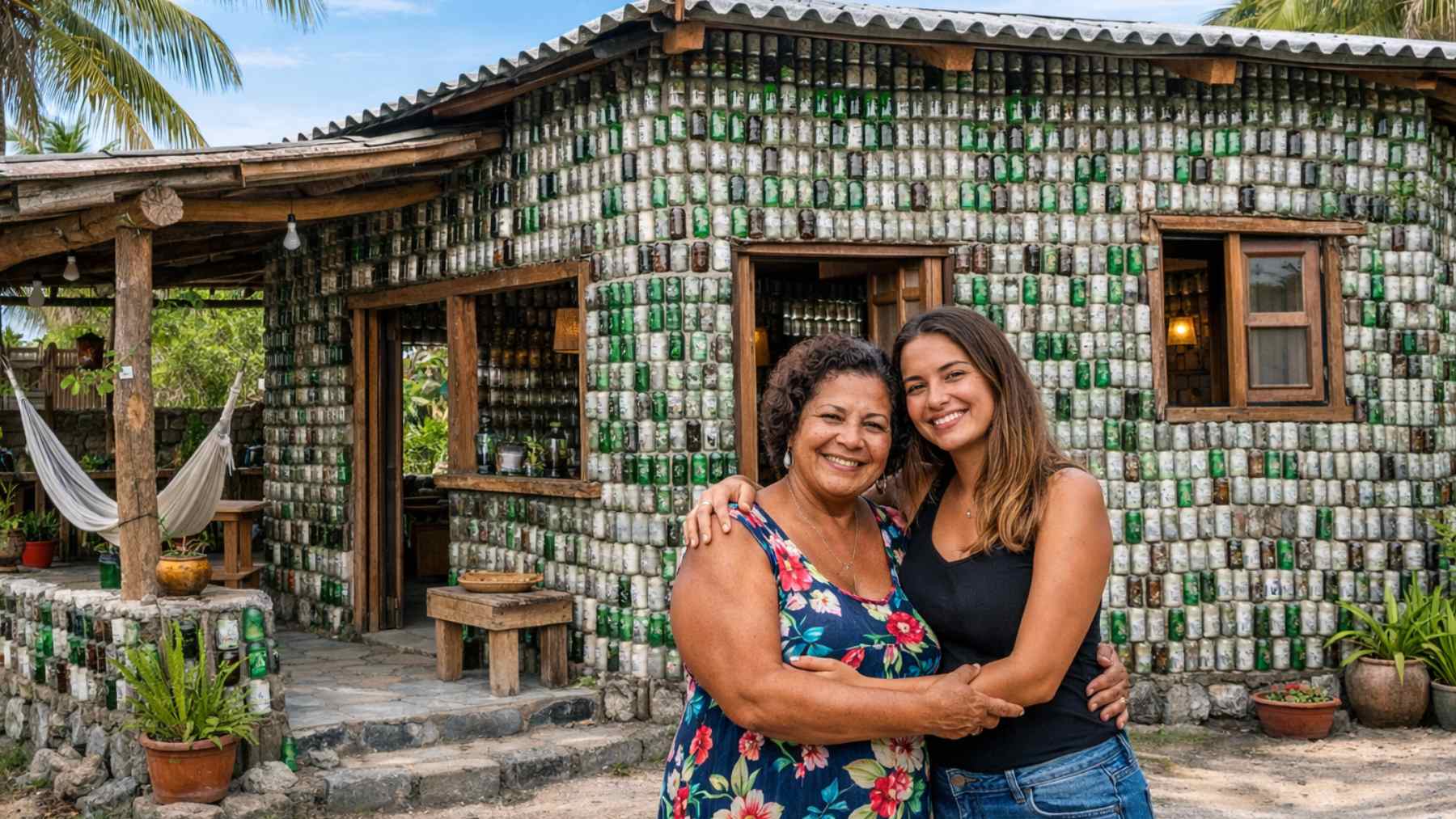
A mother and daughter on Brazil’s island of Itamaracá spent two years collecting about 8,000 discarded glass bottles, then used them to build a seven-room home that now stands as a quiet challenge to waste, housing insecurity, and old expectations about who gets to build.
The project, known as Casa de Sal, began during the COVID-19 pandemic after the pair kept seeing bottles piled up after peak tourist seasons. What do you do when the beach keeps handing you the same problem, again and again?
A home that started with cleanup
The idea came from Edna Dantas, a socio-environmental educator who looked at the bottle-strewn shoreline and decided the waste could become building material. She summed it up simply with a goal that later became the project’s backbone: “I want to build a house with glass bottles.”
Her daughter, Maria Gabrielly Dantas, a sustainable fashion designer, joined her in turning that idea into an actual structure. The result was a house assembled with reused wood and thousands of bottles, with interior dividers made from recycled pallets and even roof tiles fashioned from used toothpaste tubes.
Why Itamaracá’s beaches kept supplying the materials
Itamaracá, in the state of Pernambuco, is widely known for its beaches and rich coastal ecosystems. It also sits within an Environmental Protection Area called the APA Estuarina do Canal de Santa Cruz (CPRH), a protected zone created in 1986 that covers multiple nearby municipalities and is meant to balance conservation with human activity.
In practical terms, that means nature is supposed to come first, but the island still deals with the messy reality of heavy visitation and inadequate waste control. Glass bottles are especially stubborn, and when they are tossed and do not shatter, they can linger in the environment for a long time, season after season.
The DIY engineering behind those glass walls
Reports on the home describe walls built from carefully fitted bottles, plus design choices meant to make the structure livable, not just eye-catching. One detail that stands out is that the bottles were placed upright rather than laid sideways, which helps daylight travel through the glass and brighten the inside.
The build also required patience and improvisation that is hard to romanticize when you are living it. Gabrielly recalled a long stretch without a conventional bathroom and everyday chores done with basic tools, yet she kept returning to the same point: the house “has our signature,” meaning their decisions, labor, and technique are visible in every part of it.
A bigger debate about housing, waste, and who gets taken seriously
Casa de Sal lands in the middle of two national conversations that rarely meet in the same sentence. One is housing and poverty, and the other is what a consumer economy leaves behind in places where tourism booms and trash systems lag.
Brazil’s official statistics office, the Brazilian Institute of Geography and Statistics, reported that between 2023 and 2024 about 8.6 million people moved out of poverty and about 1.9 million moved out of extreme poverty, but it also shows how many people still live on very tight budgets. That gap is why unconventional, low-cost building ideas keep resurfacing, even when they look unusual at first glance.
The story also highlights a quieter barrier: gender. The pair described working in a space often treated as male by default, where outside help sometimes came with unsolicited “corrections,” as if their competence was always up for debate. It is not flashy, but it is real.