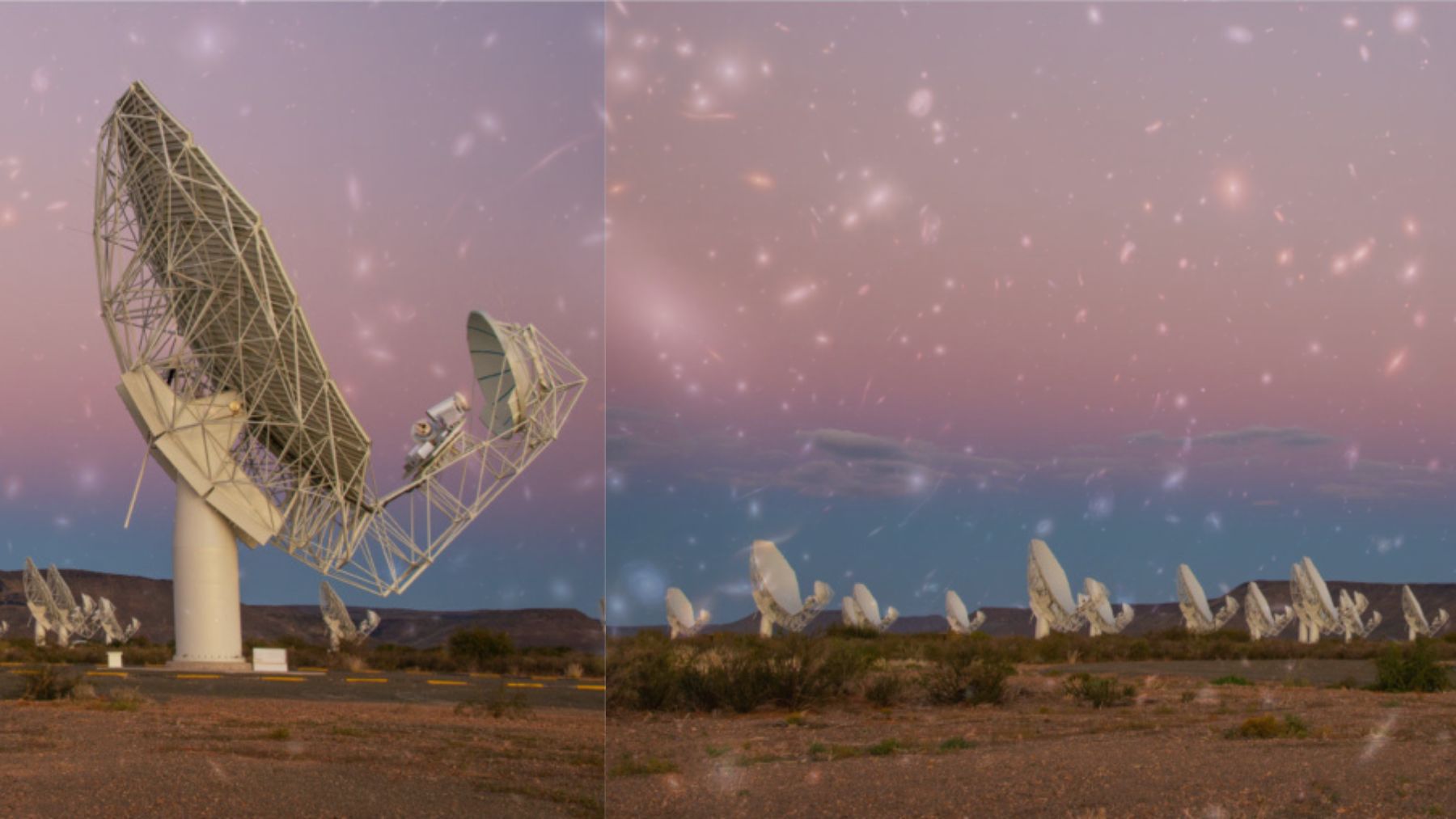
In less than the time it takes to get through a long work afternoon, astronomers have stumbled on 49 previously unknown galaxies rich in star forming gas. Using the MeerKAT radio telescope in the quiet desert of South Africa, a team led by Dr Marcin Glowacki detected the telltale radio glow of hydrogen in dozens of systems during a single 2.3 hour observation.
MeerKAT radio telescope and 49 gas-rich galaxies
The observation was not even planned as a galaxy hunt. Glowacki and colleagues originally pointed MeerKAT at one known radio galaxy, hoping to map its reservoir of hydrogen, the raw material that fuels new stars. Instead, when they combed through the data, patches of gas lit up all across the field, each patch tracing a separate galaxy that had never been cataloged in this way.
In total, the team picked up neutral hydrogen from 49 galaxies. The astronomers nicknamed them the “49ers,” a nod to the miners of the California Gold Rush, because each detection felt like a small nugget of cosmic treasure. Glowacki admitted his own surprise, saying “I did not expect to find almost fifty new galaxies in such a short time.”
Hydrogen gas, radio telescopes and star formation
So what makes these galaxies special, beyond the catchy name? For one thing, they are unusually rich in hydrogen gas. Hydrogen is the most abundant element in the universe and the main ingredient in the giant clouds where stars are born. Radio telescopes like MeerKAT listen for a faint signal from this gas, a whisper at a specific radio wavelength that human eyes cannot see.
Mapping that gas lets astronomers track where future generations of stars may ignite and how galaxies grow over time.
Galaxy groups, interactions and gas stripping
Many of the 49ers sit close together, forming at least three distinct galaxy groups and possibly part of an even larger supergroup. In everyday terms, it is less like finding 49 isolated towns and more like uncovering several tightly knit metropolitan areas. In these crowded regions, gravity pulls galaxies toward each other, distorting their gas and sometimes setting off bursts of star formation.
One set of three galaxies stands out. MeerKAT’s hydrogen maps reveal that their gas envelopes actually connect, like overlapping clouds. Follow up studies at other wavelengths show that the central galaxy is building stars at a rapid pace.
Glowacki and his team report that it is likely siphoning gas from its two neighbors, using their fuel to feed its own stellar boom. Over time, that process could starve the smaller companions and leave them quieter and less active.
To a large extent, this is environmental science on a cosmic scale. Just as Earth’s forests, oceans, and atmosphere exchange energy and material, galaxy groups swap gas and stars within their own vast “ecosystems.” When a big galaxy strips gas from a smaller one, it changes the future of that system, much like diverting a river can reshape life downstream.
MeerKAT surveys, data-intensive astronomy and dark matter halos
The MeerKAT result also shows what a modern radio array can do in a surprisingly short snapshot. The telescope’s 64 dishes work together as a single instrument, offering both sensitivity and sharp vision across a wide field of view. The observation used open time on the facility and analysis support from the Inter University Institute for Data Intensive Astronomy, which specializes in handling the massive data sets produced by instruments like this.
By applying search techniques developed for major surveys such as LADUMA, the team could automatically sift through the data cube and flag even faint hydrogen signals. In six of the brighter systems, they went further and built rotation curves to model how mass is distributed, including the contribution from dark matter halos that surround each galaxy.
Professor Ed Elson of the University of the Western Cape, a co-author on the study, noted that the find “highlights the raw power of the MeerKAT telescope as an imaging instrument.” In practical terms, that means many more hidden, gas rich galaxies are probably sitting inside existing data, waiting for someone to look more closely.
Hidden galaxies and our changing view of the universe
For most of us, city lights and busy evenings mean the night sky is easy to ignore. Yet while we deal with traffic jams and rising electric bills, telescopes in remote landscapes keep quietly scanning the dark, adding new pieces to the story of how the universe assembles its structures.
The 49ers are a reminder that even brief observations can reveal crowded, dynamic regions where galaxies tug on each other and recycle their gas. At the end of the day, discoveries like this do more than redraw star charts. They show that the cosmos remains an active laboratory, one that still has plenty of surprises hidden in the background noise.
The study was published on “Monthly Notices of the Royal Astronomical Society” via Oxford Academic.
Image credit: SARAO – South African Radio Astronomy Observatory /