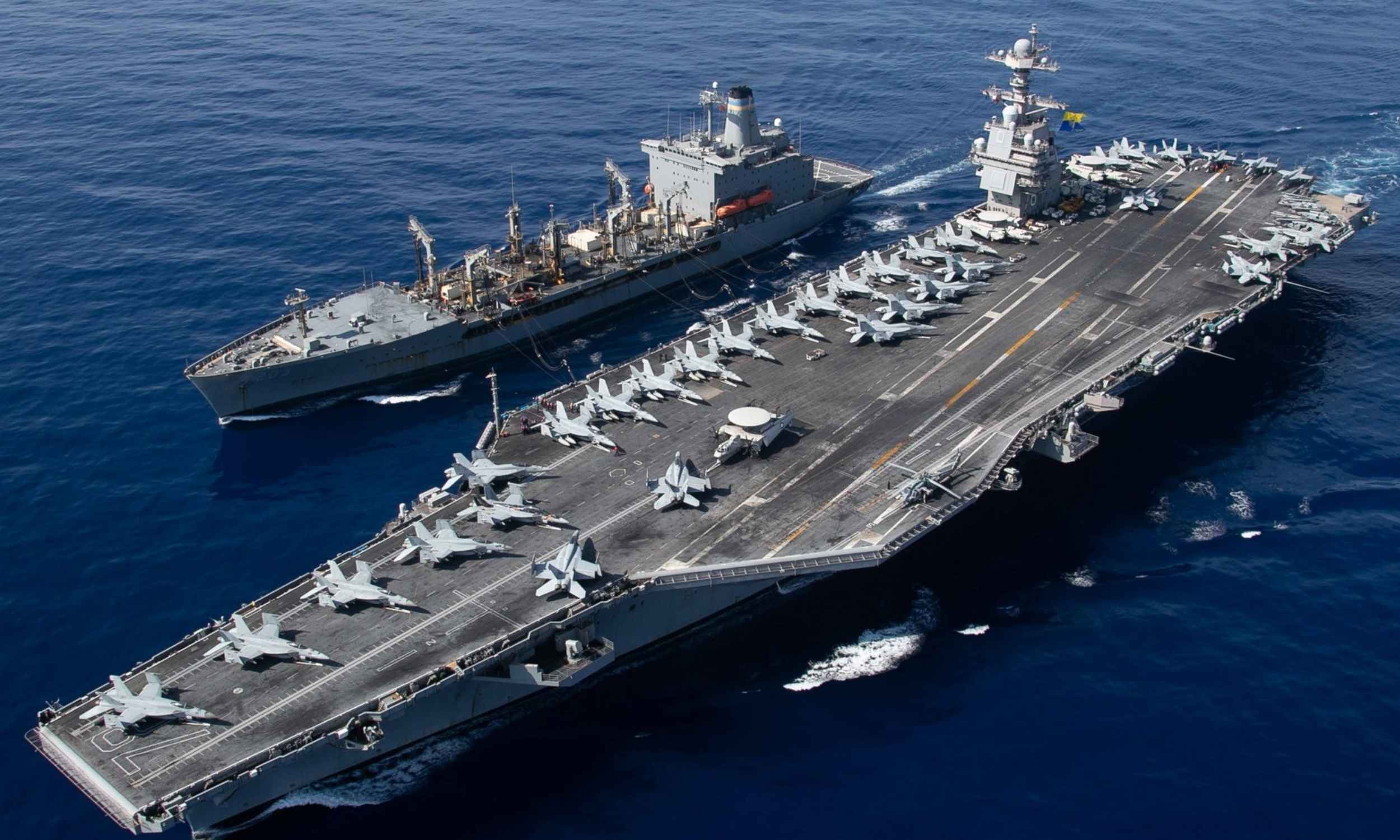
On the most expensive warship ever built, the daily headache is not a missile or a radar screen. It is the toilets.
The nuclear-powered aircraft carrier USS Gerald R. Ford (CVN 78) carries more than four thousand sailors and relies on a high-tech vacuum sewage system that clogs so often the Navy has to clear it with aggressive chemical cleaning that costs about $400,000 per treatment, according to the US Government Accountability Office.
The problem is not new. In a 2020 shipbuilding report, the US Government Accountability Office warned that the new toilet and sewage system installed on the carriers CVN 77 and CVN 78 was experiencing “unexpected and frequent clogging” and would need regular acid flushes for the entire life of the ships. Each flush costs about $400,000 and was classified as unplanned maintenance.
Since then, internal Navy emails obtained by public radio reporters show how serious this has become at sea. Documents cited by NPR describe 205 toilet breakdowns in just four days and note that “a trouble call has been made for the ship’s sewage system every day the full crew is aboard” since mid 2023.
For anyone who has ever dealt with a single blocked toilet at home, it is not hard to imagine what that looks like when it involves hundreds of fixtures and thousands of people in a floating metal city.
A cruise ship solution on a warship
The Ford uses what is known as a Vacuum Collection, Holding and Transfer system, often shortened to VCHT. Instead of relying on gravity, powerful pumps create a vacuum that moves waste through a maze of narrow pipes to treatment tanks. The concept is similar to the loud, sharp flush familiar to anyone who has flown on a commercial airliner.
This approach was borrowed in part from the cruise ship industry and has a clear advantage. It uses far less water than older gravity systems, an attractive feature on any vessel where fresh water must be carefully managed. In theory, that should be good news for sustainability. Less water pumped around the ship, less energy consumed, fewer resources wasted.
In practice, the combination of narrow pipes, long runs and heavy use by more than 4,600 people has created a brittle system. When one valve fails or a small leak appears, an entire “zone” of toilets can lose suction at once.
The Ford’s sewage network is broken into around ten such zones serving more than six hundred toilets. If a problem hits during peak times, sailors can find themselves queuing along passageways instead of focusing on their jobs.
When high-tech plumbing meets real life waste
On paper, engineers expected clogs to come mainly from “improper materials” flushed into the system. And yes, maintenance teams have pulled out T shirts, mop heads and even long pieces of rope. Anyone who has seen a public restroom after a busy concert knows people do not always treat toilets gently.
But oversight bodies and reporters have identified deeper design issues. The GAO concluded that the pipes on these carriers were undersized for the crew they were meant to serve. Navy officials told local station WHRO Public Media that the acid cleaning is used in port to remove calcium buildup inside the lines, a byproduct of the way the system operates.
For the crew, this is not just a technical detail. Photos shared with WHRO by the mother of a sailor showed toilets backed up and waste on the floor during the ship’s 2025 deployment. She described the situation as “hazardous” and questioned how sailors could be asked to live in those conditions.
In everyday terms, imagine having to mop a bathroom where the contents of the bowl have climbed out on their own, then trying to get ready for another twelve hour shift.
The hidden environmental cost
From an environmental perspective, the story is not only about clogged pipes and stressed crews. It is also about what happens when basic systems are so fragile that they require frequent, resource intensive interventions.
Each acid flush means hundreds of thousands of dollars spent on specialized chemicals and dockside work to dissolve deposits throughout the network. Because of safety and environmental considerations, this treatment can only be done in port, so the carrier must rely on stopgap measures such as power washing pipes while at sea to manage sludge and mineral buildup.
Marine industry analysts have pointed out that these aircraft-style toilets undermine long-term sustainability. Instead of a robust gravity system that works with physics, the Navy is locked into a complex, maintenance heavy design that consumes chemicals, labor hours and budget for decades.
Every time those strong cleaners circulate through the system, they have to be contained, neutralized and handled carefully so they do not end up where sailors or marine life will pay the price later.
At the same time, repeated overflows inside the ship carry their own health and environmental risks.
Unsanitary working and sleeping spaces can increase disease risk for the crew and complicate the safe handling of wastewater before it reaches treatment units. On a nuclear-powered vessel meant to stay at sea for long stretches without refueling, that kind of fragility is more than an inconvenience. It chips away at resilience.
Lessons for greener engineering at sea
For ecologists and sustainability experts, the Ford’s toilet saga reads like a case study in how not to roll out “efficient” technology. A system that saves water on paper but needs constant chemical cleaning and emergency repairs does not look very green once all the inputs are counted.
The experience of the earlier carrier USS George H. W. Bush (CVN 77) should have been a warning. In 2011, all 423 of its toilets failed at once on at least two occasions, and crews reportedly spent around ten thousand work hours in a single year fighting the waste system.
Those numbers hint at how much hidden energy, time and money can be sunk into “invisible” infrastructure when design choices are not fully tested under realistic conditions.
There is a broader lesson here for any large-scale project that aims to be efficient or climate friendly, from new ferries to offshore platforms. Cutting water use or crew size is only truly sustainable if the technology can cope with everyday misuse, peak loads and long deployment cycles without constant heroic effort from maintenance teams.
Otherwise the system simply shifts the burden to different parts of the budget and to the environment.
On the Ford, Navy leaders say reliability is improving and that upgrades to the VCHT network are planned, but even they acknowledge that a full redesign will be costly and will take years. Until then, thousands of sailors will keep living with the consequences of a plumbing experiment that tried to outsmart gravity.
The report that first flagged these costly sewage problems in detail was the 2020 Navy shipbuilding study, and that study was published by the Government Accountability Office.