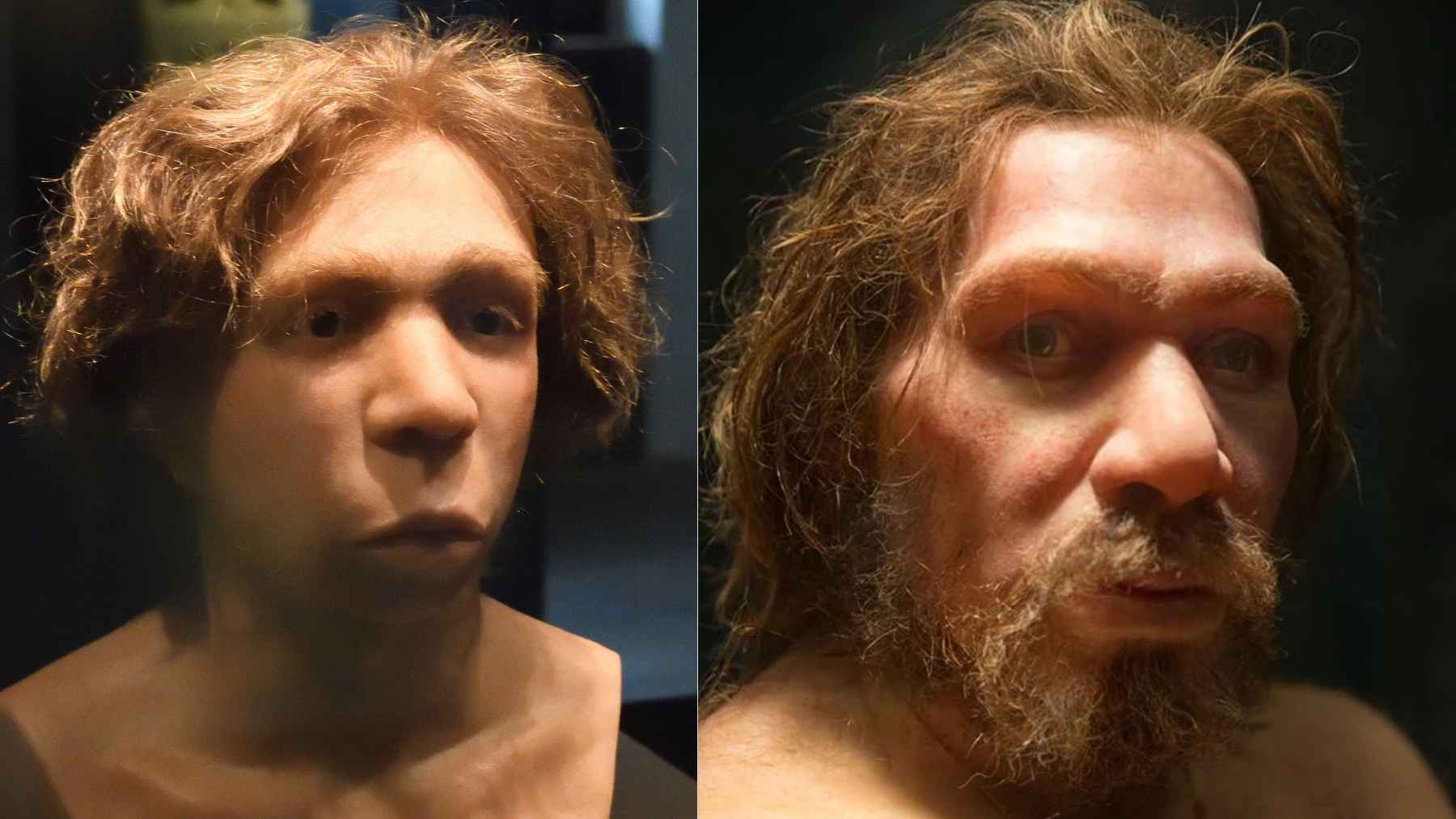
If you have ever opened a DNA ancestry report and spotted a tiny slice labeled “Neanderthal,” here is a twist you probably did not see. That inheritance is spread unevenly across your genome, and the X chromosome often looks strangely empty.
In a peer-reviewed paper published February 26, 2026, in Science, researchers report a 62% relative excess of modern human ancestry on Neanderthal X chromosomes compared with other Neanderthal chromosomes.
Their conclusion is that ancient interbreeding was strongly sex biased, mostly between male Neanderthals and female anatomically modern humans, although later selection and demographic factors may have shaped what survived.
Why the X chromosome keeps the receipts
Most people with non-African ancestry carry small amounts of Neanderthal DNA, often in the low single-digit percent range, sprinkled across many chromosomes. But researchers have long noticed “Neanderthal deserts,” stretches where Neanderthal ancestry is unusually rare, and the X chromosome is one of the most extreme examples.
That matters because the X chromosome is inherited differently by males and females. Females have two X chromosomes, one from each parent, while males have one X from their mother and a Y from their father, so the direction of ancient pairings can leave a measurable imbalance.
For years, one popular idea was that Neanderthal DNA on the X caused fertility or health problems in hybrids, so selection steadily removed it. The new study does not dismiss selection entirely, but it argues that a simpler social pattern can do much of the explanatory work.
What the new genomes comparison actually found
The researchers compared DNA from three Neanderthals, often referred to as Altai, Chagyrskaya, and Vindija, against genomes from African populations used as a reference because their ancestors did not mix with Neanderthals.
Then they asked a mirror question, not only where Neanderthal ancestry is missing in humans, but where modern human ancestry shows up inside Neanderthal genomes.
The standout result was on the X chromosome. The analysis found a 62% relative excess of modern human ancestry on Neanderthal X chromosomes compared with Neanderthal autosomes, while modern humans show the opposite pattern, with Neanderthal ancestry strongly depleted on the human X.
Daniel Harris, a co-first author, called it “a striking imbalance.” If incompatibility alone were the main driver, you would expect both groups to show similar foreign DNA shortages in the same places, but the Neanderthal X held plenty of modern human sequence.
Mate preference looks simpler than complicated migration stories
So how do you get that mirror-image pattern? The logic is straightforward once you remember basic inheritance.
If pairings were more often between Neanderthal males and modern human females, fewer Neanderthal X chromosomes would make it into the long-term human gene pool, while human X chromosomes could flow into Neanderthal groups more easily.
The authors tested this idea with analytic and numerical models and found that sex-biased mating could reproduce the observed distribution with fewer moving parts than scenarios that depend on shifting, sex-specific migration across time and geography. Alexander Platt put it plainly, saying “mating preferences provided the simplest explanation.”
There is a crucial nuance, though. The study notes that demographic sex biases could still play a role, and subsequent negative selection likely further reduced Neanderthal variants in functional X-linked regions, so this is not a story of culture replacing evolution, but rather both operating together.
A window into life on shifting ancient landscapes
It is tempting to read the findings like an ancient romance plot, but genetics cannot tell us motives. Researchers have said they cannot determine whether these encounters reflected peaceful partner choice, coercion, or something in between, and that is an important guardrail for anyone trying to turn DNA into narrative.
Still, the work is a reminder that evolution is not only about who survives winter, finds food, or avoids disease. After the two lineages split roughly 600,000 years ago, later migrations brought humans into Eurasian regions where Neanderthals had long lived and adapted. It is also about who forms families, who moves between groups, and how small communities connect.
Outside experts have urged restraint in interpretation. Commentators gathered by Science Media Centre Spain stressed that these are demographic inferences based on population models, not direct observations of social behavior, and they highlighted alternative possibilities like group structure or imbalances in who was available to mate.
What this changes for the story of our own species
In practical terms, the study shifts attention from a purely genetic “cleanup” explanation toward the idea that repeated mating direction can shape the genome for millennia. That matters for how scientists interpret why certain regions, like the human X, ended up with so little Neanderthal ancestry even though Neanderthal DNA persists elsewhere.
It also offers a more everyday takeaway for anyone who has ever scrolled through an ancestry app on their phone. When someone casually says “I have 2% Neanderthal,” it helps to picture that number not as a uniform coating, but as a patchwork with real gaps that may reflect ancient social dynamics as much as biological compatibility.
The study was published in Science.