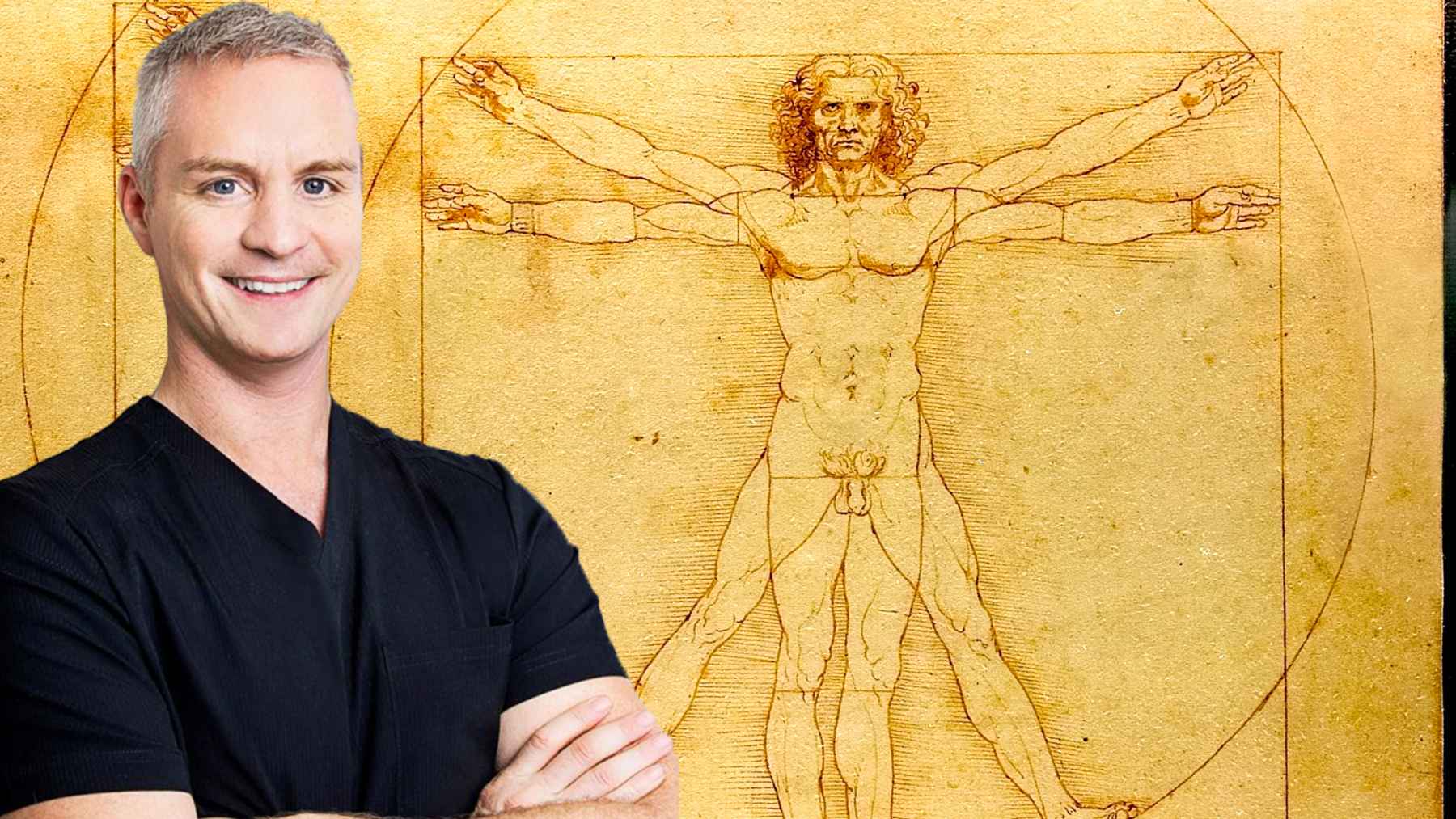
For more than 500 years, Leonardo da Vinci’s Vitruvian Man has been treated like a visual riddle. How did he make one body fit cleanly inside both a circle and a square, and why do the proportions feel so exact even when the math is hard to pin down? A 2025 analysis says the answer may have been sitting in plain sight all along.
London dentist Rory Mac Sweeney argues that a small equilateral triangle, described in Leonardo’s own notes as appearing between the figure’s legs, helps explain the drawing’s geometry.
His measurements point to a ratio of about 1.64 to 1.65, close to a “tetrahedral ratio” of 1.633 that shows up in efficient packing and balanced structures found in nature. If that sounds abstract, think of it as a reminder that the shapes that help bodies work can also help us design lower-waste, lower-carbon technology.
A triangle hiding in plain sight
Mac Sweeney’s key move is to take Leonardo’s instruction literally. Leonardo wrote that if you open the legs and raise the arms, the space between the legs becomes an equilateral triangle. Mac Sweeney says that triangle helps unlock the long-debated relationship between the circle and the square in the image.
When he ran the numbers, he found a proportion in the drawing around 1.64 to 1.65. ScienceAlert reports that this is close to 1.633, the tetrahedral ratio, a relationship it says was formally described in 1917 and can be illustrated by packing four spheres as tightly as possible into a pyramid-like arrangement.
That matters because it links the drawing to a geometry associated with stability and efficient organization.
Still, this is not a final verdict from the art world, and it will rise or fall on whether others can reproduce the measurements. The intriguing part is that the “hint” is not new at all, because Leonardo wrote it down. Now the debate shifts to the math.
Why the circle and square matter
The Vitruvian Man draws on ideas attributed to the Roman architect Vitruvius, who described an ideal human form that can be inscribed in both a circle and a square.
Leonardo created his version around 1490, and he shows two positions at once, with the square holding a pose where the legs are together and the arms are straight out, while the circle surrounds the pose with legs apart and arms raised.
Many popular explanations lean on the golden ratio, but the reported measurements do not line up neatly enough to close the case. That is why this triangle claim is getting attention. It offers a specific geometric step, not a vibe or a myth, and it is something anyone can test on a high-resolution copy of the drawing.
From jaws to geometry
Here is where Mac Sweeney’s day job matters. The paper points to Bonwill’s triangle, an equilateral triangle used in dental anatomy to describe an optimal arrangement for jaw function, and notes it has been used since 1864. Seeing a similar triangle in Leonardo’s sketch is the kind of pattern a dentist might spot quickly.
Mac Sweeney suggests the match is not coincidence, and that the same tetrahedral geometry may underlie parts of human craniofacial structure. That is a bold leap, and experts may disagree on how far it can be taken, but it frames the Vitruvian Man as anatomy plus mechanics rather than pure symbolism.
Nature’s efficiency playbook
The broader claim is that biology often “organizes” around efficient shapes, because living things have to handle stress with limited material.
ScienceAlert notes that Mac Sweeney connects the ratio to patterns seen in minerals, crystals, and other biological packing systems, and argues that tetrahedral geometries can maximize mechanical efficiency.
If you have ever noticed how a honeycomb packs space without wasted gaps, you have already met the basic idea. The caution is that nature also compromises, so repeating a ratio does not automatically mean there is one universal blueprint. But as a starting point for asking better questions, geometry can be surprisingly useful.
What it could mean for low-carbon design
Triangles and tetrahedrons are not just pretty. Engineers lean on them because they tend to be stiff and strong for their weight, which can reduce the amount of material needed to carry a load. In practical terms, that can mean less cement, less steel, and fewer emissions tied up in the stuff we build.
Buildings and construction remain a major climate driver, consuming about 32% of global energy and contributing about 34% of global CO2 emissions, according to a recent UN Environment Programme report.
The same report warns that materials like cement and steel account for about 18% of global emissions, so shaving material waste can matter. When your electric bill spikes during a hot summer week, you are feeling how building choices ripple into everyday life.
What comes next is simple and messy, like most science. Other researchers will test the geometry, art historians will weigh the interpretation, and designers will keep hunting for ways to copy nature’s “do more with less” logic without overselling it.
The study was published in Journal of Mathematics and the Arts.