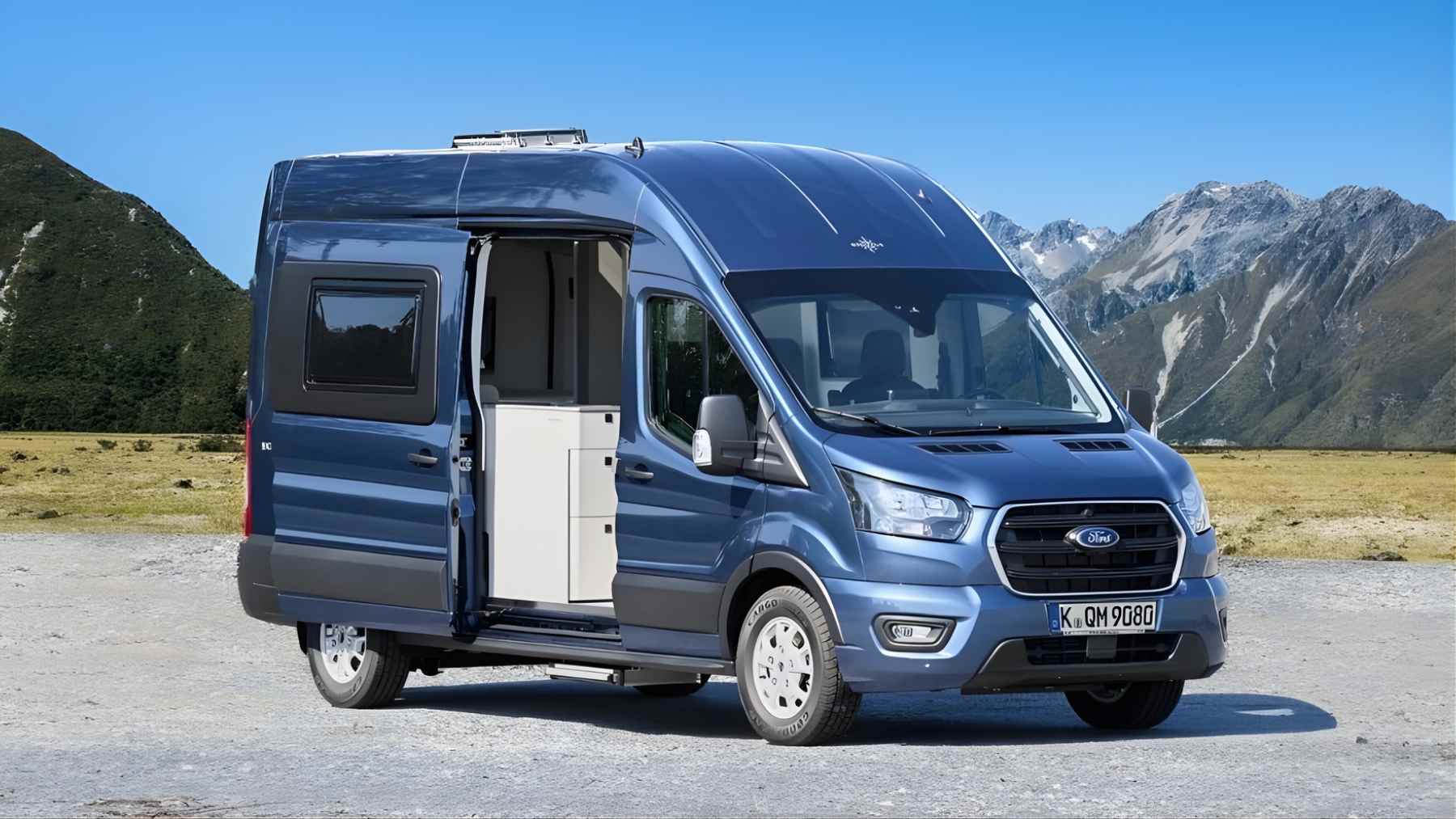
The Ford Nugget is getting a birthday present that will catch plenty of eyes at campgrounds this year. To mark four decades on the road, Ford Pro and Westfalia have created a limited “40 Years of Nugget” edition that revives the original black and white look from 1986, complete with pop-up roof and compact home on wheels.
Underneath the nostalgia, though, sits a familiar diesel engine, which puts this cult camper right in the middle of today’s debate over how to travel without burning through the planet’s remaining carbon budget.
A birthday party for a cult camper
The first Nugget rolled out in 1986 on a Ford Transit base, converted by Westfalia, and quickly became a European vanlife icon. That partnership is still alive today and it is Westfalia again that helps Ford Pro deliver the anniversary model for CMT 2026 in Stuttgart, one of the world’s largest tourism and camping shows.
Visually, the special edition leans heavily on the original. The body wears “Frozen White” paint with contrasting black roof, dark shoulder line and slim, black pinstripes along the flanks. The fabric of the pop-up roof follows the same theme. Inside, warm, white furniture is paired with dark countertops and black handles, plus small anniversary badges that quietly remind owners they are not in a standard Nugget.
The van uses the long wheelbase L2 layout and Active trim. Power comes from Ford’s two liter EcoBlue diesel with 170 horsepower and automatic transmission. The longer body adds significant storage volume in the kitchen and wardrobe compared with the shorter Nugget, and buyers can choose between extra cabinets or a permanently integrated rear toilet.
Pricing in Germany starts around 89,650 euros, the same level as an equivalent standard Nugget Active L2, which means the retro look and anniversary pack come without a surcharge according to Ford.
Compact home on wheels
Step inside and the Nugget’s three-room concept feels surprisingly close to a tiny apartment. The rear holds an L-shaped kitchen that stays out of the main traffic flow, which makes cooking less stressful when everyone is coming in and out with sandy shoes and wet jackets.
In front, the three-seat bench, two swivel cab seats and removable table create a living and dining space that converts into a double bed at night. Up in the pop-up roof, another double bed turns the van into a comfortable base for a couple or small family.
Panel vans like this often have a smaller material footprint than large motorhomes, simply because there is less bodywork, insulation and furniture to build. You still get a fridge, hob, sink, hot water and real beds, just in a footprint that can squeeze into a supermarket parking space or a narrow village street. For many travelers, that is the sweet spot between comfort and practicality.
Where nostalgia meets the climate math
Here is the tension. Europe has committed to deep cuts in greenhouse gas emissions and transport is one of the hardest sectors to clean up. Transport is responsible for roughly a quarter of total EU greenhouse gas output, and most of that comes from road vehicles such as cars and vans.
Studies of motorhome use suggest that a typical vehicle traveling around ten thousand kilometers per year can be responsible for roughly four tons of carbon dioxide equivalent, once both manufacturing and driving are counted. Panel van conversions tend to sit at the lower end of that range, yet they are still far from climate neutral.
At the same time, research on life cycle emissions shows that battery electric vehicles sold in Europe already produce around 70% less greenhouse gas emissions over their lifetime than comparable gasoline cars and that plug-in hybrids only deliver modest reductions. Climate analysts increasingly argue that fully-electric drivetrains are the only way to align road transport with Europe’s long-term climate goals.
Set against that backdrop, the Nugget anniversary model stays firmly in the diesel era. Ford’s stand at CMT also includes a Nugget Active with plug-in hybrid drive, which hints at a more efficient future, but the headline retro van itself relies on a conventional combustion engine.
Making vanlife a little greener
For many campers, the choice is not between a perfect zero-emission holiday and a diesel van. It is between driving to the mountains or flying across an ocean. In that real world context, a well-used camper van carrying several people can compare reasonably with other forms of leisure travel, especially when it replaces multiple short-haul flights and hotel stays.
Some analyses suggest that road trips by camper can beat flying on a per-person basis once distance and accommodation are counted, although results depend a lot on how far you drive and how full the vehicle is.
There are also everyday choices that reduce the footprint of any camper, Nugget included. Keeping speeds moderate, planning routes to avoid unnecessary detours and combining trips all lower fuel use. Packing the van with people rather than excess gear spreads emissions across more travelers.
Choosing campgrounds that use renewable electricity or limiting on-board heating and air conditioning can shave off more carbon, and sometimes a train plus rental bike will still be the better option for a quick weekend away.
In the end, the “40 Years of Nugget” edition tells two stories at once. It is a carefully crafted tribute to four decades of van-based freedom, with a smart retro design that will turn heads in any campsite. It is also a reminder that beloved travel habits are being asked to adapt to a fast-tightening climate budget.
The press release was published by Ford Media Center.