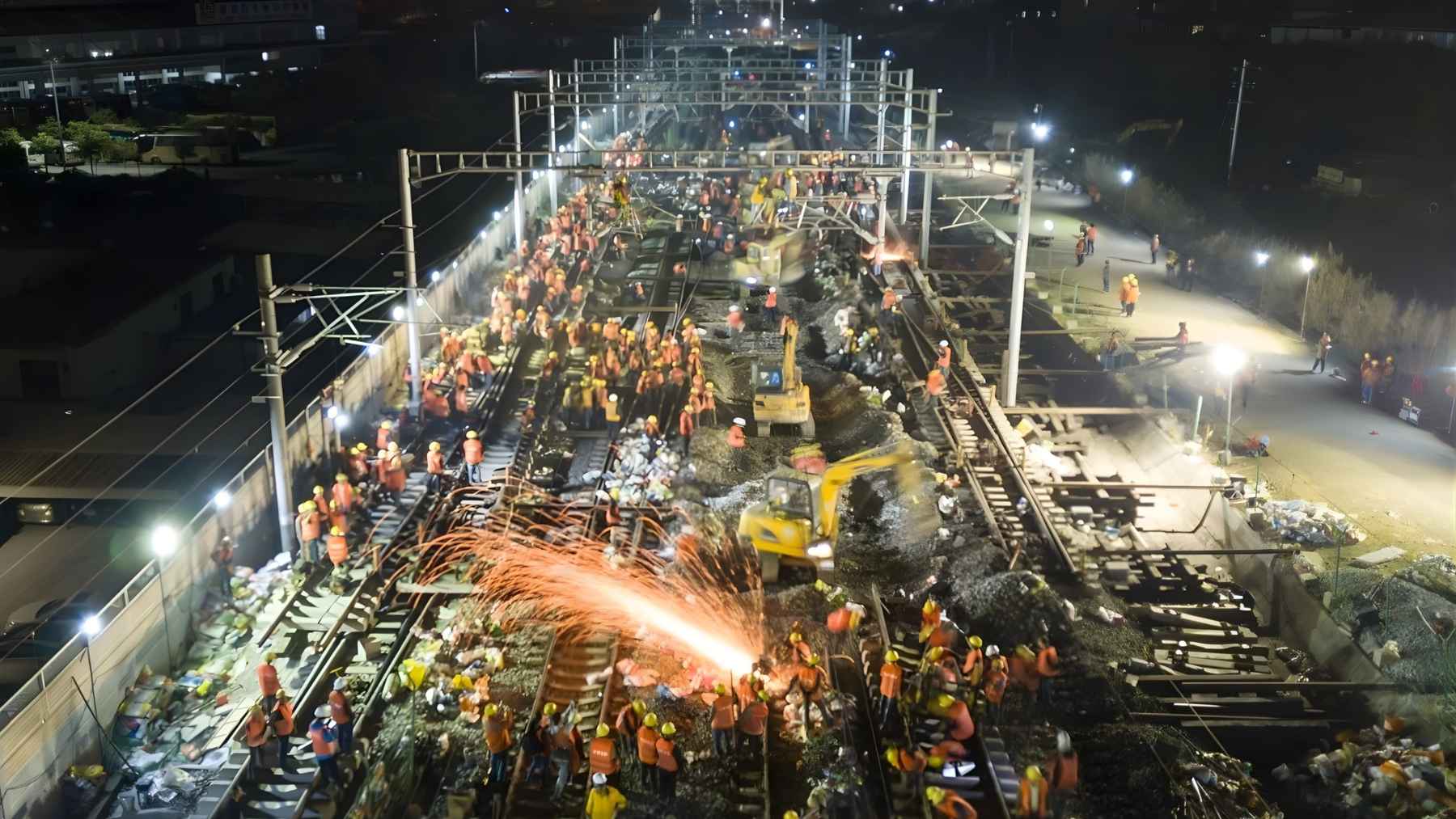
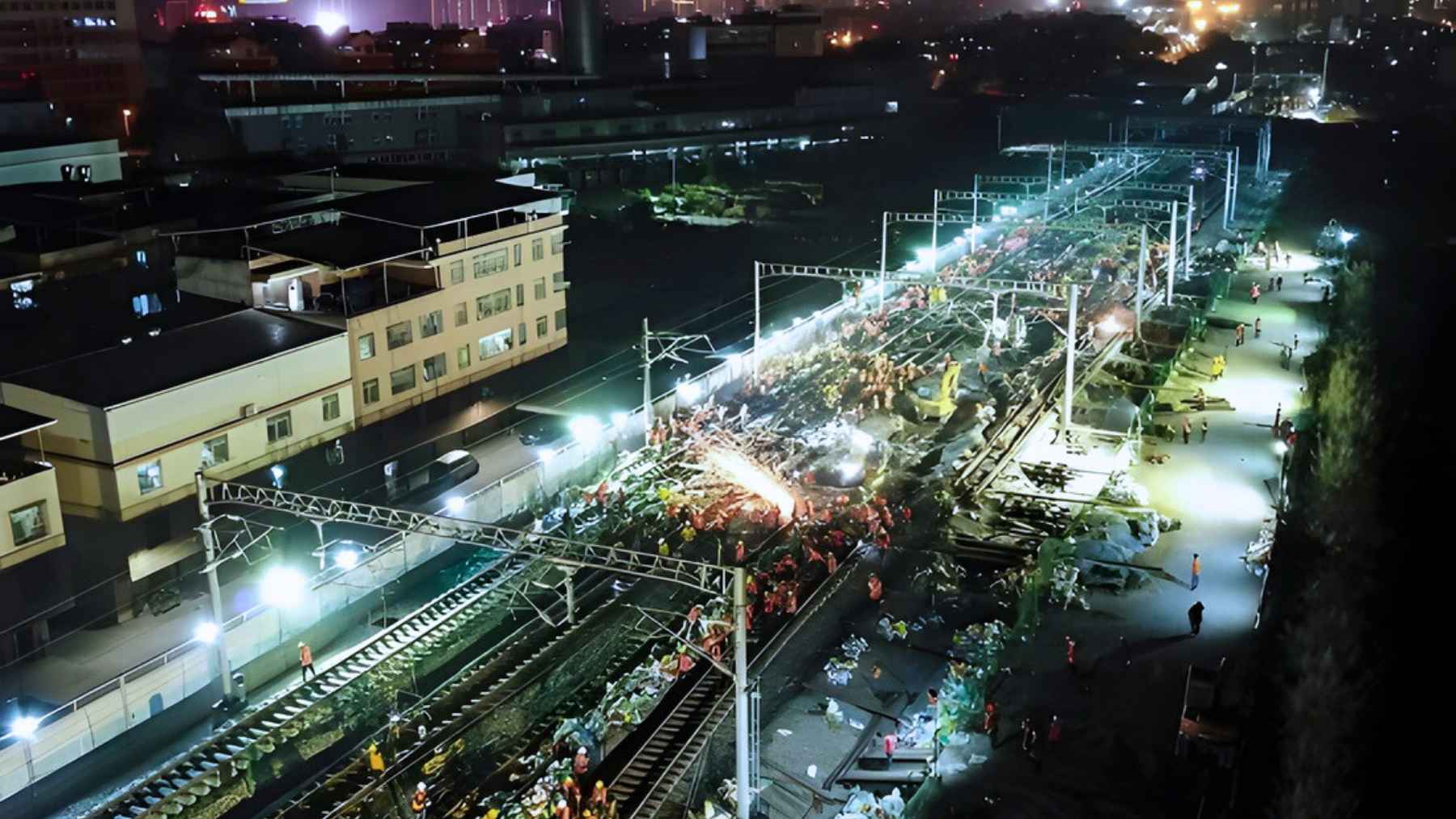
In one carefully choreographed night in southeastern China, more than 1,500 railway workers turned a seven-hour ride into a ninety-minute trip. At Longyan station in Fujian Province, crews cut and reconnected tracks so high-speed trains could run on the new Nanping Longyan line, designed for speeds of 200 kilometers per hour.
The on-site work wrapped up in about eight and a half hours, yet it permanently reshaped how people move across this mountainous region.
The overnight operation, filmed in viral time lapse clips and often described as an example of “China speed,” did not build a station from scratch. Official reports explain that workers upgraded an existing passenger station and tied it into a newly built 246 kilometer railway linking Longyan with the city of Nanping.
Seven work trains, 23 excavators and seven specialized crews worked in parallel, following months of simulations and planning so regular services paused for only a single night.
Although the construction itself took place in January 2018, the story has resurfaced as new high-speed lines open and the country doubles down on rail as a backbone of low-carbon mobility.
By the end of 2025, the national network had reached about 165,000 kilometers in total, including more than 50,000 kilometers of high speed track. Current plans aim for roughly 180,000 kilometers of rail and 60,000 kilometers of high speed lines by 2030.
High-speed rail as a climate tool
Why does a regional rail junction matter for the environment you might wonder. Because transport is one of the hardest sectors to clean up. Global assessments from the United States Environmental Protection Agency and researchers at Our World in Data show that transport is responsible for around 15 to 16 percent of worldwide greenhouse gas emissions, with most of that coming from burning fuel in road vehicles.
Rail sits in a very different place on that emissions chart. The International Energy Agency estimates that trains carry about 7% of global passenger travel and 6% of freight, yet account for only about 1% of transport-related emissions. Electric rail moves many people or tons of cargo using comparatively little energy, especially when the power grid shifts toward renewables.
Look at individual trips and the gap becomes easier to picture. Analysis of European routes suggests that a typical national rail journey releases about 35 grams of carbon dioxide per passenger kilometer.
A petrol car for the same distance averages around 170 grams, while a domestic flight emits roughly 246 grams. In practical terms, choosing the train can cut the climate impact of a trip to about one fifth of the same journey by car and to well under one sixth of the emissions from flying.
So a corridor like Nanping to Longyan that shrinks travel time from seven hours to one and a half is more than a convenience upgrade. For many travelers it suddenly becomes realistic to skip a slow overnight bus, a long highway drive or a short-haul flight and instead sit on a ninety-minute train that leaves from the city center and avoids security lines, toll booths and traffic jams.
Speed, concrete and the hidden footprint
None of this makes high-speed rail impact free. Building long viaducts, tunnels and large stations requires a lot of steel and cement, both materials with heavy carbon footprints. A life cycle study for several high-speed lines in France, Taiwan and China found that construction emissions ranged from roughly 58 to 176 tons of carbon dioxide per kilometer of track per year when spread over the lifetime of the projects.
That is not trivial, especially if trains run half empty or if lines are duplicated where other good options already exist.
The balance shifts in favor of the climate only when the lines are used intensively and powered by cleaner electricity. China’s rail operator has set targets for a network that is close to four fifths electrified by 2030, and provinces like Fujian are investing heavily in low-carbon infrastructure. Official profiles describe Longyan as a pilot area for “ecological civilization” with extensive forest cover and efforts to align economic growth with environmental goals.
If passengers choose rail over cars and planes in large numbers, those upfront construction emissions can be paid back over years of low carbon service. Each full train that replaces hundreds of car journeys or several short flights nudges the overall equation toward net savings for the climate.
Why “short window” projects matter
The Longyan upgrade is also an example of what planners call a “short window” operation. The city has around 2.7 million residents, many of whom depend on the train for daily trips to work, school or nearby towns.
Shutting the station for several days would likely have pushed thousands of people into cars and buses, clogging local roads and raising noise, smog and emissions in the short term. Months of staging work allowed seven task zones to operate at once so the new section could open after a single night, keeping most riders on rail rather than onto the highway.
There are still open questions about this style of construction, from worker safety during overnight shifts to the ecological footprint of repeated rapid build projects across such a vast network. Yet if decarbonizing transport means building out rail systems quickly, the nine-hour “miracle” in Longyan suggests that speed itself is not the main obstacle. Financing, planning and political commitment are.
For commuters tired of endless traffic and for a planet strained by rising transport emissions, that is the quiet lesson behind the viral video. What looked at first like a jaw dropping construction stunt is also a glimpse of how fast cleaner mobility can arrive when a country chooses to back it at scale.
The official statement was published on Xinhua.