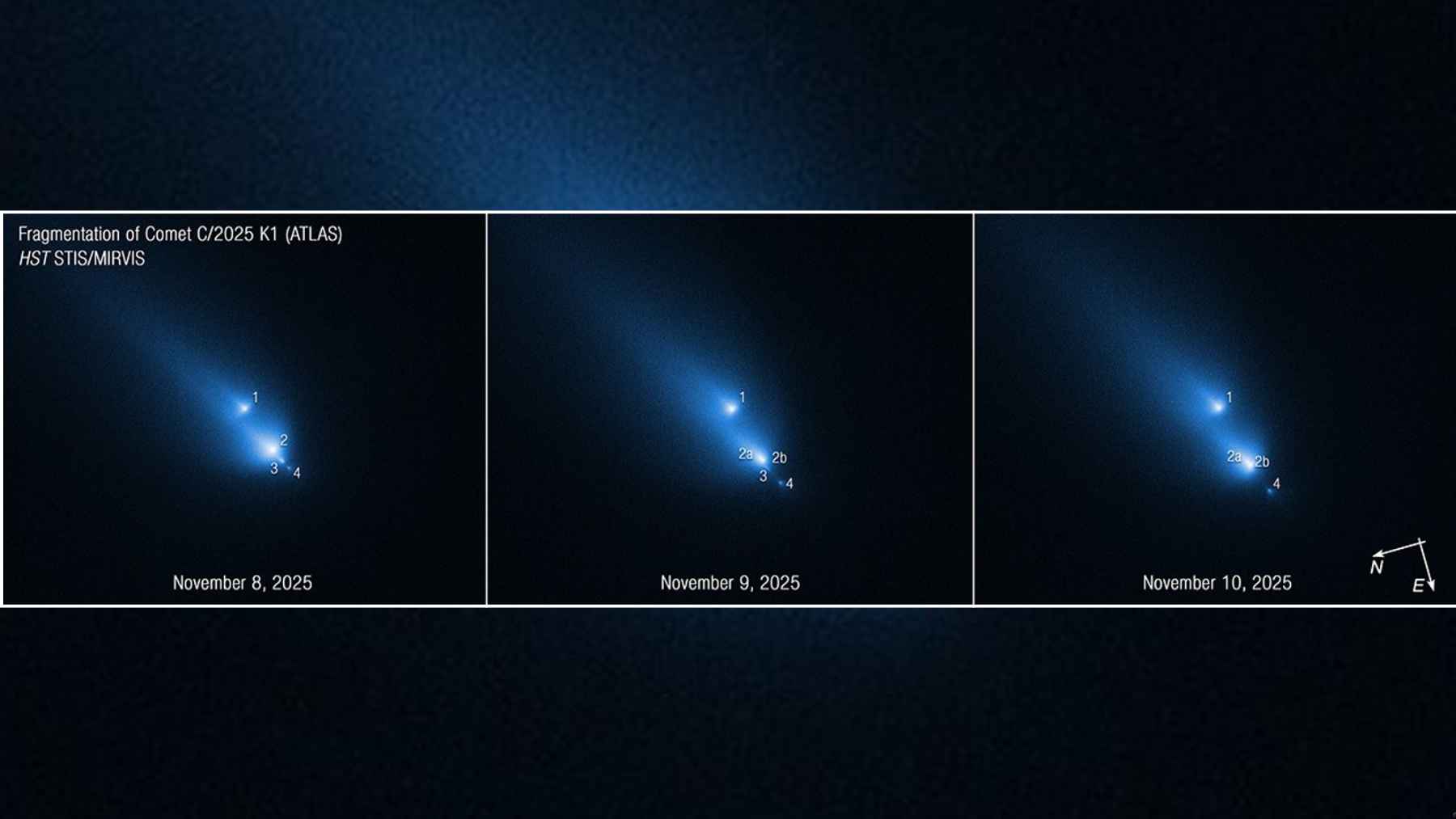
The Hubble Space Telescope, a joint mission between NASA and ESA, unexpectedly caught Comet C/2025 K1 (ATLAS) breaking apart in November 2025. Over three days of images, the comet split into multiple fragments, including at least four main pieces, and the team reported the chance find in March 2026, noting it is not the interstellar comet 3I/ATLAS.
Comets are icy leftovers from early solar system history, so a breakup can expose interior material that has stayed hidden from sunlight. K1’s breakup also came with a delayed brightening seen from Earth, and researchers are still trying to explain what that says about a comet’s dusty surface.
A last-minute target swap
The comet was not the original target for the observing run, and the team switched after technical limits made another comet hard to study. Co-investigator John Noonan, a research professor at Auburn University, captured the mood by saying, “Sometimes the best science happens by accident.”
Noonan only realized something unusual had happened after he reviewed the images the next day. He recalled seeing “four comets in those images when we only proposed to look at one,” which meant the target was already fragmenting.
Principal investigator Dennis Bodewits emphasized how unlikely the timing was, saying, “The irony is now we’re just studying a regular comet and it crumbles in front of our eyes.” Catching a breakup on purpose is difficult, because these events are unpredictable and space telescope schedules are planned far in advance.
What Hubble actually saw
Hubble’s frames show separate fragments, each wrapped in its own coma, the fuzzy cloud of gas and dust around a comet’s icy center. That cloud is what makes comets look bright and “smoky” in photos, even when the nucleus itself is small.
The telescope captured three 20-second exposures on November 8, 9, and 10, 2025, and the sequence shows the disintegration happening fast. In the middle image, the brightest piece has split again, which is why the series can look like four pieces one day and five the next.
From the ground, the fragments mostly blurred into a few faint blobs. Hubble’s sharper view let scientists track fragment positions and work backward to estimate when the breakup began.
The rough trip near the Sun
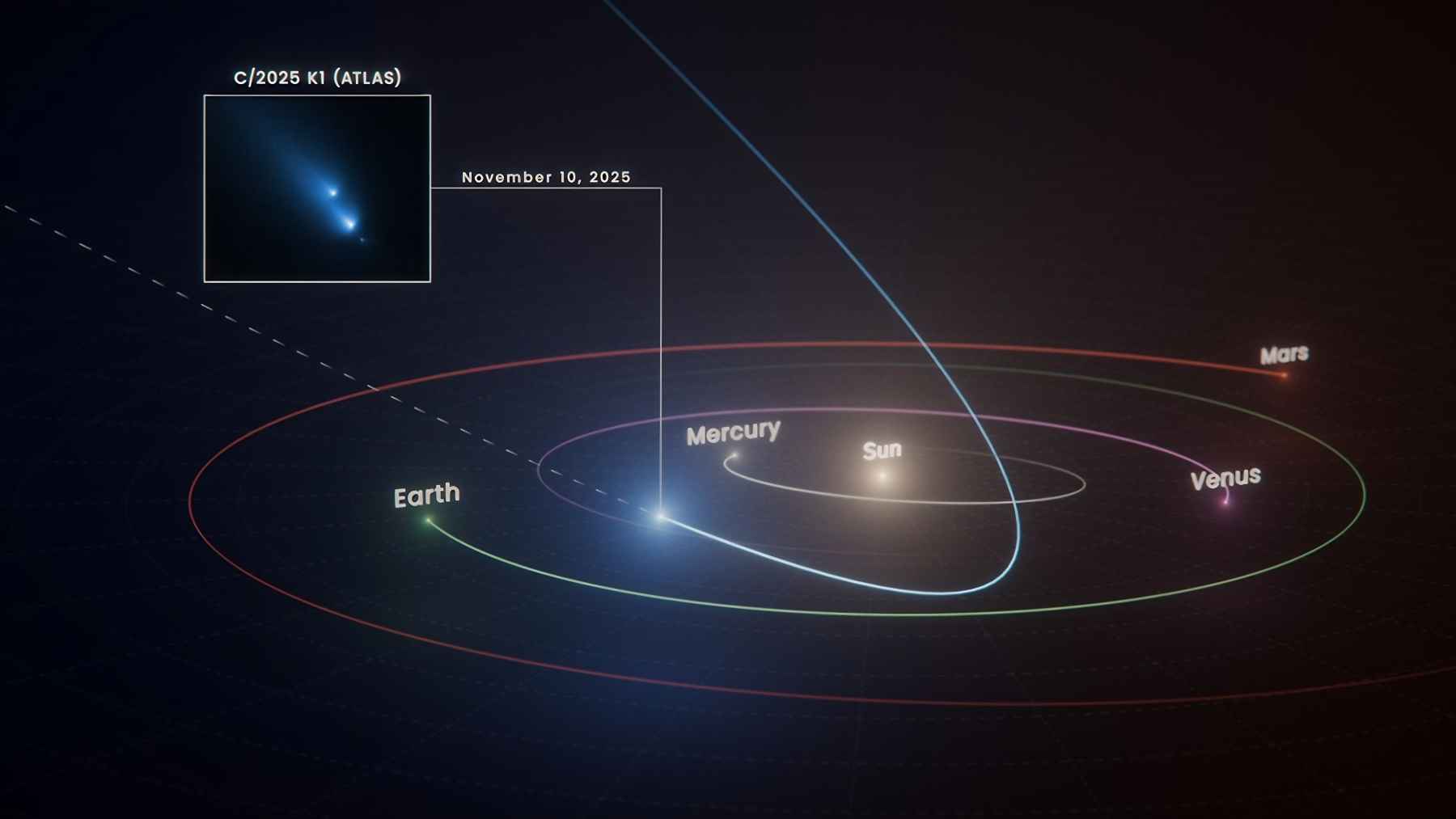
The likely trigger was perihelion, the moment a comet reaches its closest point to the Sun. K1 hit perihelion on October 8, 2025, passing inside Mercury’s orbit at roughly 31 million miles from the Sun, about one-third of Earth’s distance from the Sun.
That close pass is a stress test, because heat turns surface ice into gas and can open cracks or peel material away. Many long-period comets seem to fail soon after the close pass, but the details vary from object to object.
Before the breakup, K1 was likely about 5 miles across, which is on the large side for a comet. Researchers estimate the disintegration began about eight days before Hubble’s first image, so the telescope caught the aftermath close to the start.
The brightness lag mystery
If the comet cracked open and exposed fresh ice, why was there not an immediate surge in brightness? The lag is a key clue, because it suggests the surface needed time to start releasing dust efficiently.
A comet’s visible glow mostly comes from sunlight reflecting off dust grains, not from the ice itself. So a breakup may not look dramatic until enough dust is lofted into the coma and spreads out.
Researchers have outlined a few explanations that fit the delay, and none are fully confirmed yet. One idea is that a dry dust layer must form over exposed ice before gas can blow it off in a noticeable burst, while another is that heat builds pressure below the surface before it pushes out an expanding shell of debris.
A comet with odd chemistry
Ground-based measurements suggest K1 is chemically unusual, because it appears strongly depleted in carbon compared with many other comets. Put simply, some carbon-related gases astronomers often detect were much weaker than expected around this one.
To study those gases in more detail, researchers use spectroscopy, which spreads light into a rainbow-like pattern to reveal chemical fingerprints. Hubble can do this with instruments such as STIS and COS, helping scientists compare K1’s gas mix with other comets.
That comparison matters because comets carry two stories at once: what they were made of long ago and what the Sun has changed since then. A breakup can briefly reveal less-processed interior material before it disperses into space.
Why this matters for future missions
Today, K1 is a collection of fragments about 250 million miles from Earth in the constellation Pisces, and it is heading outward. Because it is not expected to return, these images may end up being one of the best close looks scientists will ever get of this comet.
Astronomers also note that long-period comets like K1 seem more likely to fragment than short-period comets, though the reason remains unclear. The Rosetta mission visited the short-period comet 67P/Churyumov-Gerasimenko and showed what sustained close-up tracking can reveal, but long-period comets arrive with less warning and can be more fragile.
A planned mission called Comet Interceptor aims to visit a long-period comet later this decade, and K1’s breakup offers useful clues for that effort. Co-author Prof.
Colin Snodgrass of the University of Edinburgh said, “Hubble’s chance observation of K1 will help us understand why some long-period comets split apart and give us a first view of their interiors.”
The official study has been published in Icarus.