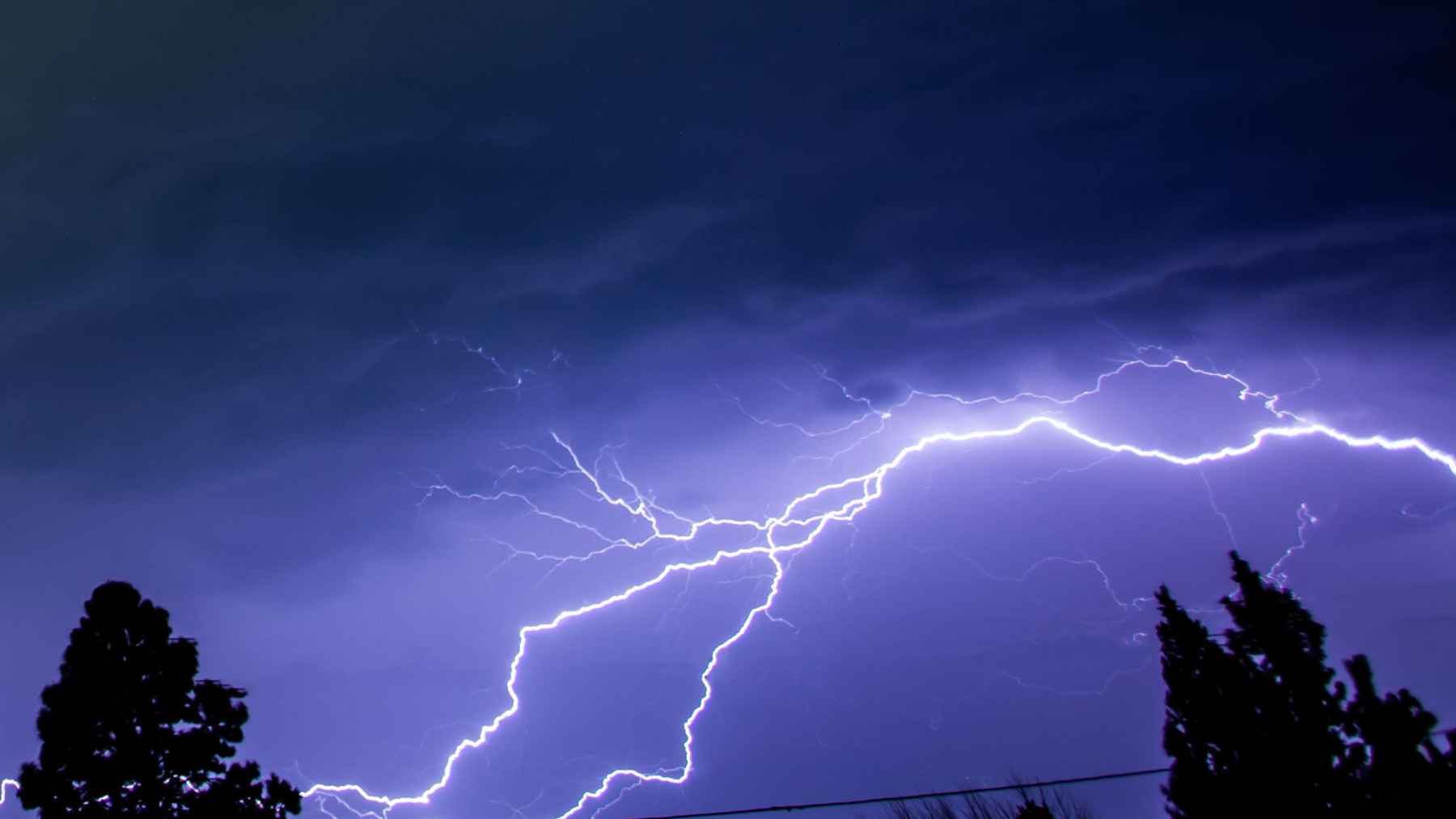
Thunderstorms already have a lot going on. Now researchers say there is another layer to the chaos, a nearly invisible shimmer of ultraviolet light flickering from the tips of leaves high in the canopy.
A team led by meteorologist Patrick McFarland at Penn State reports the first outdoor observations of these tiny electrical discharges, known as “coronae,” on trees during storms along the U.S. East Coast. The takeaway is simple: forests may be “lighting up” more often than we realize, and scientists still do not know what that means for tree health or the chemistry of the air.
The first proof that treetops really glow
During a thunderstorm in Pembroke, North Carolina, the team aimed an ultraviolet-sensitive camera at three branches of a sweetgum tree and later identified 41 distinct corona events in about 90 minutes. Each flicker lasted up to 3 seconds, and the signals often hopped from leaf to leaf as branches swayed in the wind.
Penn State’s account suggests the full count can be much larger when you include every detectable event, with 859 coronae on the sweetgum and 93 on a nearby loblolly pine during that same storm. Researchers also reported similar activity under additional thunderstorms as they traveled between Florida and Pennsylvania in the summer of 2024.
If humans could see ultraviolet light, McFarland says the treetops would look like “thousands of UV flashing fireflies” arriving all at once. It is a vivid image, but it marks a shift – something long suspected in labs has now been recorded outdoors.
A weather phenomenon called a “corona”
A corona discharge is a weak electrical leak into the air that forms around sharp points when the electric field gets strong enough. It belongs to the same family of effects as Saint Elmo’s fire, a bluish glow sailors sometimes reported on ship masts during storms.
In practical terms, a thundercloud can build up a strong charge that pulls an opposite charge up from the ground below. In a forest, that rising charge funnels through trunks and branches until it concentrates at leaf tips and needles, where it can spark a faint blue glow and a burst of ultraviolet.
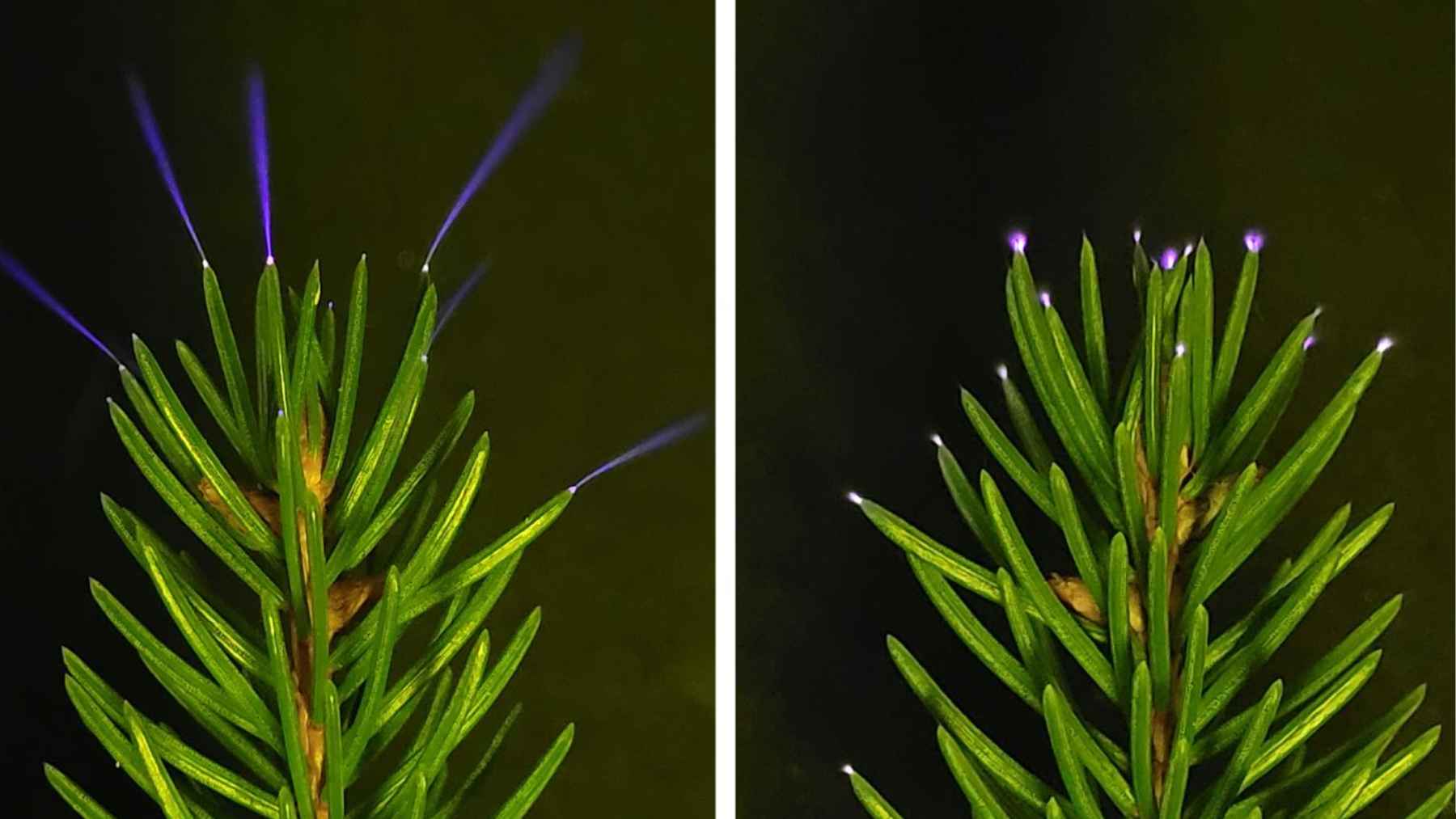
In the lab, researchers can barely see that glow when the room is darkened, but outdoors it is drowned out even under a stormy sky. That is why the field team leaned on ultraviolet measurements, which act like a fingerprint for coronae when your eyes cannot do the job.
The minivan that chased thunderstorms
To catch something so subtle, the researchers turned a 2013 Toyota Sienna into a rolling storm lab with a weather station, an electric field detector, and a laser rangefinder. They also mounted a periscope-style system feeding light into an ultraviolet camera, after cutting a hole about 12 inches wide through the roof.
They started in Florida, betting on frequent summer storms, but many cells fizzled quickly. On the way back north, the team set up near the University of North Carolina at Pembroke and trained their instruments on trees about 100 feet away while lightning flashed and rain fell for nearly two hours.
Penn State calls the setup the Corona Observing Telescope System, essentially a telescope paired with a UV camera and calibrated for ultraviolet emissions. The system blocks the solar UV band, leaving only a few possible sources in the recordings: coronae, lightning, and fire.
What this could mean for forests
These observations matter because coronae are not just “pretty” physics – they can affect plant tissue. The AGU press release notes that coronae can leave leaf tips visibly burnt within seconds, and lab work suggests the discharges may damage the cuticle, the waxy layer that helps leaves resist dehydration and UV stress.
One corona does not seem to do much harm by itself, but storms do not happen only once. Researchers speculate that repeated events across a canopy could add up, which is why they want forest ecologists and botanists involved next.
For ecologists, the unanswered questions are the point. Do these flashes measurably affect photosynthesis or growth, or do trees shrug them off as minor wear and tear from thunderstorm season?
A possible link to cleaner air and greenhouse gases
The story is not only about trees – it is also about the air swirling through the branches. Penn State researchers explain that ultraviolet light from coronae can break apart water vapor, producing hydroxyl, a highly reactive molecule often called the atmosphere’s main “cleanser.”
Hydroxyl reacts with many chemicals, including volatile organic compounds released by trees and methane, a potent greenhouse gas, turning them into forms that are easier for the atmosphere to remove. The Penn State release points to the group’s earlier work suggesting corona discharges in forest canopies can be a substantial source of these oxidizing chemicals.
If coronae are widespread during storms, they could briefly boost this chemical “scrubbing” in and above forests when thunderheads roll through. But the scale, and whether it meaningfully changes regional air quality or climate-relevant chemistry, is still uncertain.
What researchers want to learn next
Now that coronae on wild trees have been documented, the next step is figuring out how common they are and under what conditions they spike. In practical terms, that likely means more field campaigns that pair storm electricity measurements with careful tree biology.
There is also a measurement angle – lab tests found the ultraviolet emission from coronae scales with the electrical current measured in the tree. If that relationship holds widely outdoors, ultraviolet cameras could become a new way to map storm-driven electrical currents moving through forest canopies.
Next time a summer storm turns the sky dark, it is worth remembering that the treetops may be shimmering in a spectrum we cannot see.
The study was published in Geophysical Research Letters.