Archaeologists working in a cave in northern Vietnam have identified what they describe as the oldest known case of one person harming another in mainland Southeast Asia. The victim is a man who lived about 12,500 to 12,000 years ago. A sharp quartz blade struck him in the neck or upper chest, fractured an extra rib and triggered an infection that probably killed him months later.
The man, labeled TBH1, was unearthed between 2017 and 2018 in Thung Binh 1, a cave in the Tràng An Landscape Complex of Ninh Binh Province, a UNESCO World Heritage site. His community laid him to rest in a fetal position, with his face resting on his hands. That careful posture, researchers say, points to a deliberate and respectful burial, not a body simply abandoned in a shelter.
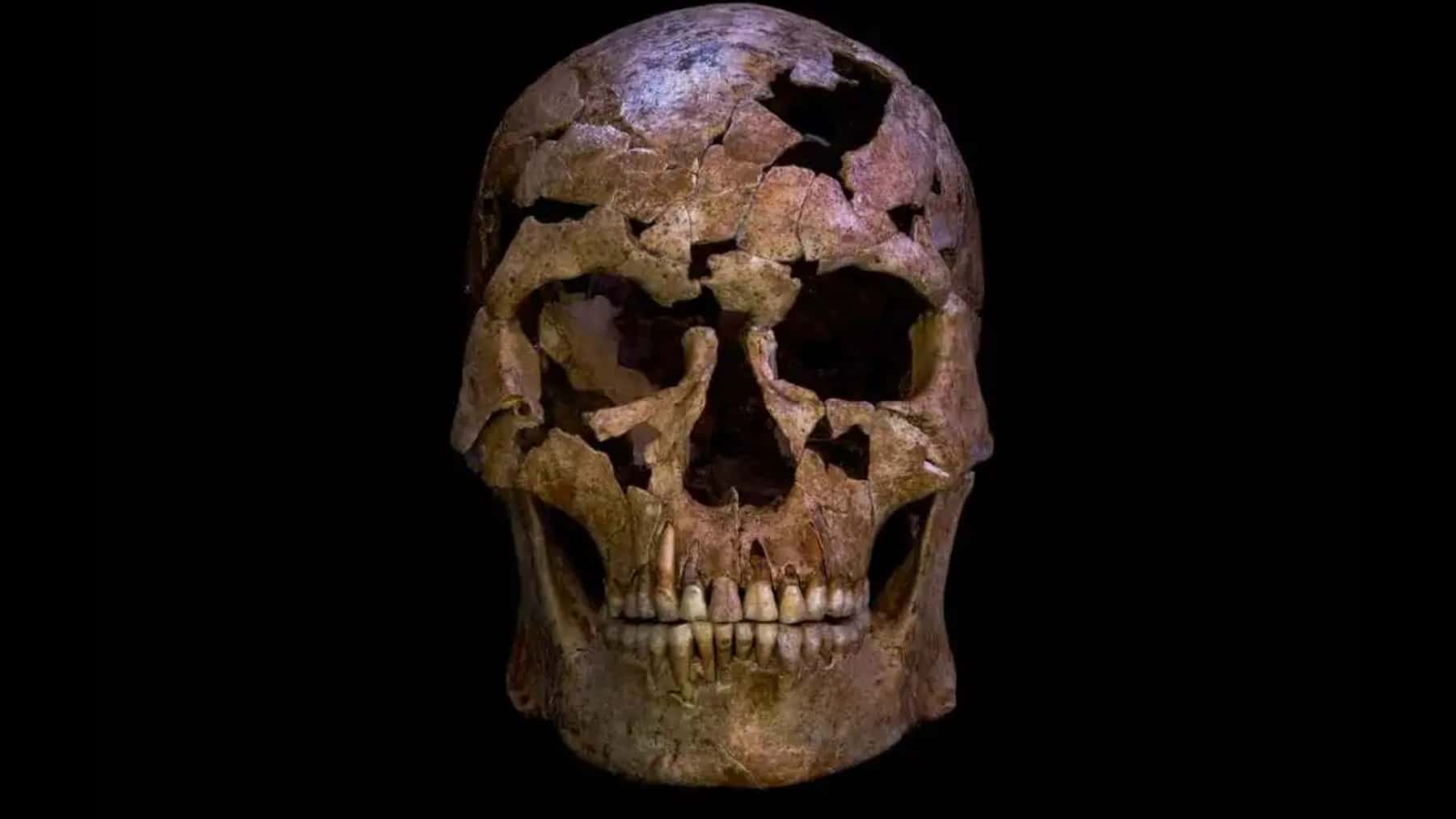
Although his skull had collapsed under a fallen rock, specialists managed to reconstruct most of it along with a nearly complete skeleton. Analysis shows TBH1 was a relatively healthy hunter gatherer who stood around 1.7 meters tall and died at about 35 years of age. For the most part his bones show no sign of long-term disease or repeated injury, which makes the single serious wound on his upper body stand out.
Quartz projectile and cervical rib injury in TBH1
That wound focused on an unusual feature. TBH1 had a supernumerary rib near his neck, an extra cervical rib seen in fewer than one percent of people. On this small rib, scientists found clear evidence of a complete fracture, a thickening of bone and a gap created by draining pus. In the same block of sediment, next to fragments of the rib and shoulder bones, they uncovered a tiny stone tool. It was a triangular flake of milky quartz only about 18 millimeters long, shaped and notched in a way that suggests it had been hafted as a barb on a projectile such as an arrow or dart.
Taken together, the broken rib and the position of the quartz flake point to a narrow, high-velocity impact that penetrated soft tissue near the neck. Zooarchaeologist Christopher Stimpson, a co-author of the study, explained that the damage pattern strongly suggests a strike to the neck or upper chest. The research team wrote that “TBH1 lived for several months after the injury occurred” and that if it were not treated, “infection would have ensued” and led to death weeks or months later. The pattern of bone healing and infection supports that timeline.
The quartz piece itself adds another layer to the story. Among more than six hundred stone artifacts from the cave, only a few were made of quartz, and none shared this exact microlith-like design. The authors note that this fragile projectile technology is “exotic” for the local archaeological record of that time and region. That raises the possibility that the weapon came from outside the immediate group, hinting at conflict between different bands of hunter gatherers rather than an accident within a single community.
Mitochondrial DNA and ancestry of Southeast Asian hunter gatherers
At the same time, TBH1’s remains tie him firmly to the indigenous populations of Late Pleistocene Southeast Asia. His skull is complete enough for detailed measurements that cluster him with other Late Pleistocene crania from the region. Mitochondrial DNA extracted from his inner ear bone provided the earliest genetic evidence so far recovered from Vietnam. His DNA belonged to the M macrohaplogroup, which connects him to ancient hunter–gatherer groups of South and Southeast Asia. This genetic signal matches a picture where local foragers were already established long before later waves of farming peoples moved in from the north.
The find arrives in the middle of an ongoing debate about the ancestry of modern East Asians. One long standing model emphasizes continuity from early hunter gatherers, while another proposes a major later migration of agricultural communities into Southeast Asia. TBH1 does not settle that debate, but his cranium and DNA strengthen the case that indigenous foragers were present and thriving in northern Vietnam as the last Ice Age drew to a close.
Hunter gatherer life and environment in Late Pleistocene Vietnam
Seen through an environmental lens, the discovery also opens a window on how people lived with their landscapes at the time. Thung Binh 1 sits inside a limestone hill amid river plains and karst towers. The burial was dug into a shell-rich midden, a dump of food remains that shows repeated visits to the cave. These clues suggest a community that knew its forests, rivers and caves well and depended on a mix of hunting and gathering to survive rapid climate and sea level changes.
Social care, conflict and early human societies
So what does this single injured rib really tell us about early societies? To a large extent it reminds us that interpersonal violence has deep roots, even among small mobile groups who lived close to nature. Yet TBH1’s story is not only about a violent encounter. His survival for months with an infected open fracture implies care from those around him. Someone probably cleaned the wound, shared food, maybe adjusted the pace of travel so he could keep up.
In that sense, this twelve-thousand-year-old case from Vietnam captures two sides of our species at once. There is the capacity to harm with a finely made projectile point. There is also the capacity to tend to an injured companion and then bury him carefully in a cave he once shared with his group. For researchers who study how humans have shaped and been shaped by their environments, TBH1 offers a rare and very human glimpse into a world where social bonds, conflict and care are already intertwined in the tropical forests of Southeast Asia.
The study was published on the Royal Society Publishing site.