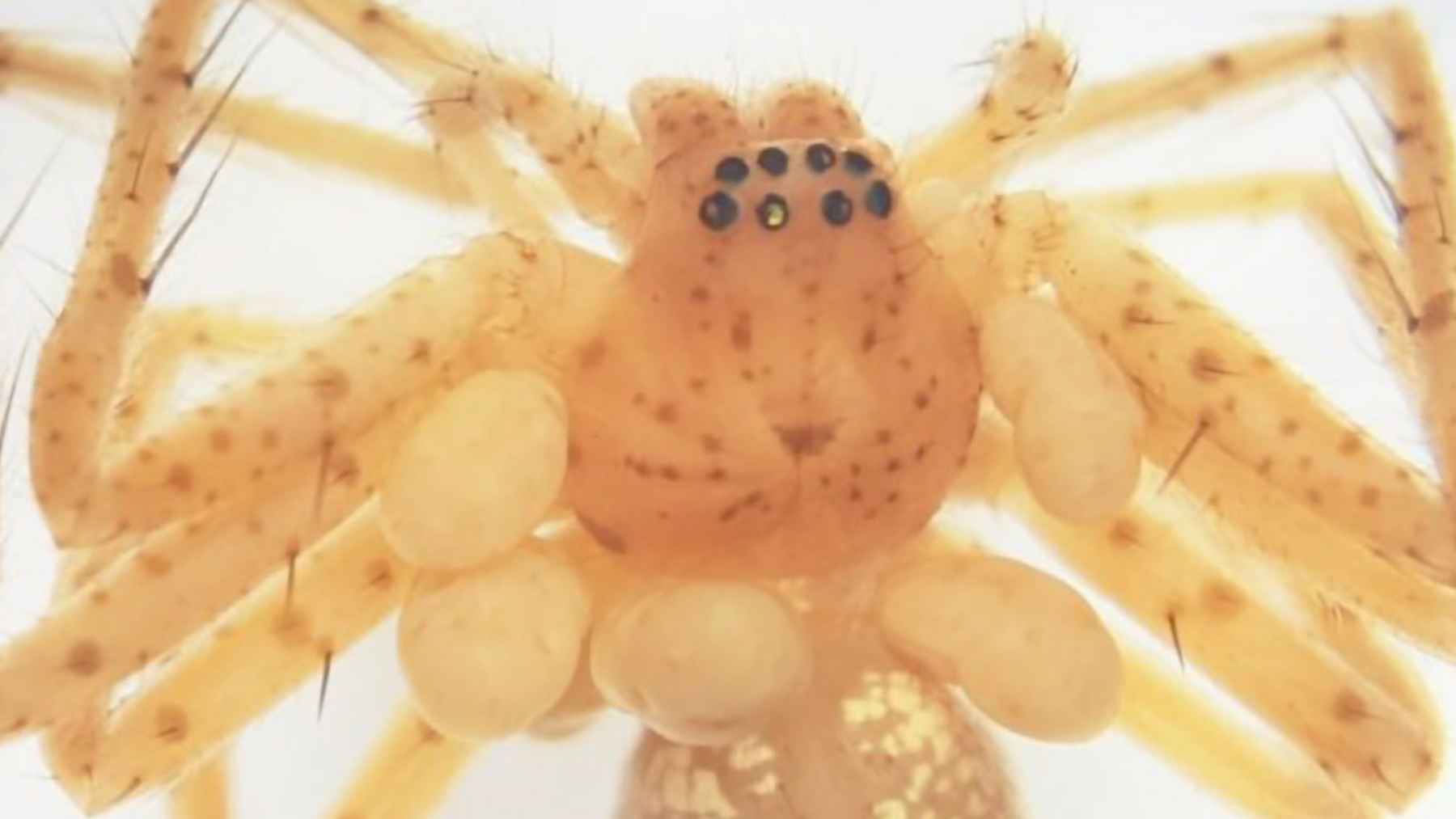
At first glance, it looked almost cute. A tiny spider in a museum jar seemed to be wearing a delicate pearl necklace around its neck. Under the microscope, though, those pale beads turned out to be very much alive.
They were parasitic mite larvae, and they belong to a newly described species that is changing what scientists know about hidden life on Brazilian spiders.
The new species, named Araneothrombium brasiliensis, belongs to a group of mites that are parasites as larvae but become free‑living predators as adults. It is the first member of its family recorded in Brazil and only the second spider‑parasitic mite species documented in the country.
The discovery also extends the known range of the genus Araneothrombium, which was previously confirmed only in Costa Rica, to another part of the Neotropical region.
A tiny spider and a big surprise
The story began in the Zoological Collections Laboratory at Butantan Institute in São Paulo. Researchers were sorting through jars of preserved spiders and scorpions when one juvenile spider, just a few millimeters long, caught their eye.
A spider only a few millimeters long appeared to be wearing a strand that looked like a pearl necklace, so they asked a colleague who specializes in mites to take a look. A mite specialist was called over and quickly recognized the “pearls” as engorged larvae.
Each larva is about half a millimeter long. On such a small host, lining up side by side, they form the beaded collar that has now gone viral in news photos.
The spider itself came from near caves and grottos in the municipality of Pinheiral in the state of Rio de Janeiro, where field teams had collected juvenile spiders from several families, including orb weavers and jumping spiders.
How the living necklace feeds
The mites cluster around the spider’s pedicel, the narrow region between the front part of the body and the abdomen. Here they pierce the soft cuticle and suck lymph, a fluid that circulates inside the spider.
Other body parts contain more chitin, that hard outer material, that works like armor and makes it harder for mite mouthparts to penetrate. As researcher Ricardo Bassini‑Silva explains, this spot is “the spider’s most vulnerable region.”
Because many of the hosts were juveniles, the team suspects the mites take advantage of young spiders, which are easier targets for parasites and predators.
The researchers also note that related mites can parasitize insects, so this species may eventually turn up on other arthropods as well. For now, it is known only from its larval stage, with all collected larvae already swollen from feeding.
A life cycle mostly hidden in the soil
For this group of mites, scientists often know the parasitic larvae long before they ever see an adult. Once they finish feeding, the larvae drop off their hosts and complete development in the soil.
Adults become predators that hunt tiny invertebrates, including other mites, which makes them hard to find and even harder to study. The wider family Microtrombidiidae is already one of the most diverse in its order, with well over one hundred genera and hundreds of described species.
That is why one spider sitting quietly in a jar could hold such a surprise. The specimens had been in storage for years before anyone noticed the mites.
Curators and taxonomists say this is a textbook example of why zoological collections matter for biodiversity research. Drawers and shelves that might look dusty to visitors are, in reality, time capsules filled with species that science has not fully described yet.
What this means for biodiversity
Researchers point out that more than three thousand spider species are known from Brazil, and that number keeps growing as surveys expand into new regions. That means there is enormous potential for discovering more parasitic mites that depend on these spiders, especially in tropical habitats that are still poorly sampled.
At the same time, ecologists warn that many invertebrate species worldwide may be disappearing before they are formally described. Studies on insects and other small animals suggest that their losses are often undercounted even though these creatures are crucial for food webs and ecosystem services.
In other words, when a tiny mite found on a single spider in a collection drawer gets a name, it helps close a small part of that knowledge gap.
For most of us, spiders are already easy to overlook, found in quiet corners of a ceiling or garden. The new “pearl necklace” mite is smaller still, yet it reminds us that every spider can carry an entire community on its back, sometimes literally.
The study was published in the International Journal of Acarology.