Have you ever thought about what a Stone Age status symbol looked like? On the forested western shore of Lake Onega, one of Europe’s largest freshwater lakes, archaeologists have uncovered a glittering grave that gives a surprisingly clear answer.
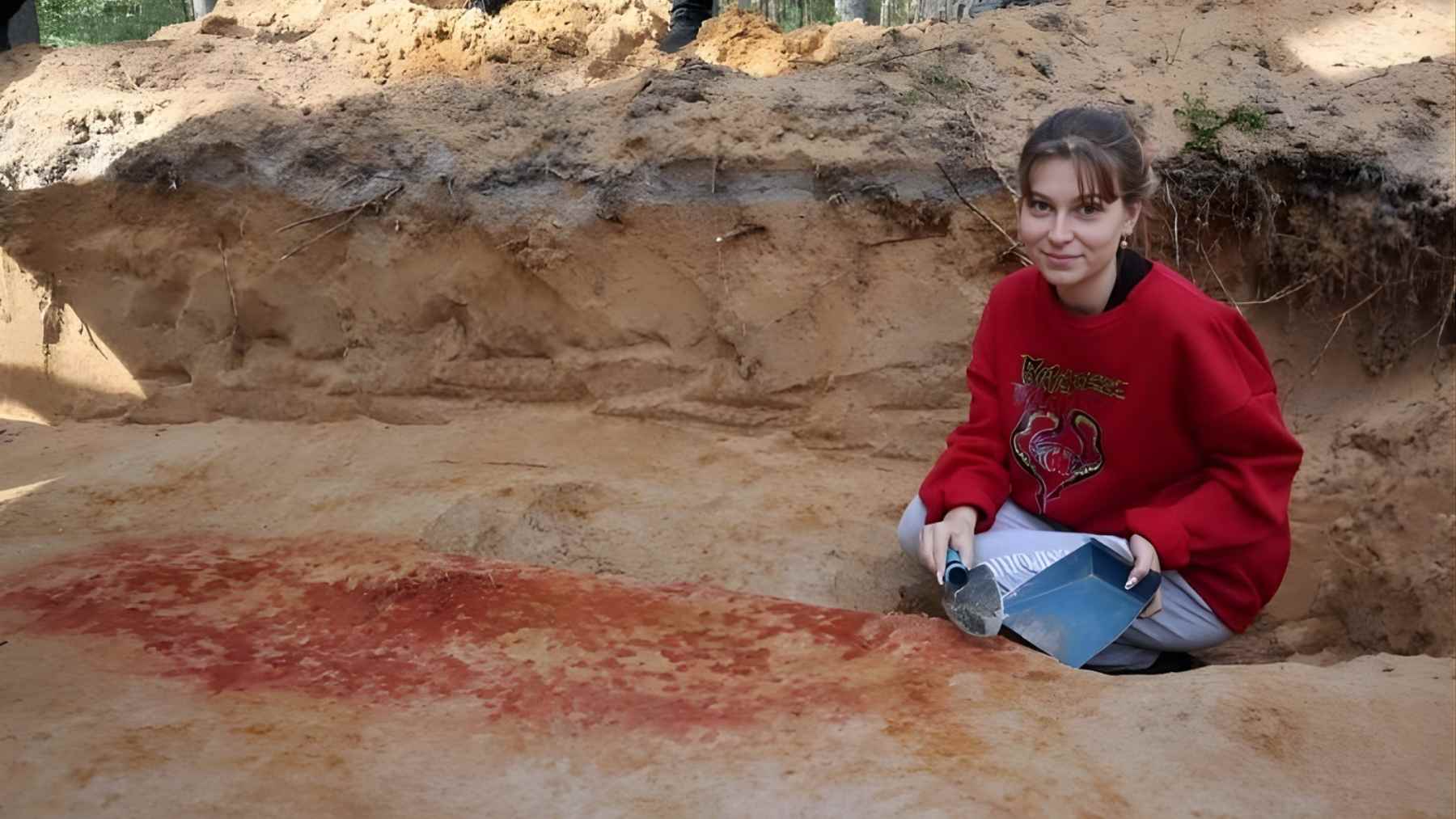
In a narrow pit lined with red ochre, a man who lived about 5,400 years ago was wrapped in pigment and covered with around 140 pieces of amber jewelry from the Baltic coast. The burial, found by students from Petrozavodsk State University under the guidance of archaeologist Aleksandr Zhulnikov, is unusually richly furnished for the northern forest belt of Europe.
A tiny grave packed with rare ornaments
During excavations at the Derevyannoye XI site, the team discovered amber pieces arranged in rows, most of the buttons placed face down and sewn onto a leather covering that once lay over the body.
Along the edges of the small grave, extra ornaments were packed so densely that they formed two bright tiers. A flint spearhead and many small flakes were interpreted as symbolic offerings that stood in for complete knives and arrowheads. Comparing the jewelry with similar pieces from Eastern Baltic settlements, researchers date the grave to roughly 3400 BC in the late Copper or Eneolithic Age.
Amber from ancient coastal forests
Amber is fossilized tree resin from forests that thrived tens of millions of years ago. The pieces in this grave are Baltic amber, also called succinite, from extensive deposits along the southern Baltic coast that formed roughly 44 million years in the past.
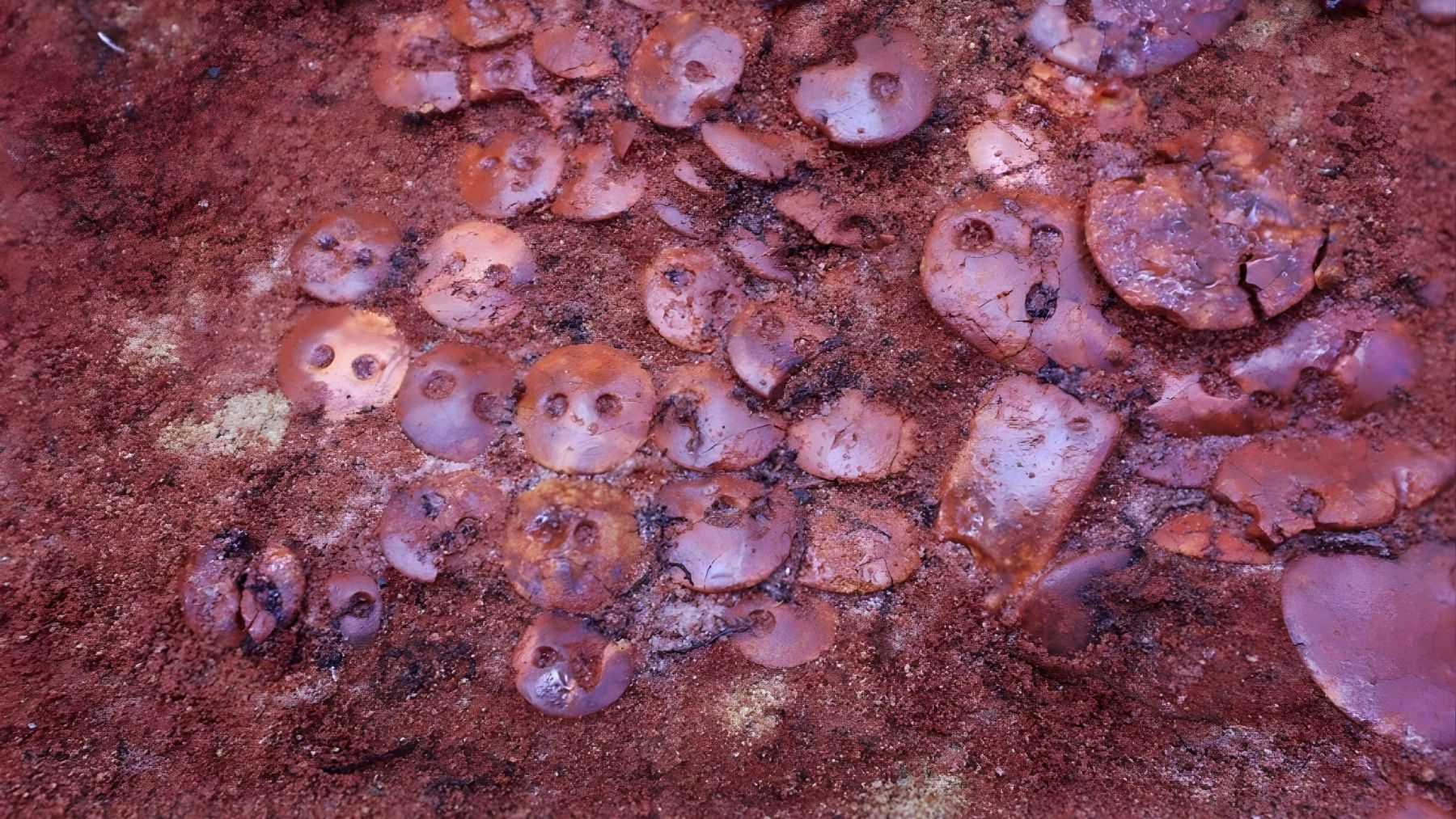
Several ornaments match types found at the Sarnate site in present day Latvia, hundreds of miles from Lake Onega. Jewelry carved from ancient coastal forests had traveled across much of northern Europe to be buried beside a man on a Karelian lakeshore.
Red pigment, flint chips and a careful ritual
No bones survive in the burial. Yet the halo of red ochre and the blanket of ornaments still trace the outline of the body and its final clothing. Analysis shows that the grave is an isolated pit at a settlement rather than part of a larger cemetery.
Tiny chips from flint tools and their blanks were sprinkled above the body even though there are no natural flint sources in Karelia, and soil chemistry shows unusually high arsenic levels that help locate the area of the Onega basin where the deceased had probably lived for many years.
Trade routes hidden in stone and resin
Taken together, these details point to a community woven into long-distance exchange networks. Workshops that produced slate axes and adzes stand right next to the burial, suggesting that visitors may have come to this lakeside terrace to trade imported amber for finely crafted local tools.
Early interpretations described the man as a possible merchant from the Eastern Baltic, while later work indicates that he or his close relatives likely spent much of their lives near Lake Onega itself. The combination of Baltic succinite, exotic flint and prized local stone tools shows that people here balanced local resources with goods from far away.
An early prestige economy in the northern forest
Across much of the northern forest belt, Mesolithic and Neolithic communities buried their dead in large ancestral cemeteries with modest grave goods. This grave is different. Here a single person was buried at a settlement with a cloak-like layer of amber and an array of rare tools, a pattern that archaeologists describe as a prestige economy where special objects signal social rank.
Think of a favorite jacket saved for important moments. For this community, ornaments carved from ancient tree resin and blades made from distant stone sent that kind of message.At the end of the day, the amber man of Lake Onega shows that long distance trade and the urge to stand out through material things are not purely modern habits.
They grow from deep relationships with landscapes, from Baltic coastal forests that produced the resin to the Karelian rock that yielded slate axes. The new work on the Derevyannoye XI burial ties those threads together.
The study was published in “Russian Archaeology“.