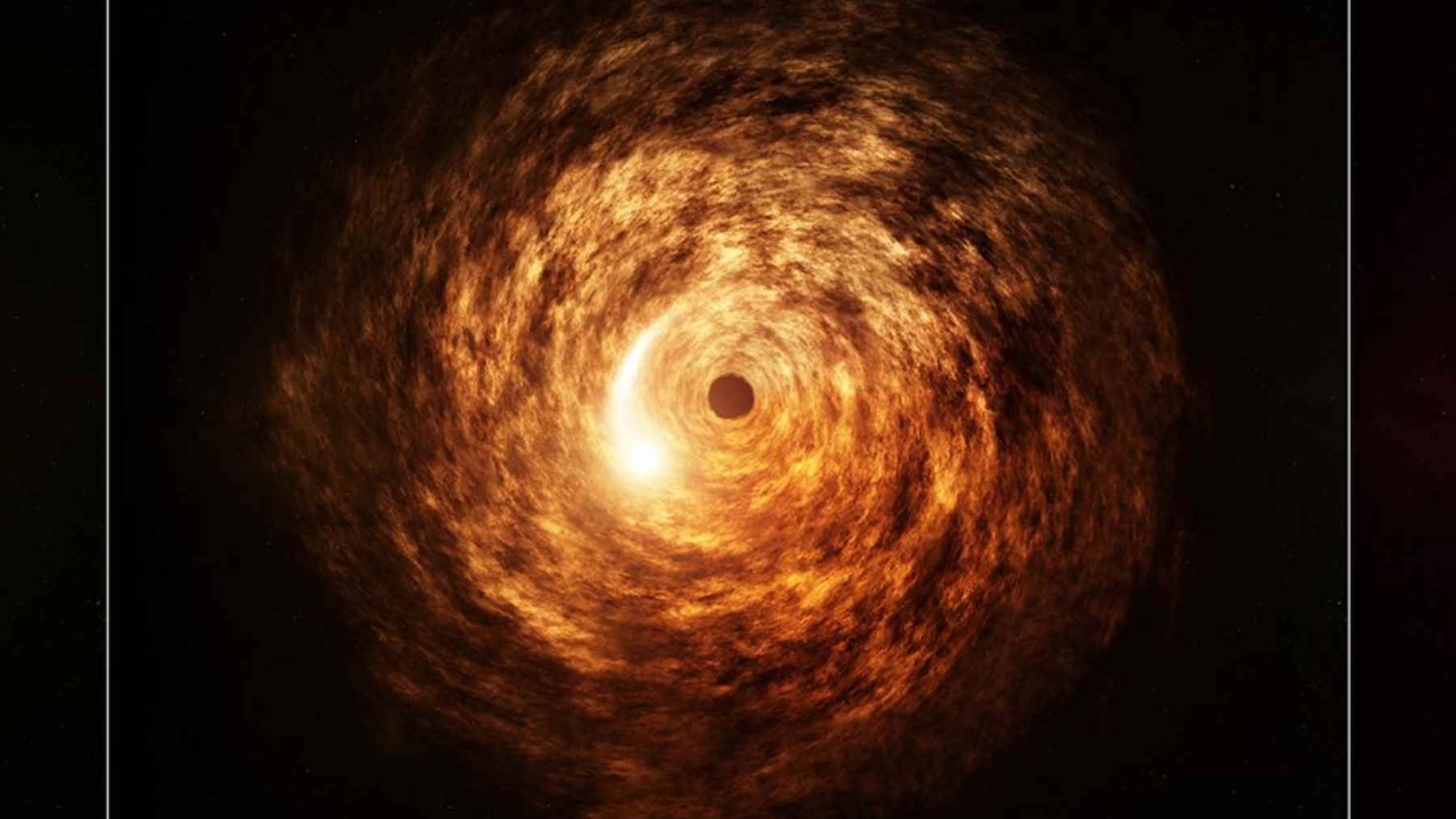
Astronomers have taken a fresh look at the giant black hole in the center of our galaxy and found that it is wrapped in powerful, spiraling magnetic fields. The new image of Sagittarius A* (often shortened to Sgr A*) shows the Milky Way’s central black hole in polarized light for the first time, revealing bright streaks that trace an intense, ordered magnetic structure right at the edge of the cosmic “shadow.”
This view comes from the Event Horizon Telescope, a globe-spanning network of radio dishes that works like a virtual Earth-sized telescope. Sgr A* sits about 27,000 light years from Earth and weighs several million times more than the Sun, yet in our sky it is so small that scientists compare its apparent size to a doughnut resting on the surface of the Moon.
So what are we actually seeing in this glowing ring? Black holes themselves do not emit light. Instead, gas and dust whirl around them in a superheated disk, shining in radio waves before either plunging in or being flung back into space. When that light becomes polarized, its waves vibrate in a preferred direction.
In the plasma near Sgr A*, particles spiral along magnetic field lines and imprint a distinct polarization pattern that the EHT can detect. That pattern lets researchers map the shape and strength of the magnetic fields threading the flow of gas.
The biggest surprise is how familiar this new picture looks. In 2019, the same collaboration released a polarized view of the much larger black hole M87* at the center of the galaxy Messier 87 and found a similar swirl of organized fields. Now, Sgr A* shows the same kind of spiral.
Project co leader Sara Issaoun describes “strong, twisted and organized magnetic fields near the black hole at the center of the Milky Way,” and notes that the polarization structure closely matches what is seen around M87*.
That resemblance matters. M87* powers a bright, relativistic jet that blasts material out of the galaxy’s core, injecting energy into the surrounding gas and affecting how and where new stars can form. Earlier work showed that magnetic fields help launch and collimate such jets.
Seeing a similar magnetic pattern at Sgr A* hints that our own black hole may also host a jet that is either faint, intermittent or pointed away from our line of sight. To a large extent, it suggests that the basic “engine” driving supermassive black holes could be universal, regardless of whether they are quietly nibbling on gas or gorging on it.
Getting this image was far from easy. M87* is massive and relatively steady, which makes it a calmer photography subject. By contrast, Sgr A* flickers and changes on timescales of minutes, so quickly that the team describes it as a source that does not sit still for pictures. To freeze that motion, researchers had to combine data from eight observatories on several continents and use advanced algorithms to reconstruct an average view of the polarized light.
Why should anyone who is not an astrophysicist care about magnetic squiggles around a distant black hole? At the end of the day, these fields help decide how much material falls in, how much is blown back out and how energy moves through the center of a galaxy. Over cosmic time, that energy can heat or sweep away gas, slowing or triggering new generations of stars. In environmental terms, Sgr A* is a kind of deep core regulator for the Milky Way’s long-term “weather.”
The new polarized image also fits into a broader effort to watch our galactic center in many wavelengths. Observations with the James Webb Space Telescope, for example, recently revealed rapid flickering and flares from the hot disk of gas around Sgr A*, showing how turbulent that region is as material edges toward the point of no return. When scientists combine Webb’s time lapse view with the EHT’s fine-scale map of magnetic fields, they can start to link specific outbursts to the invisible forces shaping them.
For now, Sgr A* remains a relatively quiet giant compared with the blazing hearts of distant active galaxies. Yet the new image reminds us that even a “calm” supermassive black hole sits inside a tight whirlpool of fields and plasma, quietly steering the evolution of its host galaxy. The EHT team plans fresh observations that may sharpen this view and perhaps reveal signs of a hidden jet.
From our vantage point under the night sky, all of that drama is packed into a speck smaller than a coin seen from thousands of kilometers away. Knowing what lies inside that speck makes our corner of the universe feel a little less mysterious and a lot more alive.
The study was published in The Astrophysical Journal Letters.