Galactic monster detected — Black hole 600,000 times bigger than the Sun is spitting stars
· 3 min read
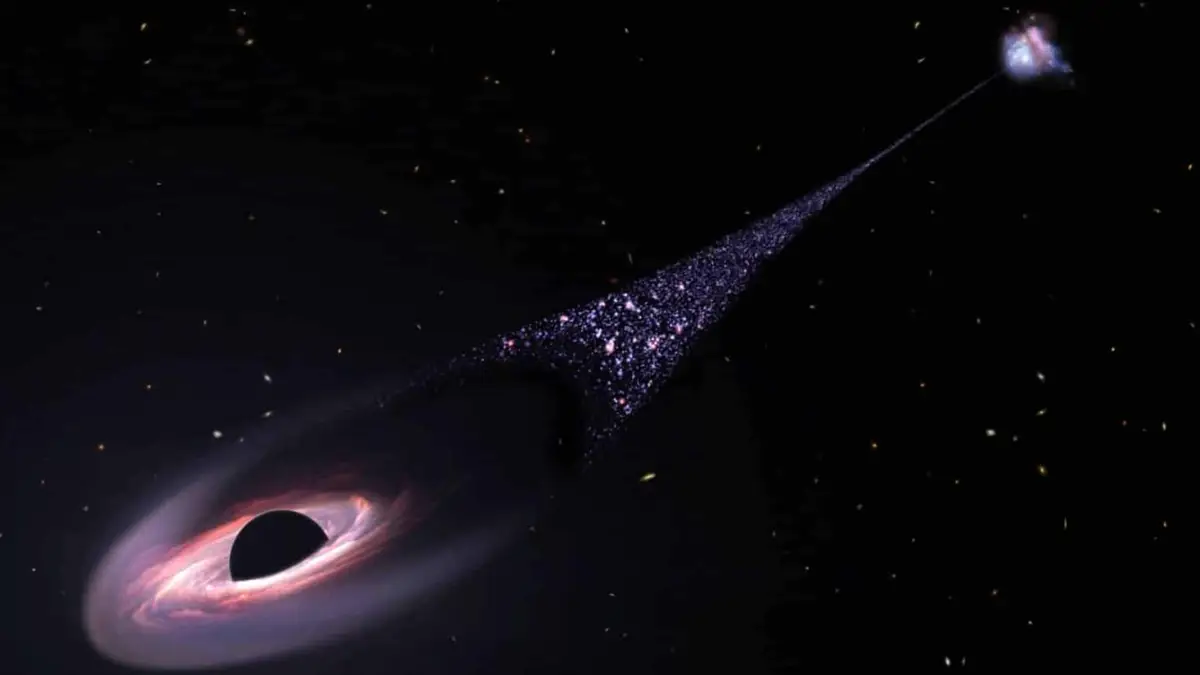
Space never ceases to amaze us. Yes, even with advanced telescopes and space missions capable of seeing the universe in previously unimaginable detail, there’s always something hidden, waiting to be discovered. This time, astronomers have found a true cosmic “monster,” camouflaged right in the vicinity of the Milky Way. This monster isn’t an exotic star or a distant galaxy, but a supermassive black hole.
The mystery of hypervelocity stars
To understand the magnitude of this discovery, we need to talk about hypervelocity stars. Yes, they’re rare, but when they appear, they attract attention for a simple reason: they travel incredibly fast. We’re talking about speeds reaching millions of kilometers per hour, so high that no gravitational force can hold them back. So, we wonder how these stars reach such speeds?
The most widely accepted explanation involves binary systems, that is, when two stars orbit each other. If this pair gets too close to a supermassive black hole, a brutal process occurs:
- One of the stars is captured by intense gravity.
- And the other is thrown outward, receiving a gravitational “push” that transforms it into an interstellar fugitive.
Using ultra-high-precision data from the Gaia satellite, they analyzed the trajectories of 21 hypervelocity stars on the outskirts of the Milky Way. What they found changed everything: half of them actually came from our galaxy’s central black hole, Sagittarius A*.
The supermassive black hole in the LMC
And this is where the revelation happens. That’s because the origin of these stars wasn’t the Milky Way, but rather the Large Magellanic Cloud (LMC), our nearest neighboring galaxy. According to Jesse Han, study leader:
“It is astounding to realize that we have another supermassive black hole just down the block, cosmically speaking.”
This finding put an end to a mystery that had intrigued astronomers for years. Of course, it was already suspected that the LMC might harbor a supermassive black hole, but no concrete evidence had ever emerged. Now, with the combination of Gaia data and new theoretical models of the LMC’s orbit, it’s become clear that the “monster” was there all along (which even reminds us of this other object that’s worse than a black hole). More on its size:

- Estimated mass: 600,000 times the mass of the Sun (like this cosmic blast).
- Comparison: The Milky Way’s central black hole has about 4 million solar masses.
- On a global scale, there are even larger black holes, with billions of solar masses. But in terms of proximity, this is undoubtedly a respectable neighbor.
The models predicted something that was confirmed in practice: the LMC black hole should produce a cluster of hypervelocity stars in a specific region of the Milky Way, and exactly this pattern was found in the observations.
“The only explanation we can come up with for this data is the existence of a monster black hole in our galaxy next door,” said Scott Lucchini, co-author of the research.
When neighbors hide giants: how the LMC’s black hole reshapes our cosmic view
The presence of a supermassive black hole in the LMC isn’t just a curious detail. It changes how we understand the evolution of dwarf galaxies and their interactions with larger neighbors, like the Milky Way. Three major implications of the discovery:
- Validation of the cosmic pattern.
- Driving force of the cosmos.
- New observation windows.
Well, the universe has once again shown us that we still know very little about what’s happening around us. The discovery of this black hole in the Large Magellanic Cloud proves that even our closest neighbors hide gigantic mysteries… It’s like peeking at the last page of a book whose conclusion we’ll never see. Yes, it’s so impressive that we even wonder: why do black holes never run out of fuel?
ECOnews Newsroom
Writer at ECOnewsA team of journalists specializing in socio-environmental news, sustainability, climate change, the environment, responsible consumption, and innovation. At EcoNews, we provide clear, reliable, and relevant coverage of the environmental and social challenges shaping our era.
More from ECOnews NewsroomComments · 0
Rules ›No comments yet. Be the first to share your view.