For many decades, we considered black holes to be the universe’s greatest predators. Largely because of their insatiable gravity, which makes them capable of devouring entire stars and distorting the very fabric of space-time, then, yes, they have always occupied the top of the cosmic chain, at least until now… That’s because a new discovery made with the help of the Hubble Space Telescope is shaking that throne. And as if that weren’t already surprising enough, it seems that the “something” that is swallowing stars with astonishing speed was, until now, hidden in plain sight.
It just seemed like a small anomaly…
The story began with a detail that, for many people, would have gone unnoticed. In the M67 cluster — a very old group of stars, similar to our Sun and located about 2,800 light-years from Earth — astronomers noticed that one star was acting… strange. While all the others followed the expected rhythm, this one was spinning like crazy: four times faster than it should.
At first, it seemed like just a weird case. A mistake? An exception? But no, there was something more there. When they really investigated, with data from Kepler and some tricks with ultraviolet light, the bombshell came: it probably swallowed another star in the past. That’s right. A rare but real stellar merger. And then everything made sense. The unusual spin, the extra energy… it was the result of a chaotic past. In the end, that bizarre behavior became a valuable clue and showed that the universe loves to hide its craziest stories between the lines.
Meet the Blue Lurker
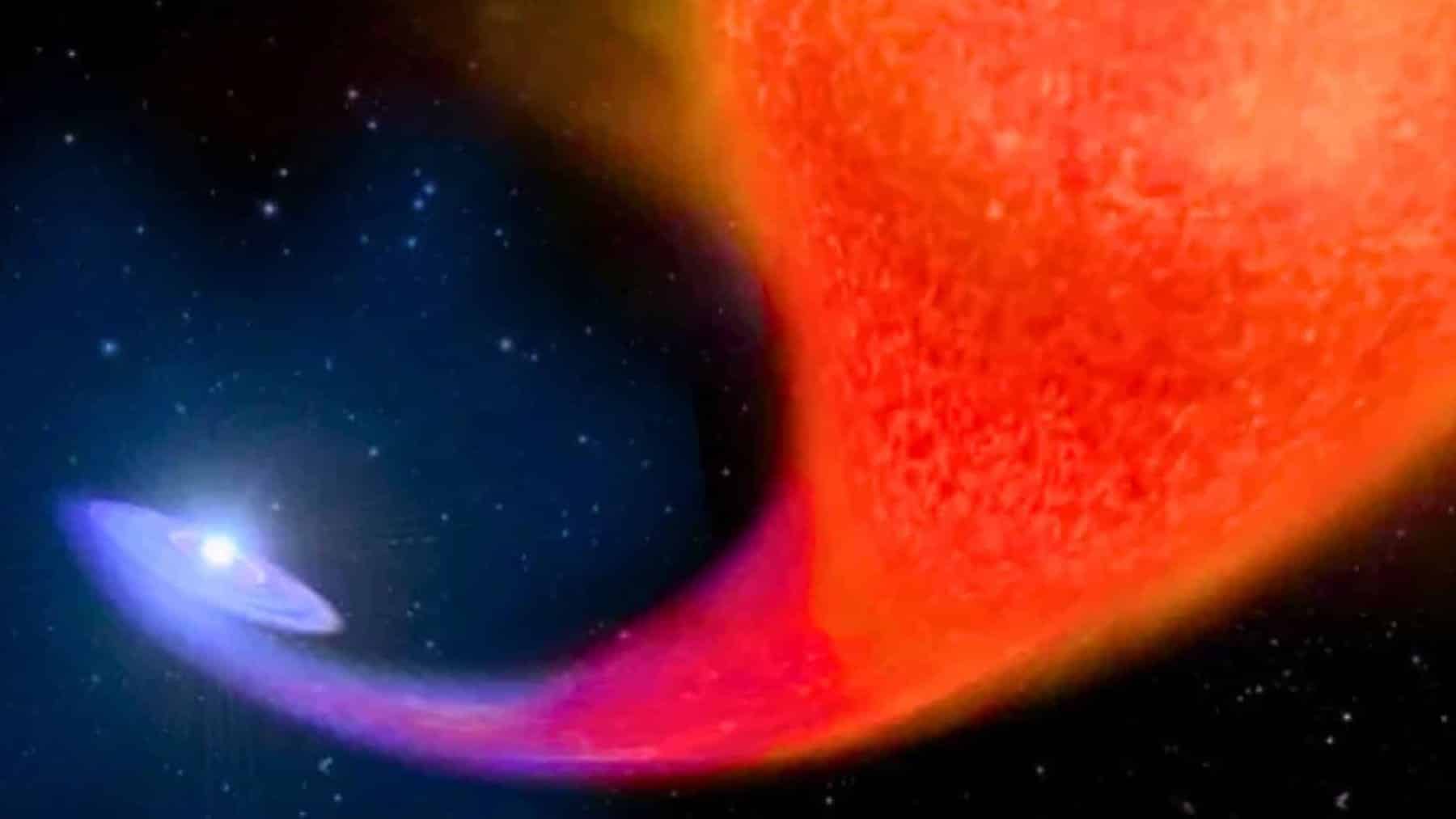
But what, besides a black hole, was “devouring” stars at such incredible speeds? Before you try to guess, it wasn’t a supernova or a new form of dark matter either. It was, in fact, an ordinary star, but with an unusual past… astronomers even named this object the Blue Lurker. It’s worth noting that this star even looks similar to the Sun, but it ended up becoming a “cosmic cannibal” after interacting with a triple system.
What does this mean? Well, about 500 million years ago, two Sun-like stars merged, forming a more massive star that quickly evolved into an extremely hot white dwarf. And during this transition, it transferred matter and angular momentum to the Blue Lurker, causing it to spin abnormally fast.
Yes, what seemed to be a harmless star is, in practice, carrying the energy of a stellar merger, and its rotation is the vestige of this process. Of course, it is not exactly “swallowing” stars like a black hole would do (like this black hole in America that continues to grow), but it is, in a way, even more surprising: a reborn star, hidden in the middle of the cluster, with predatory behavior and energy acquired from a dramatic past (it even sounds like a movie story).
What does this change about what we know about Black Holes?
You might be wondering, “Okay, but what changes with all this?” The truth? It changes a lot. This Blue Lurker isn’t just a different star; it challenges several ideas that scientists considered to be sort of settled about how stars form, live, and change. For a long time, models didn’t even take triple systems into account because, let’s face it, they’re extremely complicated to observe. But now it’s hard to ignore them anymore..
And there’s more: this star spent billions of years there, quiet, unnoticed. But what it represents goes beyond that. It seems to be a kind of hybrid phenomenon. In other words, everything that we used to consider an exception may have a much bigger role in the history of stars. That’s why NASA is already keeping an eye on the strange behavior of these two stars.