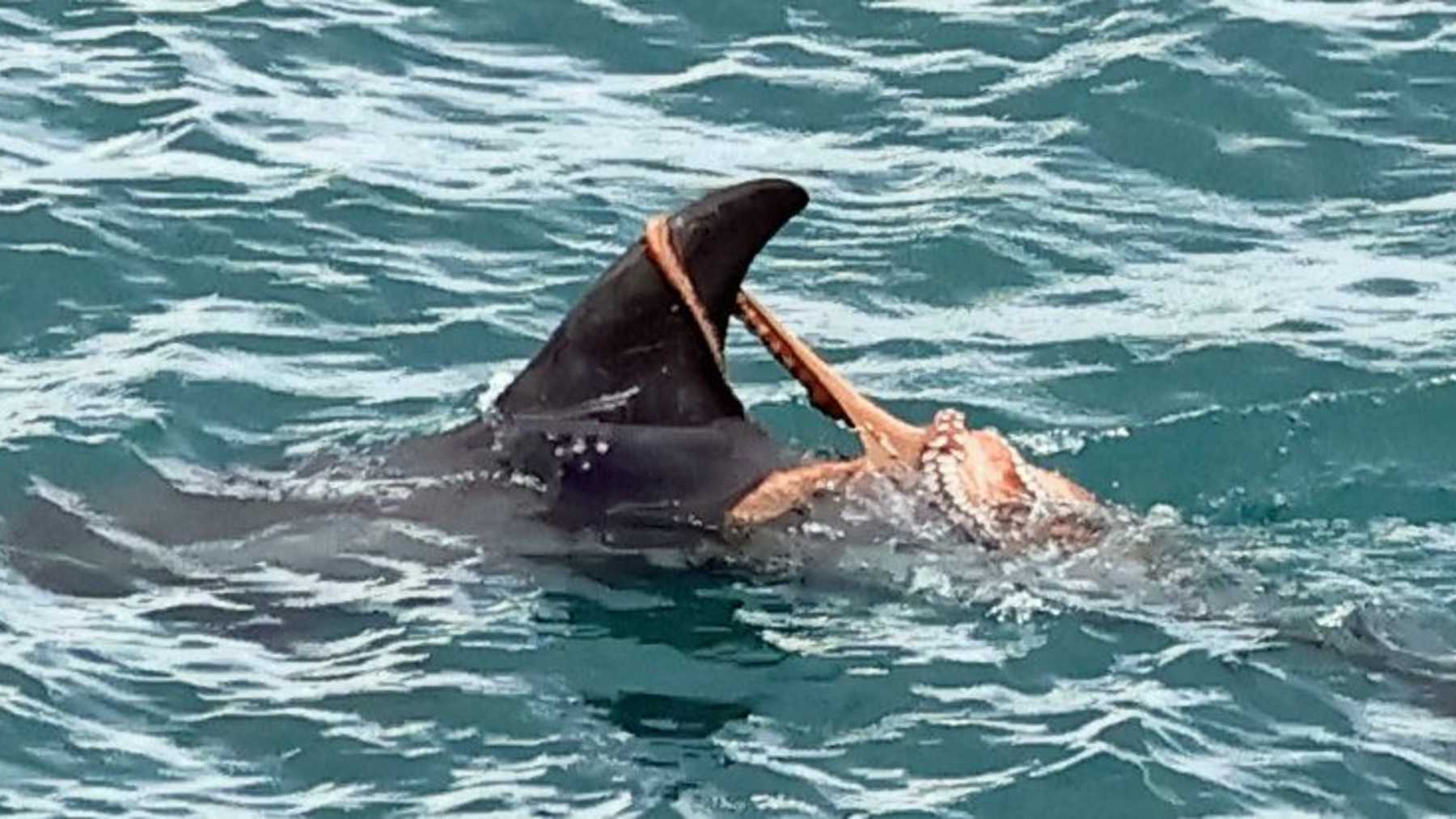
Off the coast of Devon, in southwest England, a volunteer photographer caught a scene that looks almost staged. A Risso’s dolphin cruises at the surface while an octopus clings to its tall dorsal fin, as if it had hitched a ride.
It’s not a joke picture, and it’s not just a lucky shot. Scientists say the images are real evidence of how an unusual boom in octopus numbers around Devon and Cornwall may be changing what one of Britain’s least understood dolphins eats.
The shot off Berry Head
The photographs were taken off Berry Head, in Devon, by Bill Coulson, a volunteer with the Risso’s Dolphin Project South West. They show a common octopus with its arms wrapped around the dolphin’s fin, an interaction that researchers describe as unusual.
The Marine Biological Association (MBA) shared the images in late August 2026, and they quickly spread through photography and science outlets in September. Is the octopus really “riding” the dolphin? Almost certainly not by choice. Risso’s dolphins hunt octopus, so what looks like a free ride is more likely part of a hunt.
A dolphin few people ever see
Risso’s dolphins are hard to confuse with any other species. They have a blunt, rounded head with no real beak, and adults reach 8.5 to 13 feet long and weigh 660 to 1,100 pounds, according to NOAA Fisheries.
Calves are born dark, but the animals turn paler with age until some look almost white. Their skin gets covered in scratches over the years, partly from other dolphins’ teeth and partly from struggling prey.
They also tend to live far from shore. NOAA notes that they prefer deeper offshore waters, can dive to at least 1,000 feet and feed mostly at night on squid, octopus and cuttlefish. That’s why a close encounter like this one is such a treat for researchers.
What the researchers say
The sighting connects two lines of research. One is the MBA’s work on the surge in common octopus that began in 2025, and the other is a photo identification study of Risso’s dolphins led by Josh Symes, an MSc researcher at the University of Exeter.
“These photographs offer a fascinating glimpse into the feeding ecology of Risso’s dolphins and the changing marine environment around our coasts,” Symes said. He added that “the images also highlight the value of citizen science, as observations from volunteers are helping us build a clearer picture of marine wildlife across the Southwest.”
Dr. Bryce Stewart, a senior research fellow at the MBA, sees a bigger lesson. “It’s a powerful reminder of how interconnected our marine environment is,” he said.
An octopus boom not seen in 75 years
Common octopus are native to British waters, but they are usually rare there. In 2025 that changed dramatically, with the largest bloom recorded in at least 75 years along the southwest coast.
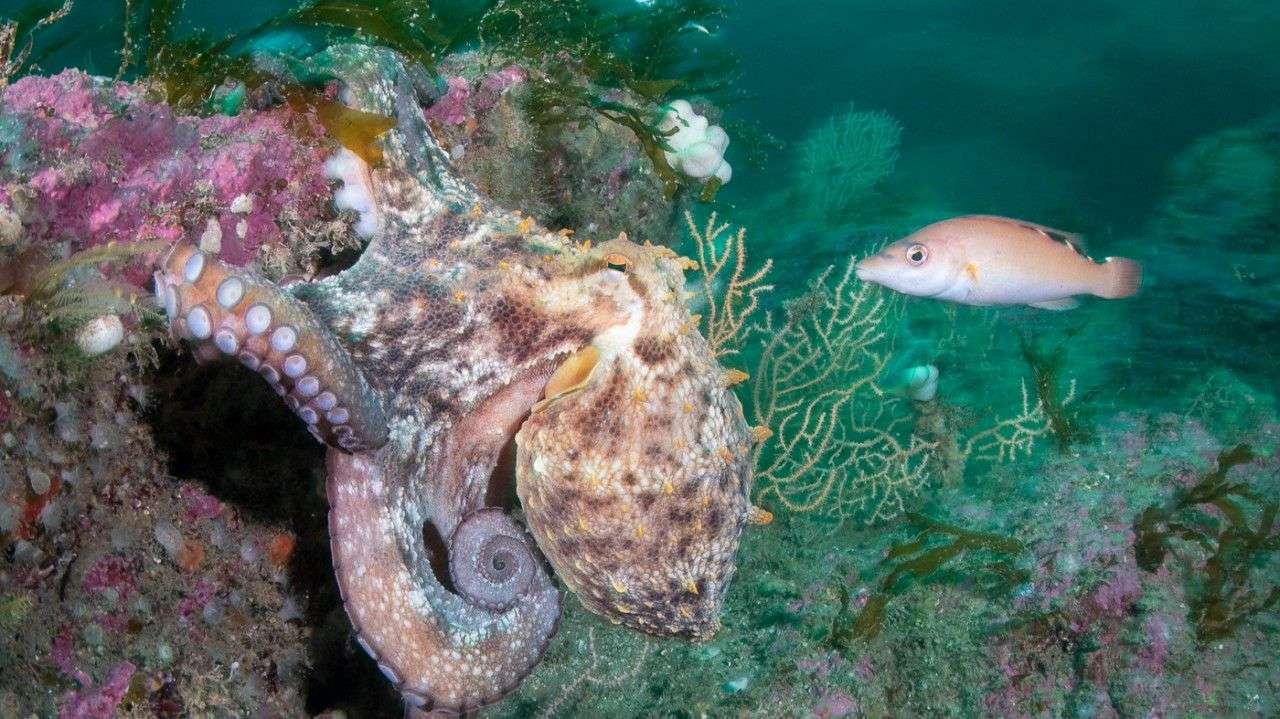
A report led by Stewart, released in January 2026, found only three comparable events in the past, in 1899 to 1900, 1932 to 1933 and 1950 to 1951. The likely recipe was unusually warm water plus steady easterly winds that carried young octopus from breeding grounds near the Channel Islands and northern France.
For fishermen, it hasn’t been a fun surprise. Octopus feed on shellfish, and catch rates for brown crabs, lobsters and scallops dropped by 30 to 50 percent in 2025, according to the same report.
A warming sea behind it all
The bigger backdrop is heat. The State of the South West’s Seas 2025 report, released by Plymouth Marine Laboratory in July 2026, called 2025 the “Year of the Octopus.” It also found that the English Channel near Plymouth hit marine heatwave levels in spring and summer, for the third year in a row.
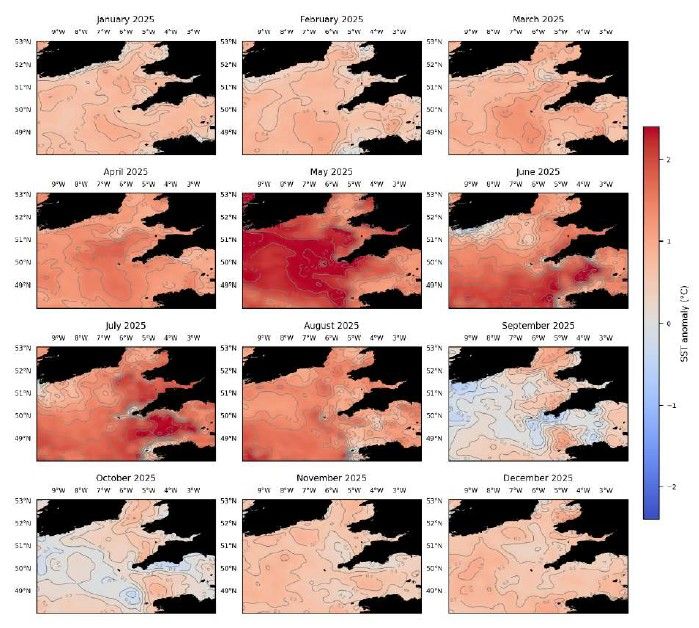
Over the last 40 years, the region’s seas have warmed by roughly half a degree Fahrenheit per decade, according to that report. It sounds small, but for animals that live and breed by water temperature, it adds up fast.
The same report found that sightings of Risso’s dolphins, adjusted for survey effort, keep trending upward. Researchers link that to more cuttlefish and octopus close to the coast. In practical terms, the dolphins may simply be following the food.
One population to protect
There’s another reason scientists are paying close attention. In August 2026, a genetic study co-led by Nicola Hodgins of the marine charity Mara and the University of Exeter showed that Risso’s dolphins around the British Isles form a single, genetically distinct population.
That matters because whatever happens to the dolphins off Devon could ripple out to the wider British population. A change in diet, good or bad, is not just a local story.
How you can help
The MBA and the Risso’s Dolphin Project South West are asking the public to report sightings of octopus and marine mammals, either through the project’s Facebook page or the iNaturalist app. Once checked, those records can be combined with scientific surveys to track how marine life is shifting.
So if you’re on a boat trip or walking the cliffs and spot something odd, take the photo. As Bill Coulson’s pictures show, one good shot from a volunteer can end up in a research file.
The press release was published on “Marine Biological Association“.
Photo: Bill Coulson / Marine Biological Association