Deep in Brazil’s Amazon, researchers found something that looked as if it had stepped out of a streaming thriller.
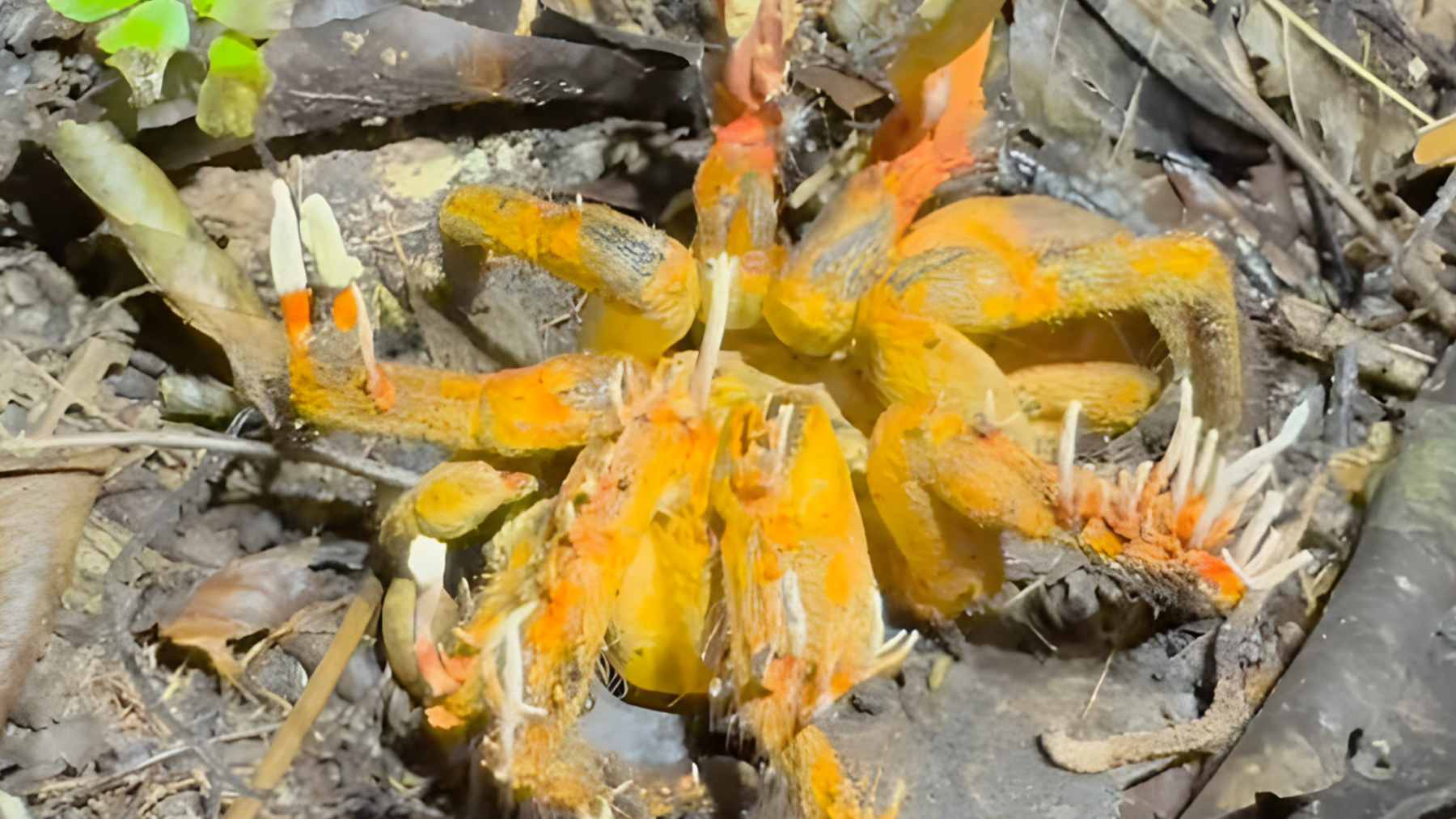
During fieldwork in January at the Ducke Reserve near Manaus, a team linked to the Federal University of Santa Catarina (UFSC), the University of Copenhagen (UCPH), and Brazil’s National Institute for Amazonian Research (Inpa) documented Cordyceps caloceroides growing from a tarantula identified in the report as Theraphosa blondii.
The image is dramatic, sure, but the scientific value may be even bigger.
This is not a human-apocalypse story but a biodiversity story. Researchers described the specimen as unusually well preserved, which could help with morphology, molecular work, and even future tests of whether more than one species may be hiding under the same name.
One infected tarantula can still tell us quite a lot about how much forest life remains uncataloged in one of the most species-rich places on Earth.
A rare record from the forest floor
Lara Fritzsche, an Environmental Science student at UCPH, spotted the parasite and its host during the Tropical Mycology Field Course. The program brings students and specialists into the Amazon to study fungal diversity in the field, from collecting and microscopy to taxonomy and ecology.
In practical terms, this was focused survey work in one of the most species-rich places on Earth.
In remarks reported after the discovery, UFSC researcher Elisandro Ricardo Drechsler-Santos said these fungus-host relationships tend to be highly specialized. He told A Crítica that cases involving arachnids are “very rare and very difficult to find,” even though similar relationships are far better documented in ants.
That matters because each new record helps scientists sharpen the map of who infects whom in the wild.
The specimen also offered a clear visual clue. UFSC said the fungus produces an orange reproductive structure, with spores released from the tips to infect other spiders. It is the kind of image that stops a thumb mid-scroll, but for mycologists it is also a working specimen, one that preserves ecological information that can easily vanish in a rainforest.
What the fungus is doing and what scientists still do not know
Cordyceps fungi spread through spores, but the exact route into tarantulas is still unclear. Drechsler-Santos said the spores may land directly on the spider’s body or be picked up when the animal crosses soil where the fungus has already germinated.
The headline is spooky, but biology is still full of open questions, and researchers are being careful not to pretend the whole mechanism is already solved.
What scientists do think is that the parasite uses the spider’s body to complete its life cycle, feeding on host tissues and eventually sending out a fruiting structure.
A Crítica also reported that the fungus may alter host behavior, steering the arachnid toward conditions that favor fungal growth, but this Amazon case is still a field record, not the final word on every stage of infection. There is still more to learn.
That is also why the comparisons with The Last of Us only go so far. Kew notes that real-world Cordyceps and Ophiocordyceps fungi infect insects and other arthropods, including some spiders, and says there is “no risk of it occurring any time soon” when it comes to a fictional jump into humans.
The real story is less about apocalypse and more about ecology, because these fungi help regulate populations and shape relationships inside forests already under pressure.
Why one tarantula can open a much bigger conversation
The broader backdrop is striking. Kew says scientists know less than 10 percent of the fungal species thought to exist, with the total often estimated at around 2.5 million. That means a single well-documented specimen from the Amazon is more than a curiosity, because it adds one more data point to a kingdom of life that remains mostly hidden.
A 2024 review in The Journal of Arachnology found that fungal pathogens have been recorded in more than 40 of the 135 known spider families, and that 92% of those infections come from fungi in the order Hypocreales.
Even so, the same review found these infections are most common in tropical and subtropical forests, which means places like the Amazon are still likely to hold interactions scientists have barely documented. That’s why rare field records keep punching above their weight.
At the end of the day, this eerie tarantula is not just a viral science moment. It is a reminder that Amazon conservation is also about the small, strange, easy-to-overlook lives that make ecosystems function, because when habitat disappears, relationships that took millions of years to develop can disappear with it.
The official statement was published on Notícias da UFSC ’s website.