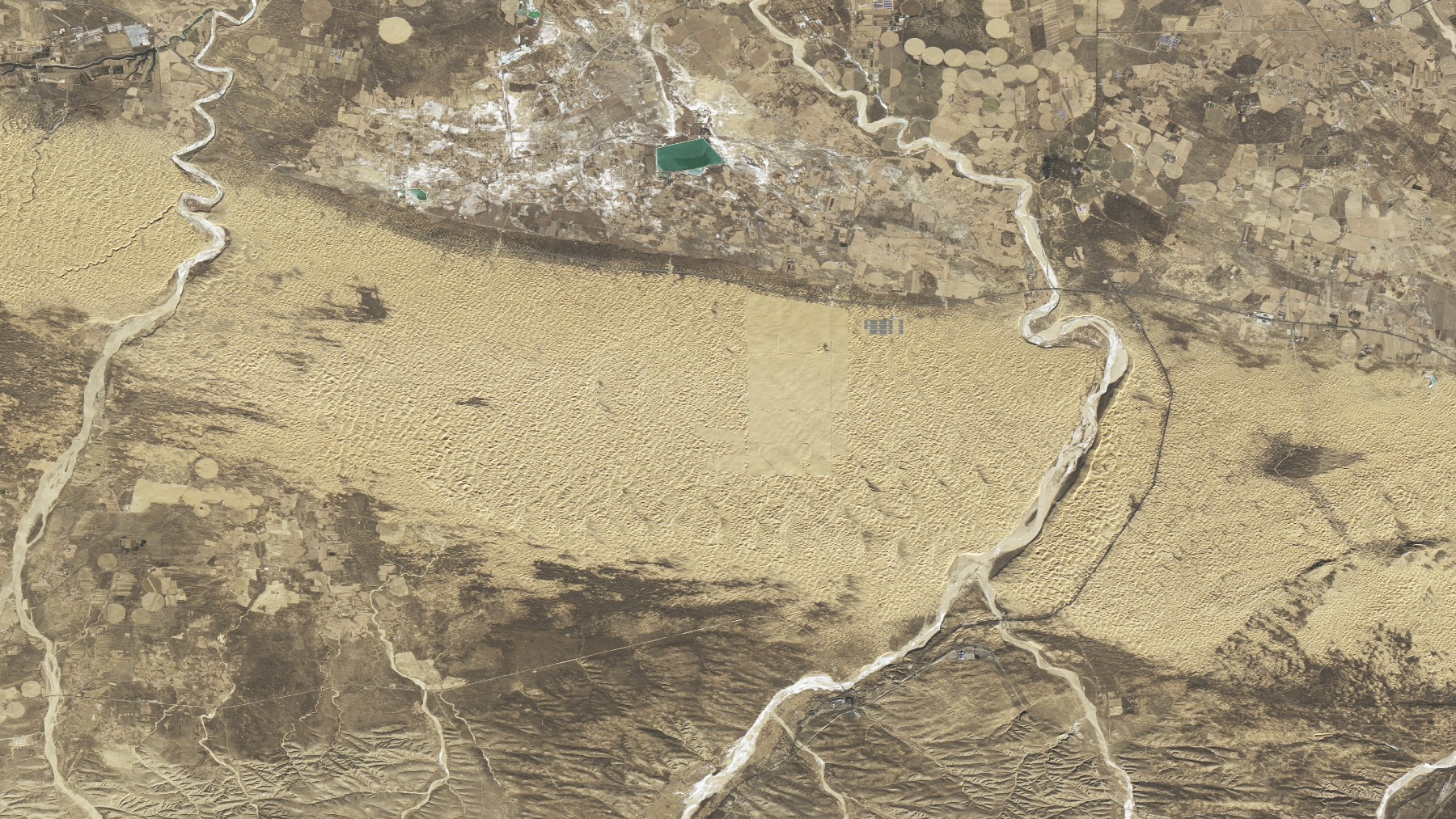
A gigantic solar wall is being constructed in Kubuqi Desert, Inner Mongolia, which was once termed a “sea of death”. This is a world’s first mega project initiated to develop this place into a renewable hub by China. This ambitious project aims to generate solar power worth about 100 gigawatts by 2030; thus, it is transforming the environment and will set international standards for the innovation.
The superlative solar wall: A grand renewable energy infrastructure the Kubuqi Desert
An unparalleled renewable energy project is being developed with the name Solar Great Wall. It will extend to 400 kilometers (250 miles) long and 5 kilometers (3 miles) wide and enable the Kubuqi Desert to rely on flat terrain and sunlight while drawing industries closer for optimizing its solar power generation.
The panels will be installed as long, narrow bands of dunes specifically along the Baotou and Bayannur surrounding the south of the Yellow River. This project is already major milestones. By around mid-2024, the installed capacity would have risen to about 5.4 gigawatts, partly driven by key state-owned enterprises, like the China Three Gorges and State Power Investment Corporation.
One of the prominent features is the Junma Solar Power Station, whose completion occurred in 2019 and has a capacity of 300 megawatts. Like a galloping horse, this Junma Solar Power Station holds the Guinness World Record for the largest image made of solar panels.
The output is about 2 billion kilowatt-hours of electricity annually, enough to meet the energy needs of up to 400,000 people. This is just the beginning, however. By 2030, the Solar Great Wall will be completing 100% of its capacity in terms of 100 gigawatts, which could be sufficient to energize cities and give a huge boost to the renewable energy portfolio of China.
With a stunning 51% of the global capacity, China is the undisputed leader in solar energy
By mid-2024, China will have become the world’s first in operational solar farm capacity at 386,875 megawatts “over half” of the total of the world: 51% as at that time, according to word from diverse sources. It was the US at second place with 79,364 megawatts and a far third position held by India, which was 53,114 megawatts.
It emphasizes how intractable enthusiasm China has for renewables over the last decade. For the period 2017-2023, China’s solar capacity was increased by an average of almost 40,000 megawatts every year. This figure is so much higher as compared to that of the US, which was just slightly above 8,000 megawatts added in the same period.
However, the investment will not only serve the energy needs of China for the time being but also place the country on track to become the global beacon in this fight against climate change. The Solar Great Wall-be it in its sheer dimensions or aspirations is representative of how the country is converting environmental hurdles into possibilities for creativity.
Solar great wall: A green revolution for the Kubuqi Desert
The Solar Great Wall produces not just environmentally friendly energy but also provides economic and environmental benefits. It helps in desertification by stabilizing wind-eroded dunes. In addition to this, solar shading reduces evaporation.
There are grasses and crops growing under such solar panels, just like in other greening desert projects across China. In wastelands such as the Kubuqi Desert, it has ensured ecologically restorative renewable energy development, thereby providing jobs, promoting solar innovation, and making energy security less dependent on fossil fuels.
It is indeed the Solar Great Wall of China Showcase that becomes the cradle of human inventedness and environmental stewardship. Roofed with kites in the fantasy of what renewable sources could achieve against the obstacles of the world: into a solar energy hub.
Indeed, the project envisions the end-of-the-road function for the year 2030 and changes the energy map of China into an emblem for the rest of the world. This certainly does show that even in deserts most arid, themes abound for progress and sustainability within their borders.