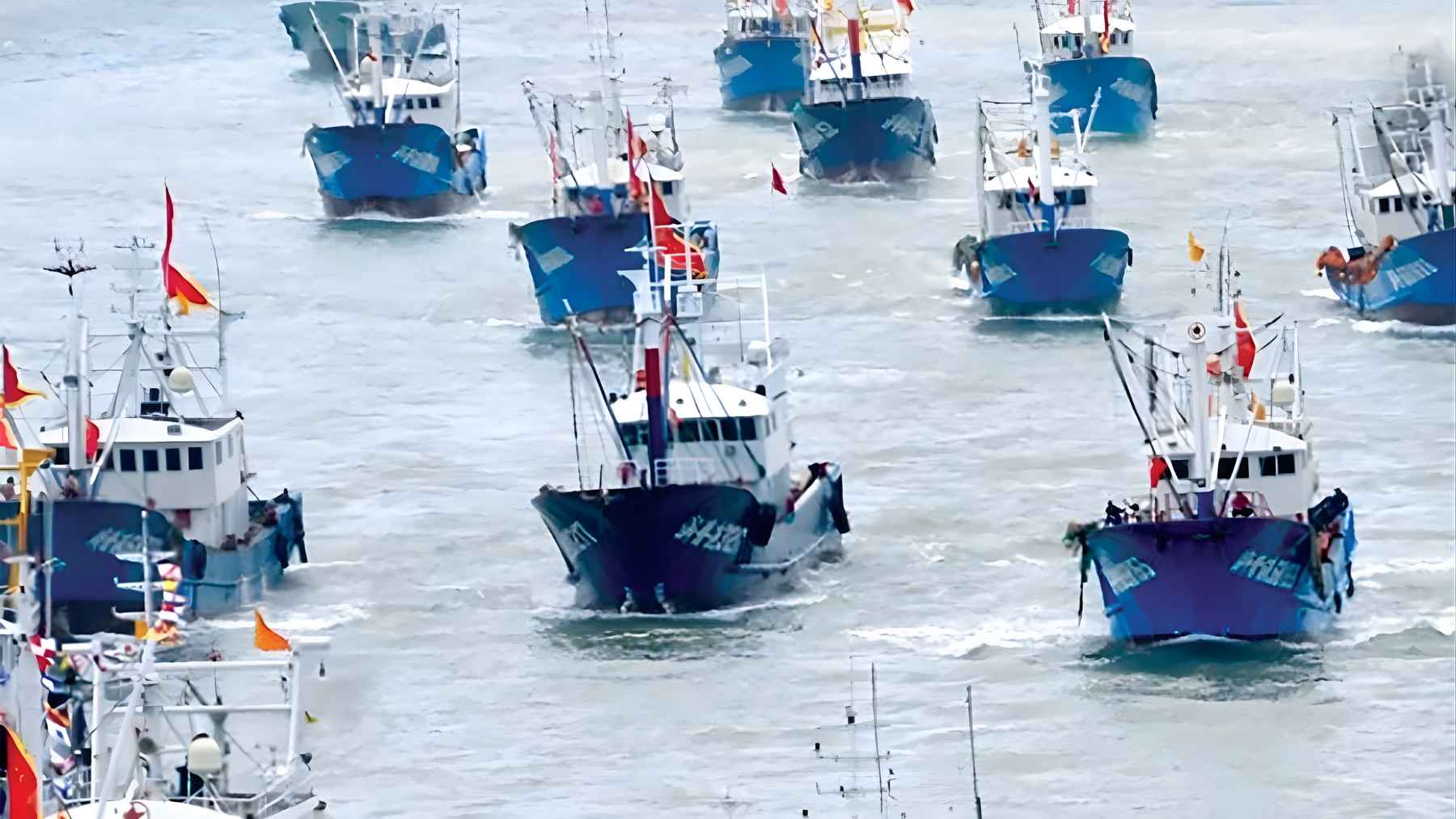
What happens when a fishing fleet stops looking like a fishing fleet? In mid January, about 1,400 Chinese vessels gathered into a tightly organized formation stretching roughly 200 miles in the East China Sea.
A similar maneuver had already appeared on Christmas Day, when around 2,000 boats formed long lines in the same waters. U.S. congressional analysts later described the January event as a new “gray zone” threat because formations like this can impede movement without a navy ship in sight.
That alone is striking. But there is another story here, and it matters for environmental readers. What looks like a security story is also an ocean story. When large fishing fleets become tools of state strategy, the line between harvesting seafood and projecting power starts to blur.
In practical terms, that suggests more uncertainty for shipping, more pressure on fisheries governance, and more strain on a sea that is already ecologically stressed.
A formation that looked unlike normal fishing
Satellite imagery and ship tracking data showed the vessels converging over several days, holding position for more than 30 hours, then dispersing. Analysts said the scale, geometry, and timing did not resemble ordinary fishing activity, and nearby cargo ships reportedly had to steer around the cluster or weave through it.
China pushed back on that reading. Embassy spokesperson Liu Pengyu said the East China Sea is an important fishing ground and that November through February is the peak winter season, adding that “It is therefore normal to see a high concentration of fishing boats operating at sea during this time.”
Still, experts keep circling back to one phrase. “Maritime militia.” The Pentagon says China’s maritime militia is a component of the country’s armed forces, operates under military control, and in peacetime helps assert Beijing’s maritime claims. The same report says China has built at least 235 large steel-hulled fishing vessels for militia-linked operations since 2014.
In other words, these are not always just boats chasing fish. Sometimes they are part of a much bigger playbook.
The East China Sea is already a tense waterway. The Pentagon’s 2024 report says Chinese coast guard ships entered waters around the Senkaku Islands on 352 days in 2023, the highest total since Japan nationalized the islands in 2012.
Add a huge civilian flotilla to that picture and everyday navigation starts to look less routine. Anyone who has sat in traffic knows how fast a crowded route can change behavior, even before it becomes a full blockage.
The environmental angle people should not miss
Here is the part that should not get lost. The East China Sea is not just a strategic map. It is a living ecosystem under pressure. A 2022 study in Frontiers in Marine Science said China introduced management measures in the East China Sea because of depleted fishery stocks.
Another study, published in 2023, found that two important fish populations in the region, chub mackerel and conger, were overfished and declining.
And there is one more warning sign. A 2024 study in Marine Policy found that China’s “gray zone” actions in the East China Sea, Taiwan Strait, and South China Sea can reduce fishing space and lower catches in neighboring waters. That is why the January formation may matter beyond geopolitics.
Even if not every vessel in the line was actively fishing at that moment, the broader pattern suggests that fishing capacity is being folded into a system that does little to ease the burden on a sea that already needs tighter management, not more confusion.
So, was this a fishing operation, a drill, or a message? Maybe, to a large extent, it was all three at once. That is what makes the episode so unsettling. The same boats that bring seafood to market can also be used to shape access and pressure rivals, and the ocean ends up carrying part of the cost.
The official bulletin was published on the “U.S.-China Economic and Security Review Commission” website.