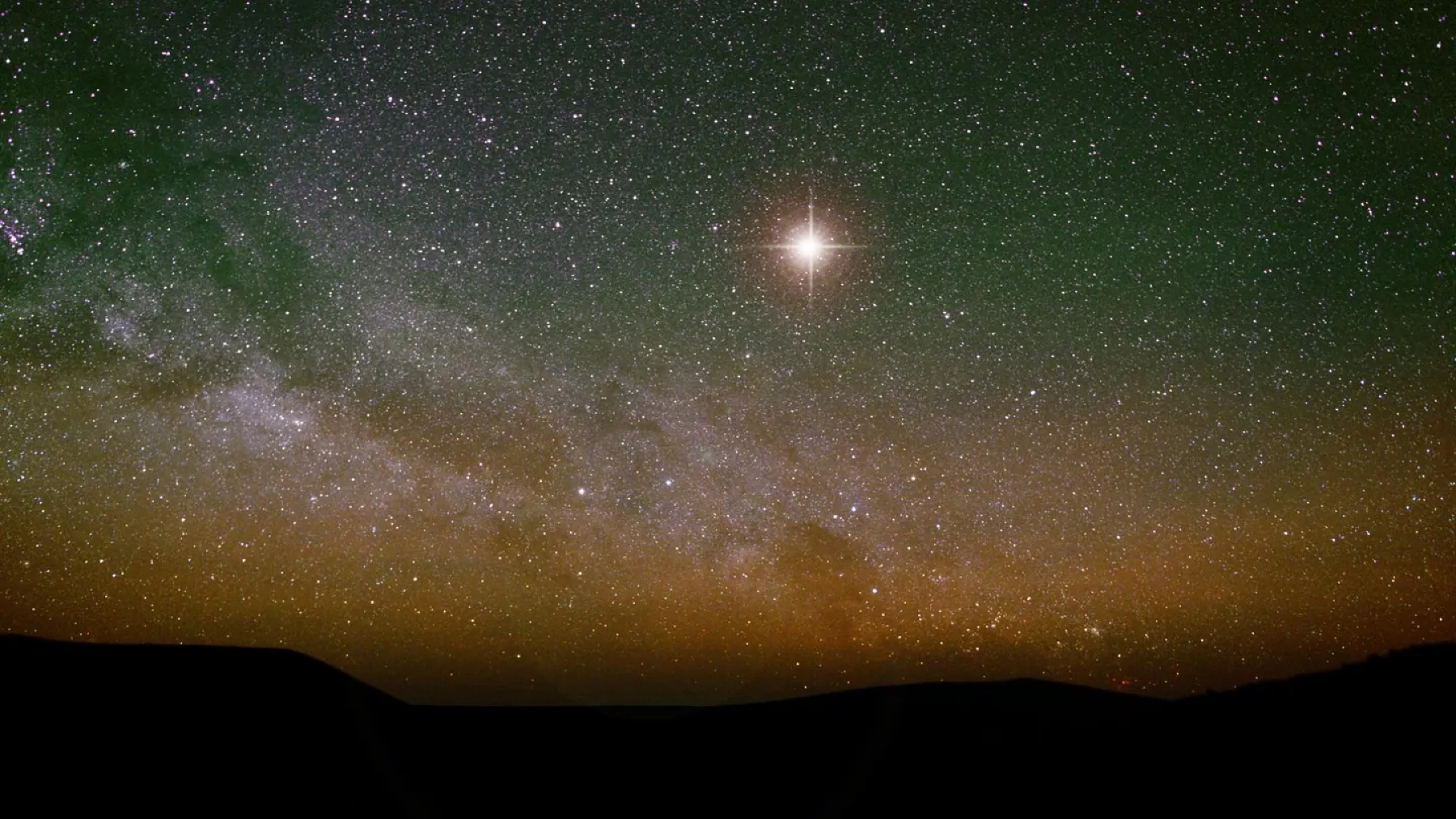
As the Christmas season approaches, the always-watchful eyes of heavenly bodies are on the lookout for the “Christmas Star” that’s fast becoming an enigma. Last year’s extremely rare one-time conjunction of Jupiter and Saturn, now long gone, will be followed by an exciting series of planetary events during December 2024. This December will not fail to delight the serious professional astronomer and the amateur lay observer alike with wonders up among the stars, big and small.
The conjunction between Venus and crescent Moon on December 4 would be seen
December is likely to be the time to see one of the earliest and prettiest conjunctions this year-the crescent moon and Venus-your visible attraction to be set in the western sky on the evening of December 4. Currently, Venus is becoming even brighter and will approach Earth’s nearest distance in February 2025.
The 14%-lit crescent moons would be present with Venus on December 4 for a beautiful, artistic, and incredible view that twinkles in the twilight. This conjunction will be available just after sunset; the bright blazing brilliance of Venus should create a view of exquisite contrast with the fine-light crescent moon.
For a few days leading up to this phenomenon, Venus will appear each night in a glowing manner. But on the December 4, when that slender arc of moon hangs quite nearby, that gives such an authentic celestial beauty view from all those bright twinkling stars overhead. This is something that will make stargazing wonderful yet casual. Wherever you may be, city or country, Venus and the crescent moon will provide an easy, pretty moment in stargazing.
Jupiter will be at opposition: Perfect time to see it on December 7
Jupiter aligns perfectly opposite to Earth with the Sun on December 7, 2024. It promises to be the best time of the year for viewing Jupiter – when it is at its fullest and closest to Earth. From the time the sun sets until the sun rises again, Jupiter will light up the evening sky easily shining as a bright, steady light to the naked eye. It is the perfect opportunity to view through binoculars or telescopes Jupiter’s cloud bands and moons. This exquisite vision will be visible until sometime in mid-January 2025, so catch it while you can!
Northern Lights are as bright as they ever were in December 2024
During this glorious December of 2024, another event reserved for the high northern latitudes: the Northern Lights, or Aurora Borealis. The Sun is currently at its solar maximum phase, meaning it is experiencing the highest level of solar activity and gives rise to many storms, which generally disturb the magnetic field of the Earth and create brilliant displays of light referred to as the northern lights.
During this period, the solar wind has become intensified, and geomagnetic storms have been very frequent. The Northern Lights now become visible at lower latitudes than what is usual. It is mainly observed at polar regions; however, this year it may go as far as areas farther south into some parts of northern USA and even in Europe. The aurora is said to put on an especially bright show for high-latitude observers.
The Northern Lights paint the sky with bands of green, pink, purple, and even red, displaying mesmerizing views well worth watching throughout the sleepless night with bright, dancing sky patterns. However, some areas distant from the prime viewing locations should still monitor the forecast as geomagnetic storms often send lights lower than usual.
Surely this is not the month of one “Christmas Star,” but December is packed with mouthwatering top-end sky events. The Venus-Moon conjunction, Jupiter opposition, and, best of all, Northern Lights visible farther south make December 2024 one of the most unforgettable skywatching months. Star-gazing enthusiasts can be of any expertise level, but the night sky is going to be full of wonders.