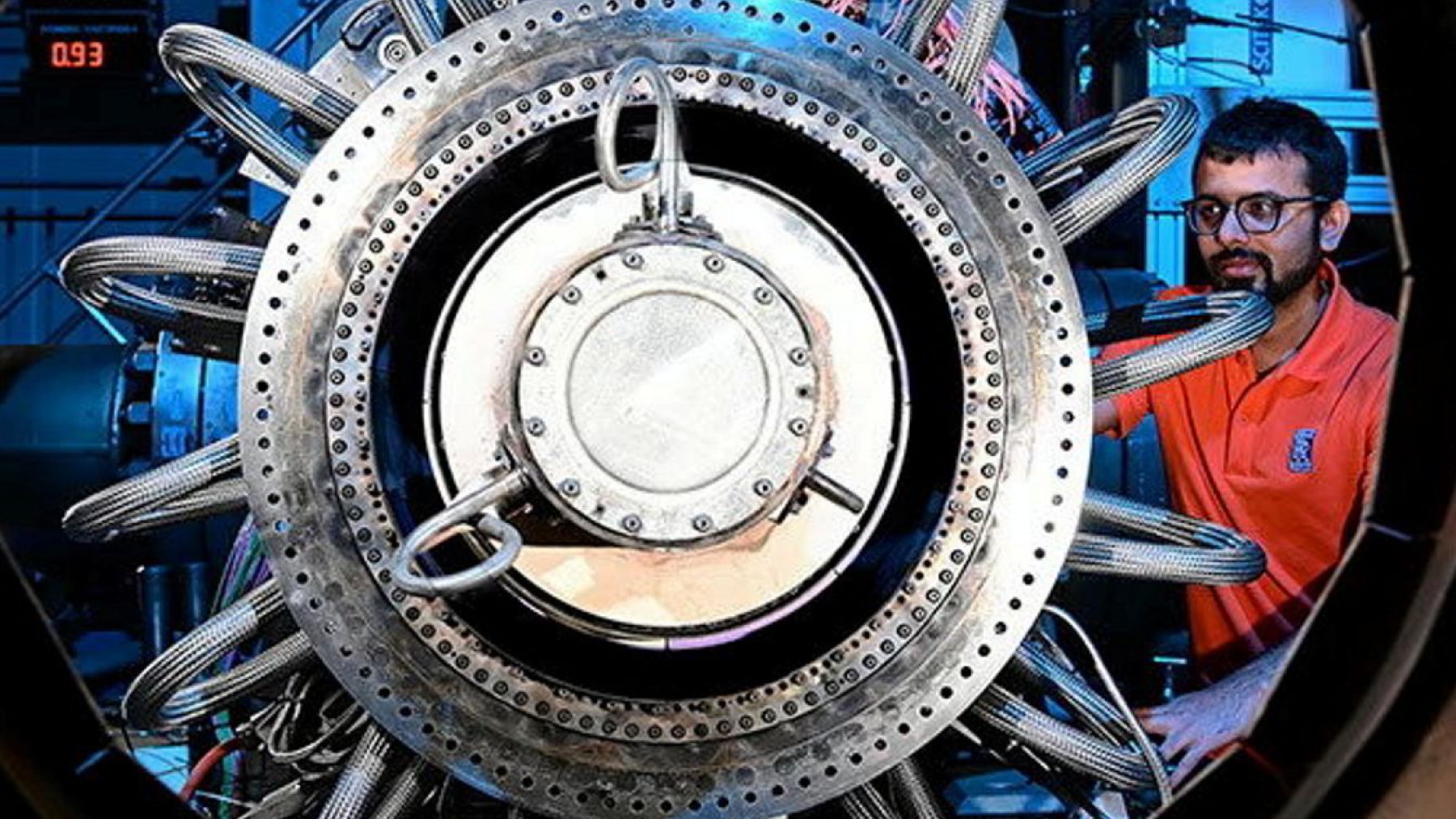
Who said EVs were going to be the future of sustainable mobility? A legendary brand has just set a historic milestone by achieving the impossible and pushing one of the most futuristic fuels almost to the limit: the colossal 2.5 MW hydrogen engine that has cost $5 million. It has broken all records, and we still know very little about it, but what we have learned has left experts in awe. It has broken all records, and we still know very little about it, but what we have learned has left the experts in suspense.
New hydrogen engine to break all records: Experts are on edge with a possible new generation of FCEVs
Rolls-Royce, which offers energy, power and propulsion services, has recently stated that it is working on a new efficiency-focused project of a combustion engine to be used in hydrogen combined heat and power systems. Specifically, the Phoenix project has set itself the goal of developing a new-generation hydrogen engine capable of equal performance as a contemporary NG CHP unit.
Rolls-Royce, together with co-operating partners who are the Institute for Sustainable Mobile propulsion systems in Technical University, Munich, MAHLE Konzern, Fuchs Lubricants Germany GmbH, BAM or German Federal Institute for Materials Research and Testing and lastly Robert Bosch AG comprise the Phoenix project.
It focuses on increasing the amount and efficiency of renewable energy sources and is being implemented as part of the programs financed by the BMWK of the German Federal Ministry for Economic Affairs and Climate Protection, with a total amount of nearly five million dollars.
The capability to adapt the current Rolls-Royce hydrogen engine is another significant factor in Rolls-Royce’s decision. The engines from the Rolls-Royce company have already been designed to use a combustion gas engine that can also use hydrogen fuel. However, in the Phoenix project, the technology goes further and seeks to create an even more efficient hydrogen engine just for CHP applications.
Some keys to understanding the Rolls-Royce hydrogen engine: Why is it so massive?
The Phoenix project has specific targets for the new hydrogen engine. Here, the Phoenix project has laid down good targets for the years ahead. They say that for a CHP unit, the consortium seeks to produce electrical and thermal energy (power density and efficiency) as produced by a natural gas CHP unit in the higher class of up to 2.5 MW.
The new flagship, next-generation stationary energy plant, when operated on renewable electricity and green hydrogen, will have zero carbon emissions. To achieve this, the project partners are developing several critical components, including:
- The injection system.
- The piston group.
- The ignition system.
- A completely new lubricant.
Rolls-Royce hydrogen engine will put an end to two fuels: One is natural gas, but the other one?
This development of such a high-efficiency hydrogen engine for CHP systems is rather significant due to the recent decisions of the German government to construct additional gas-fired power plants in order to balance the fluctuating capacities of renewable energy sources, such as wind or solar electricity.
Such small and distributed gas engine plants have a great capacity to change their operation characteristics to feed in renewable power to the grid. Instead of natural gas, these CHP systems will employ hydrogen as a fuel, and thereby it will be possible to achieve completely carbon-neutral generation, which in turn will conform to Germany’s broader decarbonization agenda.
Rolls-Royce is part of a drive to make ‘green’ the company’s engine power by inventing and perfecting CHP systems with the use of hydrogen engines. The company is also working towards the adaptability of its reciprocating MTU engines, which will enable them to support different types of fuels, such as HVO and e-fuels. Besides, the company is considering methanol for marine vessels.
As you can see, this hydrogen engine is going to break records not only in terms of power and efficiency, but also in terms of autonomy, a sector that this fuel has not yet reached. The key is in the new type of injection, which doubles the range of the conventional one and will undoubtedly become the future. So we leave electricity behind? Perhaps Elon Musk did not have time to get into this type of vehicle and revolutionize it, as he did with cars.