For almost two months in late 2024, Earth quietly traveled through space with a tiny extra companion. A new research note in Research Notes of the American Astronomical Society shows that the near-Earth asteroid 2024 PT5 was temporarily captured by our planet from September 29 until November 25, in what the authors describe as a mini moon event.
Most people who stepped outside at night never noticed a thing. The object is only about ten meters wide, roughly the size of a small bus, far too faint for backyard telescopes. Yet in dynamical terms it did something remarkable. As it approached Earth with very low relative speed and followed an orbit around the Sun similar to ours, our planet’s gravity briefly turned its path into a bound state, a situation astronomers call negative geocentric energy.
So what exactly does that mean in plain language? Think of 2024 PT5 as a slow-moving rock already drifting alongside Earth in a neighboring lane of the solar highway. For about 56 and a half days that rock slipped into our gravitational lane, looping in a tight, distorted arc around Earth before sliding back out toward its usual track around the Sun.
In their analysis, Carlos and Raúl de la Fuente Marcos classify this episode as a temporarily captured flyby, one flavor of mini moon. Objects in this category do not quite complete a full revolution around Earth while they are bound. Others, such as 2006 RH120 and 2020 CD3, stayed longer and made full loops, so they are labeled temporarily captured orbiters. These distinctions may sound technical, but they matter for understanding how small bodies drift through Earth’s neighborhood.
The story of 2024 PT5 starts earlier in 2024. Astronomers using the NASA-funded Asteroid Terrestrial impact Last Alert System, with a telescope in Sutherland, South Africa, first spotted the object on August 7 and followed it for 21 days to pin down its orbit. Their calculations show that 2024 PT5 belongs to the Arjuna group, a sparse family of near Earth asteroids whose paths around the Sun closely match the orbit of the Earth Moon system.
Those Earth-like paths are key. Because Arjuna asteroids move almost in step with our planet, their relative speeds can drop to just a few kilometers per second. That is slow by cosmic standards. Under those conditions, Earth can occasionally snag one for a while, creating a mini moon episode like the one seen in 2024. After the capture phase, simulations show 2024 PT5 passed within about 0.012 astronomical units of Earth on January 9, 2025 then headed back into deep space, with another close visit expected around 2055.
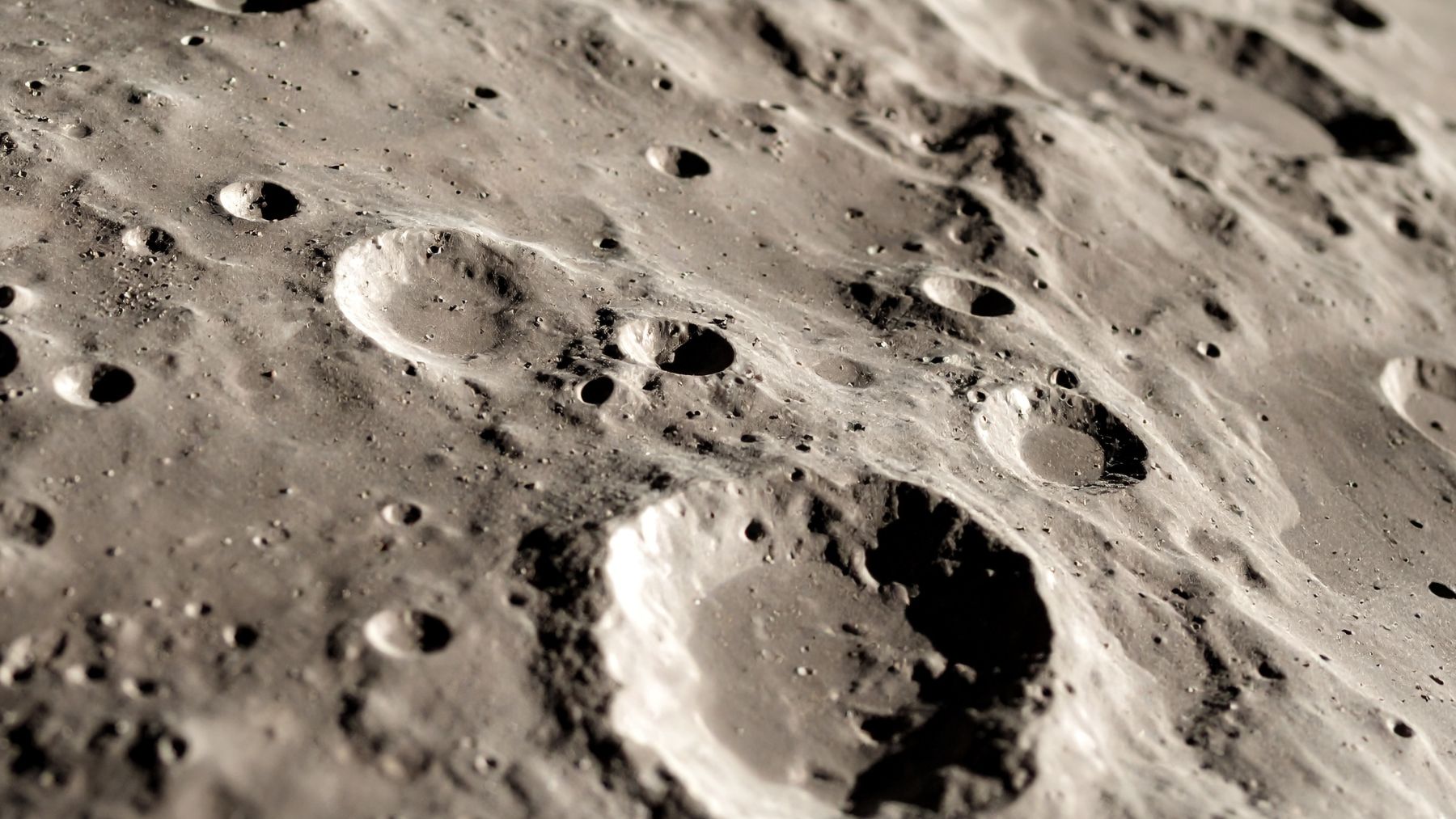
Later studies added a striking twist. A team led by the Instituto de Astrofísica de Canarias and Universidad Complutense de Madrid observed 2024 PT5 with several telescopes, including the 10.4 meter Gran Telescopio Canarias. They report that the asteroid’s optical spectrum is very similar to lunar rocks returned by Soviet Luna and NASA Apollo missions, and that its fast spin period, shorter than one hour, fits the pattern of fragments created in violent impacts. Independent work published in Astrophysical Journal Letters reached the same conclusion, arguing that 2024 PT5 likely began as material blasted off the Moon’s surface long ago.
In other words, Earth briefly captured a piece of its own Moon as a mini satellite. It is a kind of cosmic recycling loop. The Moon loses material in a collision, fragments drift into Arjuna type orbits, then every so often one of those pieces swings close enough for Earth to grab it for a few weeks. The same Spanish team notes that two other small bodies, 2022 NX1 and the quasi satellite 469219 Kamoʻoalewa, also show lunar-like surfaces, suggesting that lunar debris may quietly populate this whole group of near Earth objects.
Even the label mini moon is part of an ongoing scientific conversation. The new AAS paper describes 2024 PT5 as undergoing a mini moon event because its calculated energy relative to Earth goes negative for nearly two months. A later NASA planetary defense blog notes that in their modeling the object never becomes fully bound and prefers to call it a close companion, a reminder that definitions can differ slightly between research groups.
Why should anyone who is more worried about the electric bill or city traffic care about a ten meter rock that nobody can see? For one thing, Arjuna asteroids approach Earth slowly, which makes them interesting targets for future space missions and for planetary defense practice. Their gentle relative speeds turn them into natural laboratories where scientists can refine tracking techniques and study how tiny objects move under the combined pull of Earth, the Moon and the Sun.
For another, mini moons show that Earth’s environment does not stop at the edge of the atmosphere. Our planet sits inside a shifting cloud of small bodies that sometimes deliver meteorites, sometimes just pass by, and occasionally become short lived moons. Most of us will never notice these visitors on a clear night, but each one carries clues about how the Earth Moon system formed and how it continues to evolve.
The study was published in Research Notes of the American Astronomical Society.