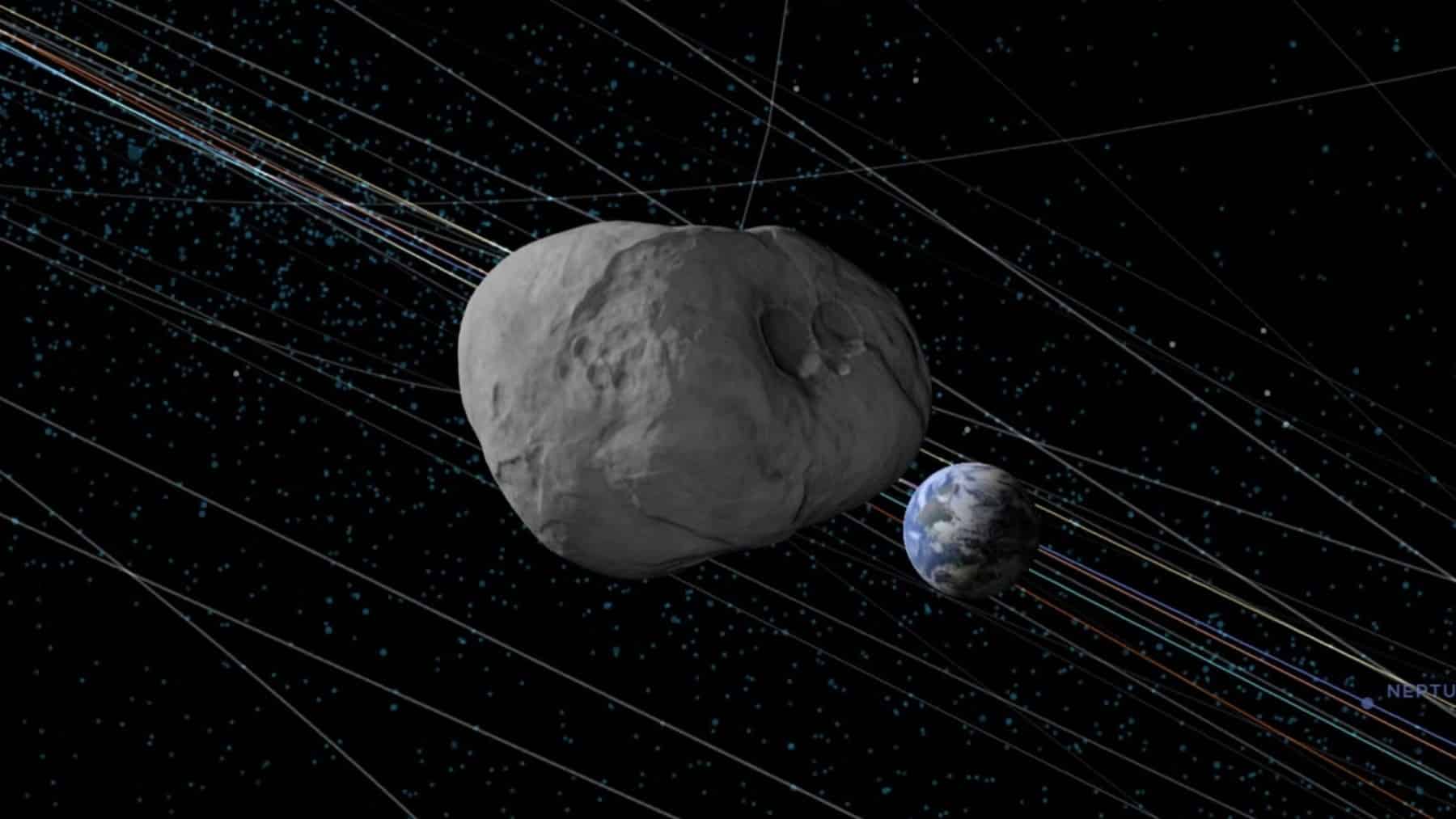
It seems that we will have the company of five objects orbiting near Earth; that’s what NASA detected this week. As much as this type of news catches our attention, these detections are part of the routine not only of NASA but also of other space agencies. After all, no one here wants something (or someone) appearing out of nowhere on the planet, right? That’s why, on a day that until then was normal, five new objects were detected coming towards Earth.
What are these objects near us?
Are these objects that are coming towards Earth UFO-like objects? Not necessarily. Experts call them NEOs (Near-Earth Objects). What do they mean? Well, these objects include everything from asteroids to comets that are orbiting in regions relatively close to us here on Earth. Does this mean that they will collide with us at any moment? No, but they are close enough to be monitored.
Remember when we said that this monitoring is part of NASA’s routine? So, they can track everything in real time through the Planetary Defense Coordination Office system. These systems help predict trajectories, calculate safety margins, and even study the physical characteristics of asteroids. So we can rest assured, because we already know that people are keeping an eye on everything that passes close to our planet, assessing whether it could be a risk or not. In this most recent case, the 5 objects coming towards us are asteroids.
And the 5 asteroids detected near Earth are…
In the last week of May, NASA confirmed the detection of five asteroids that passed close to Earth on those days. Of course, none of them posed any risk of collision (unlike this other asteroid analyzed by NASA that is very close to our planet), however, they ended up attracting attention and even being observed more due to their speed, trajectory, and size.
Of the 5 that passed by here, one of them stood out: asteroid 2025 KX3. That’s because it was “only” 34 feet wide, just to give you an idea, that’s basically the size of a bus. Other than that, it passed very close to us, at a distance of only 211,000 miles from Earth, which, without wanting to scare anyone, is closer than the Moon itself.
In addition to it, four more asteroids completed the list of objects that passed by here:
- 2025 JP: 79 feet wide, like a commercial plane, and it flew by at 3.19 million miles.
- 2025 JR: This is the largest on the list, at 250 feet (the size of a building), and it flew by at 2.87 million miles.
- 2025 KW: 91 feet (also like a plane) and flew by at 3.07 million miles.
- 2025 KU1: 63 feet (we can consider it as a house), and it was the one that flew the furthest from us at 4.6 million miles.
Why do even the smallest asteroids matter?
At first, it may seem strange to say that asteroid 2025 KX3 was the one that worried NASA agents the most, since it was the smallest of the 5. However, we need to remember that size doesn’t matter, especially when we are talking about objects close to Earth. This is because the smallest of asteroids have the power, through their kinetic energy, to destroy if they collide with our planet.
Leaving this point of concern aside, being aware of the movement of these objects is important to better understand the formation of our solar system. How so? Asteroids carry in their composition primordial elements – in other words, a lot of new information for us to explore. And as if the proximity of the asteroids wasn’t enough, NASA recently identified something else approaching Earth. They still have no idea what it is, but there is already a theory.