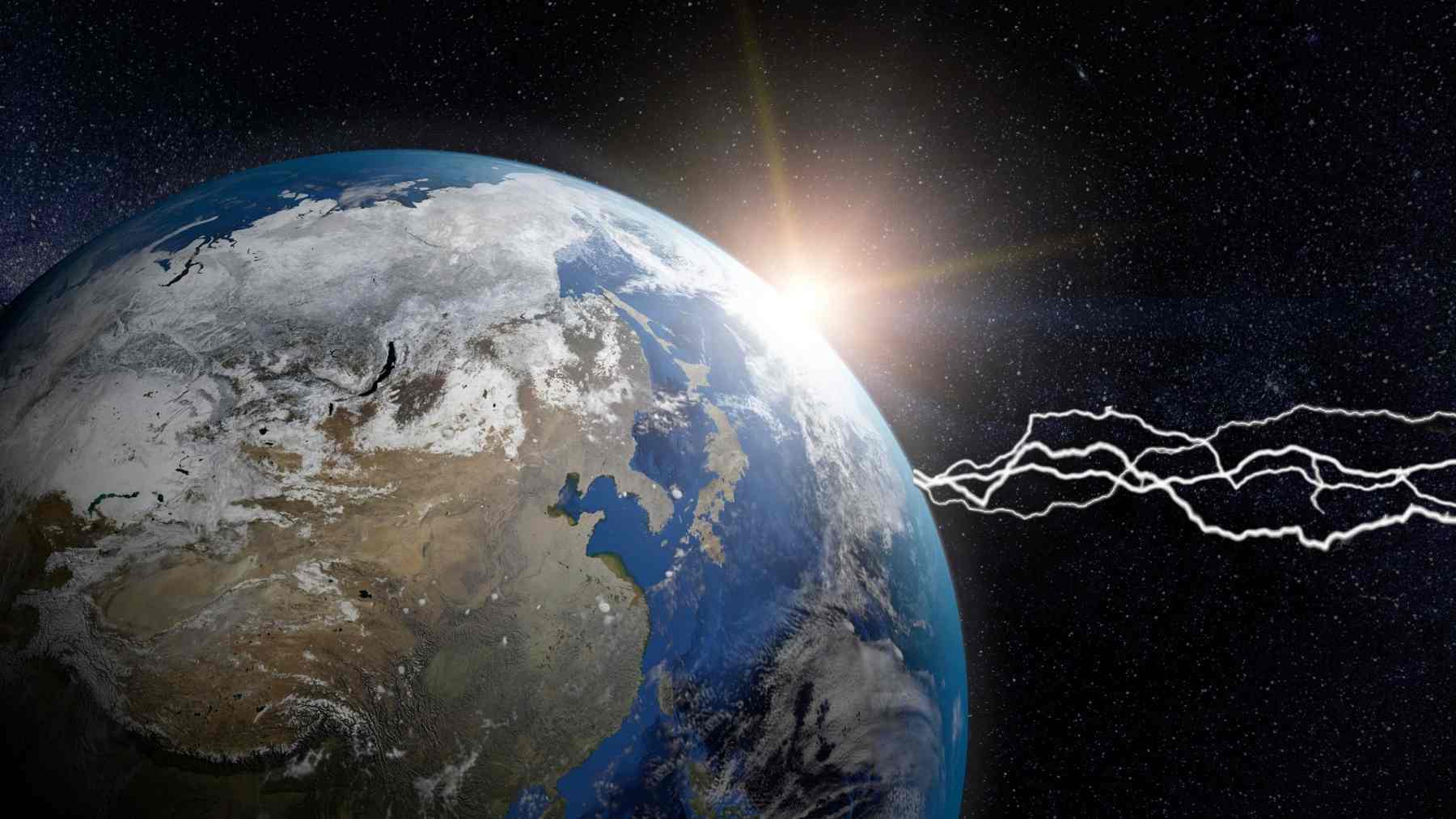
High above the weather, beyond airplane routes and polar auroras, Earth is running a silent experiment. A newly-measured global electric field is constantly tugging at the upper atmosphere and feeding a thin wind of particles into space.
For the first time, scientists have directly measured this field, known as the ambipolar electrostatic field, using NASA’s Endurance sounding rocket and reported the result in the journal Nature.
The numbers sound tiny. Endurance detected a potential drop of only about 0.55 volts between roughly 250 and 768 kilometers above the Arctic, which corresponds to an electric field of just over one millionth of a volt per meter. Yet that faint field appears strong enough to reshape the polar ionosphere and dramatically boost the supply of charged oxygen and hydrogen that escape along Earth’s magnetic field lines into space.
According to the Nature study, the field increases the height of the ionosphere by 271 percent and can raise the outflow of cold oxygen ions to the magnetosphere by more than 3,800 percent. That makes this effect a major player in how our planet slowly loses atmospheric material over billions of years.
A third global energy field around our planet
Most of us learned about two great forces that shape Earth at school, gravity and the magnetic field. Researchers now argue that this ambipolar field should be considered a third global energy system, because it constantly moves charged particles and changes how thick the upper atmosphere is.
The process starts where solar radiation knocks electrons off atoms and molecules, creating a plasma of light electrons and heavy ions. Electrons tend to race outward, while ions feel gravity more strongly. If nothing corrected that separation, the two populations would drift apart. Instead, their opposite charges create an electric field that keeps them coupled.
NASA scientists describe it as a kind of vertical tug of war. Fast-moving electrons pull ions upward while the heavy ions try to drag electrons back down. The result is a gentle but persistent lift that allows some particles to reach heights where they can escape along open polar magnetic field lines in what is called the polar wind.
As lead scientist Glyn Collinson put it, “Something had to be drawing these particles out of the atmosphere.” The new measurements show that this field fits the bill.
Rocket flight through the polar wind
To catch such a weak signal, the Endurance team needed a precise plasma spectrometer and a launch site almost on top of the North Pole. The rocket lifted off from Ny Ålesund in Svalbard in May 2022, arcing to about 768 kilometers before splashing down in the Greenland Sea less than twenty minutes later.
Across a vertical slice of about 322 kilometers, the instruments mapped the change in electric potential. The measured half volt may sound laughable next to the power flowing through a city tram line, yet spread over hundreds of kilometers it exerts a steady upward push on charged particles. Hydrogen ions in the polar wind feel an outward force more than ten times stronger than gravity, enough to accelerate them to supersonic speeds.
Heavier ions are lifted too. The team showed that oxygen ions in this region effectively behave as if they weigh about half as much as they would without the ambipolar field. That makes Earth’s upper atmosphere puffier and more extended than gravity alone would allow.
Suzie Imber, a space physicist who helped plan the launch, summed up why Svalbard was crucial. “Svalbard is the only rocket range in the world where you can fly through the polar wind and make the measurements we needed.”
Why a half volt matters for life and climate
What does a whisper of electric potential hundreds of kilometers above your head have to do with daily life or climate policy on the ground?
To a large extent, this field regulates how quickly Earth leaks its lightest gases into space. Over immense timescales, that loss affects how much hydrogen and oxygen remain available to form water and how the upper atmosphere interacts with solar radiation.
Comparisons with other worlds hint at the stakes. At Venus, spacecraft have measured a much stronger electric field that appears able to drag oxygen and hydrogen away fast enough to help strip water from the planet. Earth’s weaker ambipolar field still sends ions outward, but not so violently that our air and oceans vanish. Scientists see that balance as one piece of the broader habitability puzzle.
The discovery also feeds directly into space weather forecasting. Cold ions from the ionosphere supply a large share of the plasma in Earth’s magnetosphere, which in turn shapes how energy from solar storms is stored and released. Better models of this outflow help protect satellites, navigation systems, and even power grids that keep the lights on and the air conditioning running during that sticky summer heat we all know.
Collinson notes that similar ambipolar fields should arise anywhere an atmosphere is ionized. “Any planet with an atmosphere should have an ambipolar field,” he said. That idea links a small half volt measurement over the Arctic to big questions about which exoplanets can hang on to their air and possibly support life.
A later correction to the Nature paper adjusted technical details but left the central conclusion intact that Earth hosts a measurable planetwide ambipolar field that strongly influences ion escape.
In practical terms, this means our planet lives inside three intertwined energy systems: gravity, magnetism, and this newly quantified electric field. Together they help decide how much atmosphere Earth keeps, how space storms unfold, and how stable our environment remains over deep time. For a force you cannot feel on your skin or see in the sky, that is a quiet kind of power.
The study was published on the Nature site.