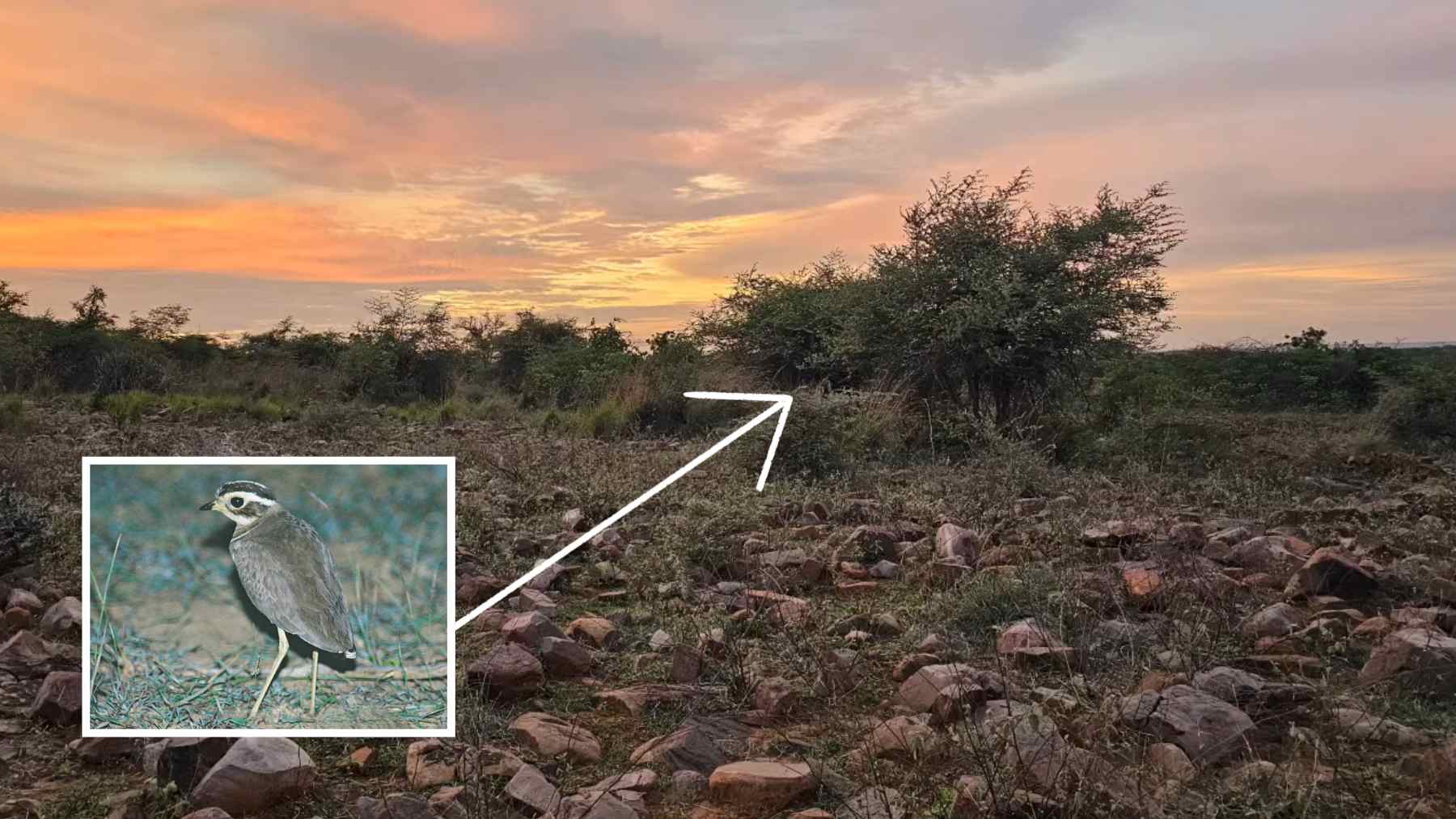
For the first time in well over a decade, a small night bird long feared on the brink of extinction has spoken up. A simple two note call recorded in late August in the Indian state of Andhra Pradesh has confirmed that the Jerdon’s courser still survives in the wild. For a species listed as Critically Endangered and missing from confirmed records for many years, that brief sound is a major conservation milestone.
Andhra Pradesh night survey recording
The recording was made on August twenty fourth during a night survey on the dry east coast of southern India. A small team of Indian birdwatchers had spent weeks poring over maps and scientific papers before heading into the field. They walked the scrub by day, learning the contours of the land, then returned after dark to listen in near silence.
On their very first night of focused listening, shortly after half past nine, the microphones captured the distinctive two note call. The file, logged with time and coordinates, was later archived so that other experts can review it.
Indian birdwatchers and Jerdon’s courser search
The effort grew from a personal obsession. Birder Harish Thangaraj became fascinated by Jerdon’s courser after reading an old description from one of the last people to see it. Together with fellow birders Shashank Dalvi, Adesh Shivkar, Ronith Urs and Pranav, he searched for scrublands that resembled the Sri Lankamalleswara Wildlife Sanctuary, the stronghold that had defined the species map for years.
Their desk research in July and August pointed to overlooked habitat outside that sanctuary, and the late August field trip quickly proved that hunch was right.
Jerdon’s courser habitat and Critically Endangered status
Jerdon’s courser is a medium sized ground bird with brown plumage, long legs and large eyes, built to run quickly over rough soil at night. It hunts insects in short bursts, then freezes for long stretches, a behavior that makes it almost invisible under a headlamp.
It favors low, thorny scrub with open patches, exactly the kind of landscape people often dismiss as empty. That secretive lifestyle, combined with a global estimate of only about fifty to two hundred forty nine mature individuals, explains why even dedicated observers rarely encounter it.
Eastern Ghats records and Sri Lankamalleswara Wildlife Sanctuary
Over the last one hundred twenty five years the species has slipped in and out of view. Described in the eighteen hundreds, it went missing for much of the twentieth century, then was rediscovered late in the century in a small corner of the Eastern Ghats. Most modern records came from a single protected landscape around Sri Lankamalleswara.
Outside that area, Jerdon’s courser seemed to vanish again. The new call from Andhra Pradesh sits beyond those familiar hotspots, challenging the assumption that the bird now survives only inside one sanctuary.
Bioacoustics and wildlife monitoring techniques
This rediscovery is also a showcase for modern listening techniques. Earlier work used tracking strips and camera traps to pick up footprints and images without chasing the bird at night. Today, researchers lean on bioacoustics, the systematic study of animal sounds. Clear protocols tell field teams how to place recorders, how long to run them and how to store each file.
Later, specialists compare the pitch, rhythm and spacing of the two-note call with older reference clips. Spectrograms turn each sound into a visual pattern, which makes it easier to separate the courser from background noise or imitators.
Verified documentation and audio archives for conservation
That chain of evidence matters because unverified rumors can mislead conservation planning. Time, place and call structure together push this record over the line into solid documentation. Audio files have been deposited in public libraries used by field biologists, so independent listeners can check the identification.
A second round of surveys using the same methods in similar weather will help confirm that the call was no accident.
Range maps, scrubland protection, and conservation planning
For ecologists, even a single verified point can reshape the map of a species that clings to a tiny range. If nearby scrub patches share the same soils, shrubs and human pressure, they are likely candidates for the next round of listening. Updated range maps do more than redraw lines on a screen.
They guide patrol routes, show where to place extra recording units in the next dry season and inform decisions about land conversion. A few acres of scrub can spell the difference between survival and silence.
Search for Lost Birds and global conservation partners
The global context makes the find even more urgent. Jerdon’s courser appears on the “Search for Lost Birds” list, a partnership that includes BirdLife International, American Bird Conservancy and the conservation group Rewild. Senior Red List Officer Alex Berryman calls the rediscovery “an incredibly exciting” result and stresses that “finding and documenting Lost Birds is the obvious first step in implementing action to conserve them”.
He notes that more than one hundred ten lost birds worldwide are still missing from recent records and many are thought to be on the verge of extinction.
Bombay Natural History Society and expanded listening surveys
Local scientists see the new call as a rare bright spot. “It means there is a hope for this species. And I am hopeful that further efforts to find the birds might yield positive results,” says Parveen Shaikh of the Bombay Natural History Society (BNHS).
She and others argue that teams should now expand standardized listening surveys well beyond traditional sanctuary boundaries, archive all audio transparently and combine sound with other methods such as camera traps and track impressions to keep the evidence chain strong.
Jerdon’s courser conservation milestone in Andhra Pradesh
In the end, this story is about more than one elusive bird. It shows how patient field skills, clear scientific protocols and committed local observers can bring a “lost” species back onto the map.
A brief call in the dark scrub of Andhra Pradesh has opened a new chapter for Jerdon’s courser and offered a rare glimmer of hope for the many other missing birds that still wait to be heard.