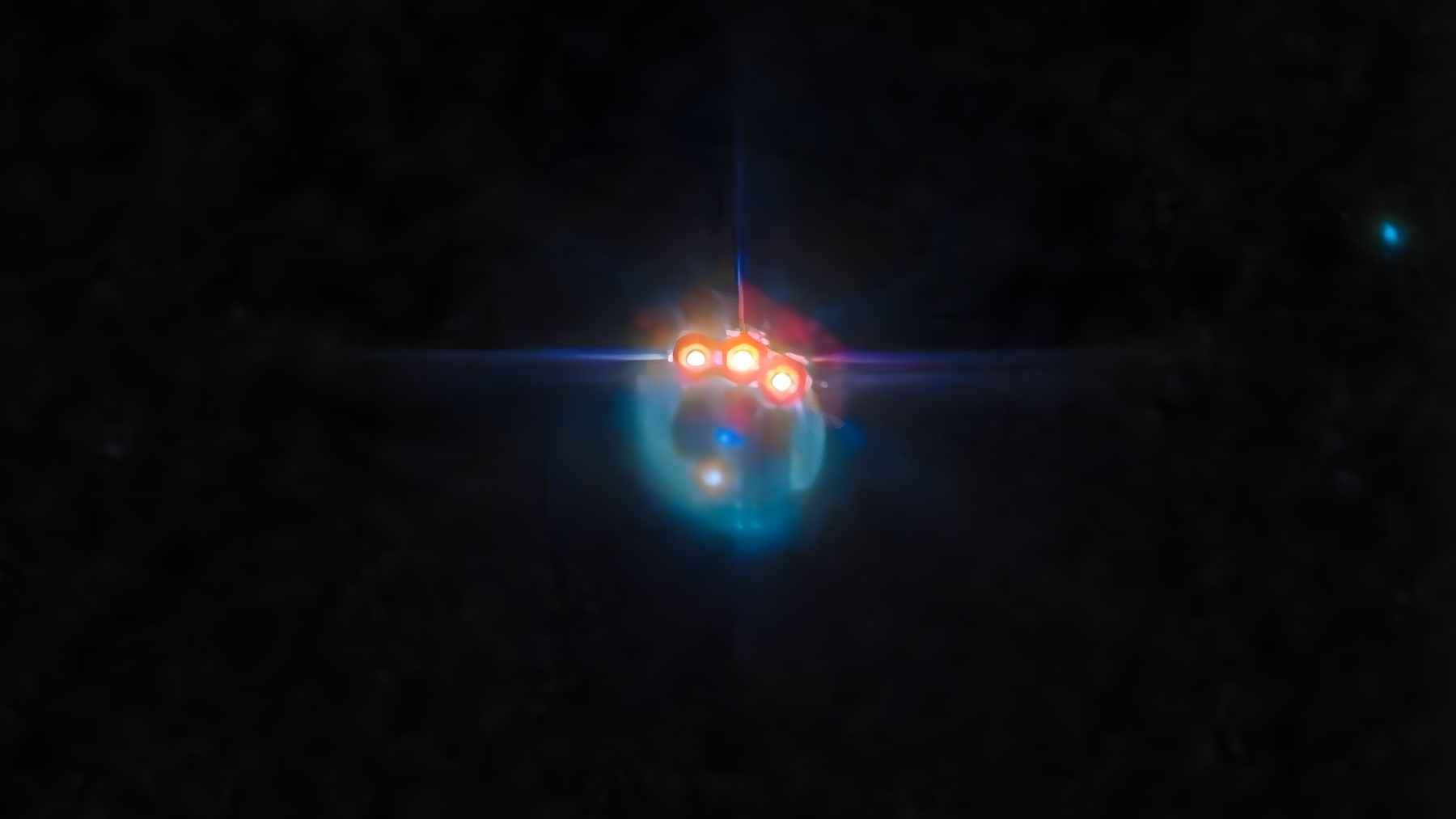
Black holes are famous for being invisible. So how do you measure a halo of hot gas wrapped around one about 6 billion light-years from Earth? Using a rare cosmic “double zoom”, astronomers directly measured the size of this corona and found that it stretches roughly as wide as our entire solar system.
Led by Matus Rybak at Leiden University, the team studied the quasar RX J1131 with the Atacama Large Millimeter or submillimeter Array, or ALMA. Their analysis, reported in a paper in Astronomy & Astrophysics, opens a new way to examine what happens right next to a supermassive black hole.
What astronomers saw around RX J1131
A black hole corona is a halo of extremely hot gas that clings to the region just outside the black hole, where swirling matter is heated to millions of degrees. It is a bit like the sun’s outer atmosphere, only far hotter and packed into a much smaller and more turbulent zone.
RX J1131 is a quasar, so its central black hole is actively feeding on gas and dust and shining as one of the brightest objects in the universe. The new measurements show that its corona spans about 50 astronomical units, a scale similar to the distance from our Sun out to the edge of the solar system.
How a rare double zoom in deep space works
Between us and RX J1131 sits a massive galaxy roughly 4 billion light-years away whose gravity bends the quasar’s light like a giant lens, splitting it into four separate images in the sky. This effect, known as strong gravitational lensing, turns the foreground galaxy into a natural telescope that magnifies the background quasar and its surroundings.
Rybak and his colleagues reexamined data from the array taken nearly a decade earlier while they were hunting for cold gas in the system.
Small brightness changes in the four images did not match up, and they eventually realized that the galaxy acts like a big magnifying glass while its stars behave like many smaller ones, creating the double zoom that can reveal fine details near the black hole.
Timing tiny flickers to map the halo
If the flickers had started near the black hole itself, all four lensed images would have brightened and dimmed together.
Follow up observations with the array in 2022 taken just a day apart instead showed that each image flickered on its own schedule, which Rybak described as a smoking gun that the extra magnification had to come from stars in the foreground galaxy.
In microlensing, every star in that galaxy behaves like a moving magnifying glass, briefly boosting the light from one small patch of the quasar while leaving others unchanged. By modeling how those boosts rose and fell over time, the team inferred that the millimeter wave emission comes from a compact region about 50 astronomical units across, consistent with a corona roughly the size of our solar system.
Why this matters for black hole growth and future telescopes
The corona shines in both X-rays and millimeter waves because fast moving electrons there spiral around magnetic field lines.
Earlier theoretical work suggested that the size of the corona and the brightness of this emission are closely tied to how strong those magnetic fields are, so measuring the corona gives an indirect way to probe fields that are otherwise hard to test.
Those fields help decide how much material falls into the black hole and how much is flung away in powerful outflows, which controls how quickly a supermassive black hole grows.
Rybak and his colleagues hope to compare their results with new observations from NASA’s Chandra X-ray Observatory, while upgrades to the array in Chile and the upcoming Vera C Rubin Observatory should provide more lensed quasars that show similar double zoom effects.
In practical terms, that means turning rare systems like RX J1131 into a whole population of distant targets where astronomers can watch gravity, gas, and magnetic fields at work up close.
The study was published in Astronomy & Astrophysics.