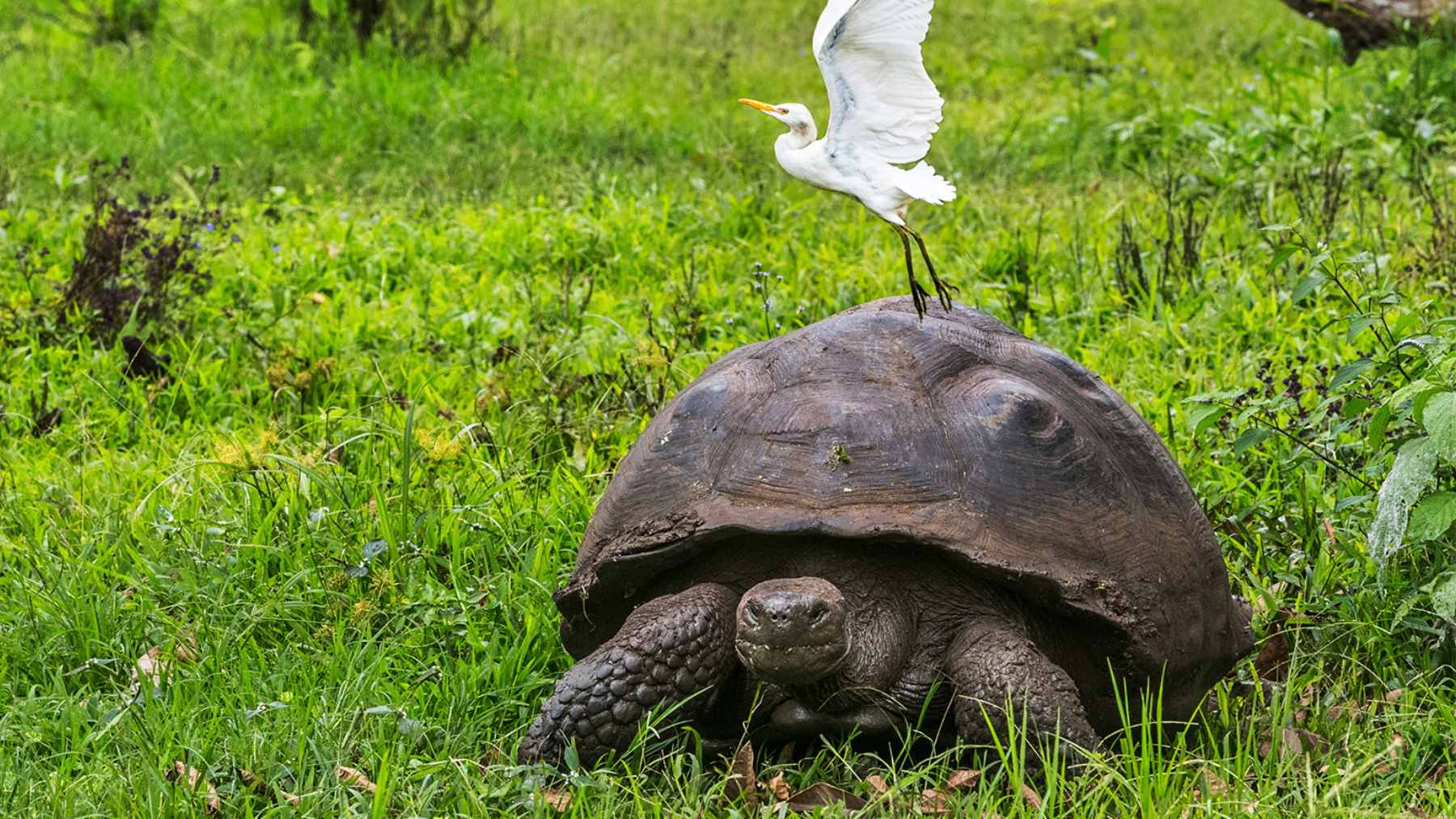
For decades, conservationists hoped that putting giant tortoises back on their home islands would do more than just save a famous reptile. Now there is solid evidence that it is working. Recent studies on Española and other islands show that reintroduced tortoises are thinning woody thickets, nudging plant communities toward grassier savannas, and restarting long-stalled ecological processes.
Over roughly half a century, captive breeding and release programs have returned close to 10,000 giant tortoises to the wild across the archipelago, after centuries of hunting and habitat damage.
Within that larger effort, more than 1,500 animals were moved between the 1990s and 2020 to key islands such as Española, Santa Fe, Pinzón and parts of Santa Cruz. These are the herds now reshaping the land.
From near extinction to ecosystem engineer again
In the 1960s, the Española tortoise population had crashed to just fifteen survivors. Today there are more than 2,300 animals on the island, and the original adults were brought home in 2020 to join their descendants. Visitors who picture tortoises as slow relics are seeing only half the story. As the shells returned, so did an entire style of ecosystem.
When tortoises graze, they clip low shrubs and herbs, press trails into the soil and churn leaf litter. Over time, those small actions add up. An eight year experiment with fenced plots on Española, combined with fifteen years of vegetation mapping, found that areas with enough tortoises shifted toward more grass cover and fewer regenerating woody plants.
Once the animals reached about one to two individuals per hectare, the advance of shrubs effectively stalled and the habitat tipped toward a more open savanna.
For ground nesting birds, small reptiles and sun-loving native herbs, that change in structure matters as much as the number of tortoises on a scientist’s clipboard.
Seeds on the move in slow motion
Tortoises do not only edit vegetation by eating it. They also act as slow-moving cargo ships for seeds. On Santa Cruz Island, tracking work has shown that tortoises disperse seeds for at least 64 plant species. About 20 percent of those seeds end up more than one kilometer from the parent plant, carried in the animal’s gut during long seasonal migrations between lowlands and humid highlands.
Seeds are dropped in dung that acts like a ready-made fertilizer package. In practical terms, that means tortoise paths can function a bit like moving tree nurseries, especially for large fruited native plants such as cacti and some trees that struggle to spread without big animals.
There is a catch. The same movement that helps native species can also boost invaders. Research on guava and passion fruit found that tortoises already transport huge numbers of their seeds into arid zones where these plants currently do not thrive. Under warmer and wetter future climates, many of those “wasted” seeds might suddenly find good conditions, speeding the spread of invasive plants.
So the seed service has two faces, helpful and risky at the same time.
Living infrastructure that runs on sunlight
Conservation groups like to say that each wild giant tortoise consumes more than 500 pounds of vegetation per year. Imagine hiring a brush clearing crew to do that work on remote, rocky terrain. You would need fuel, machinery, spare parts and a steady budget. The tortoise does it powered only by plants and sun.
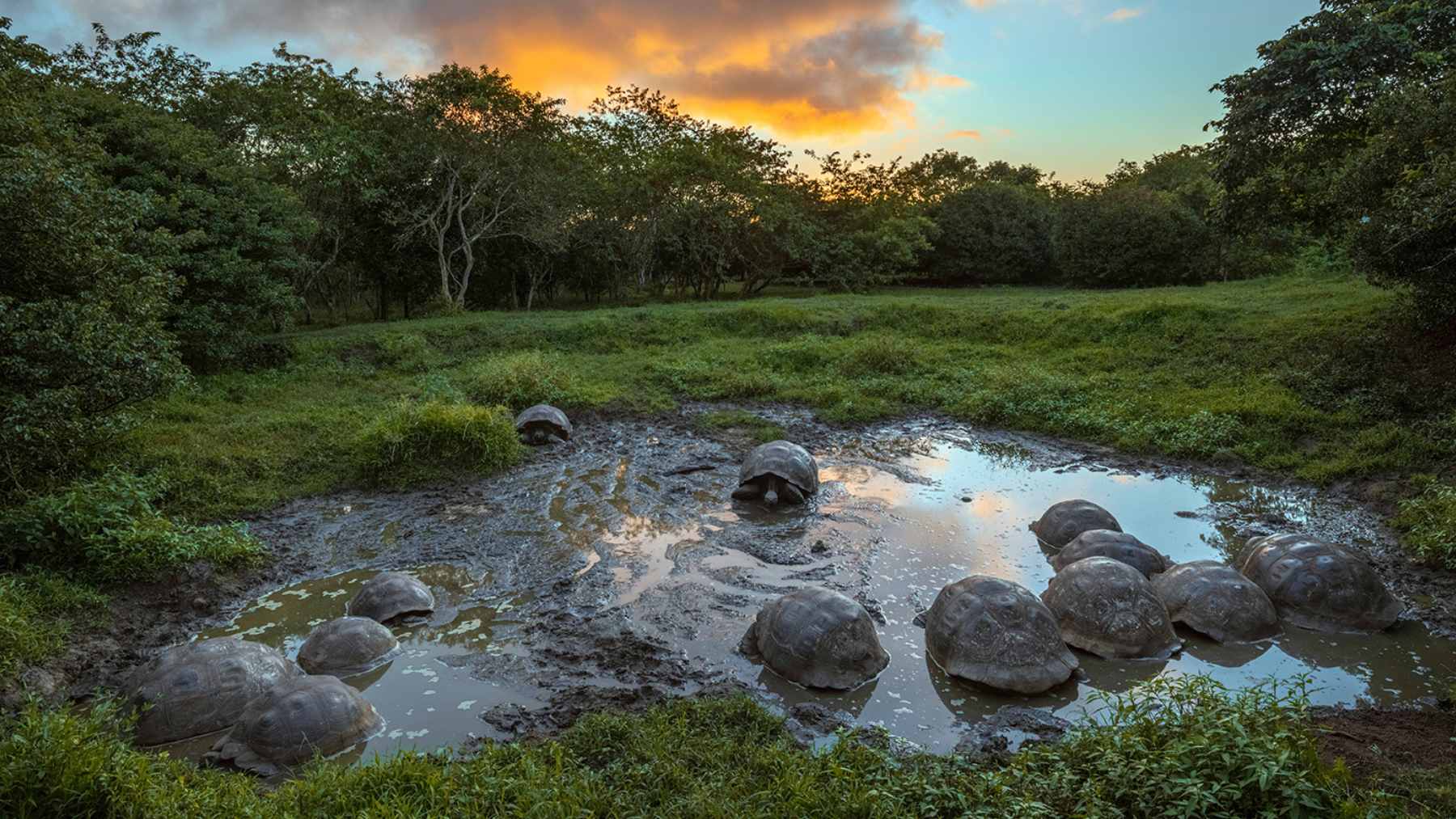
As they browse and travel, the animals open corridors through dense brush, create small muddy wallows that hold water and expose patches of bare soil where new seedlings can take hold.
For local wildlife, those patches can feel like a mosaic of tiny new neighborhoods. For land managers, it is a reminder that some of the jobs we often assign to tractors and chainsaws can, in certain places, be handled by the right animal in the right numbers.
This idea, known as trophic rewilding, is attracting attention far beyond the Pacific. Ecologists are testing similar approaches with bison on North American grasslands and with other large herbivores on islands where native giants vanished long ago.
Hopeful results with real limits
None of this turns giant tortoises into a magic climate tool. The islands still face intense pressure from invasive species, growing tourism and a changing ocean. Some studies warn that if tortoise numbers climbed too quickly in a warming, drought-prone climate, they could overgraze certain areas faster than plants recover.
That is why park rangers still patrol nesting areas, remove goats and other introduced mammals, and keep a close eye on vegetation from drones and satellite images. The animals provide the heavy ecological lifting, but people still handle the planning and the politics.
For readers far from the equator, the lesson is surprisingly down to earth. Protecting land is only a first step. When a key herbivore disappears, forests and grasslands can lock into a very different state, even if the map still shows a green protected area. Putting the right species back, at the right density, can restart natural processes that no amount of fencing or paperwork can fully replace.
The latest work that documents how restored tortoise populations are restructuring plant communities on Española was published in Conservation Letters.