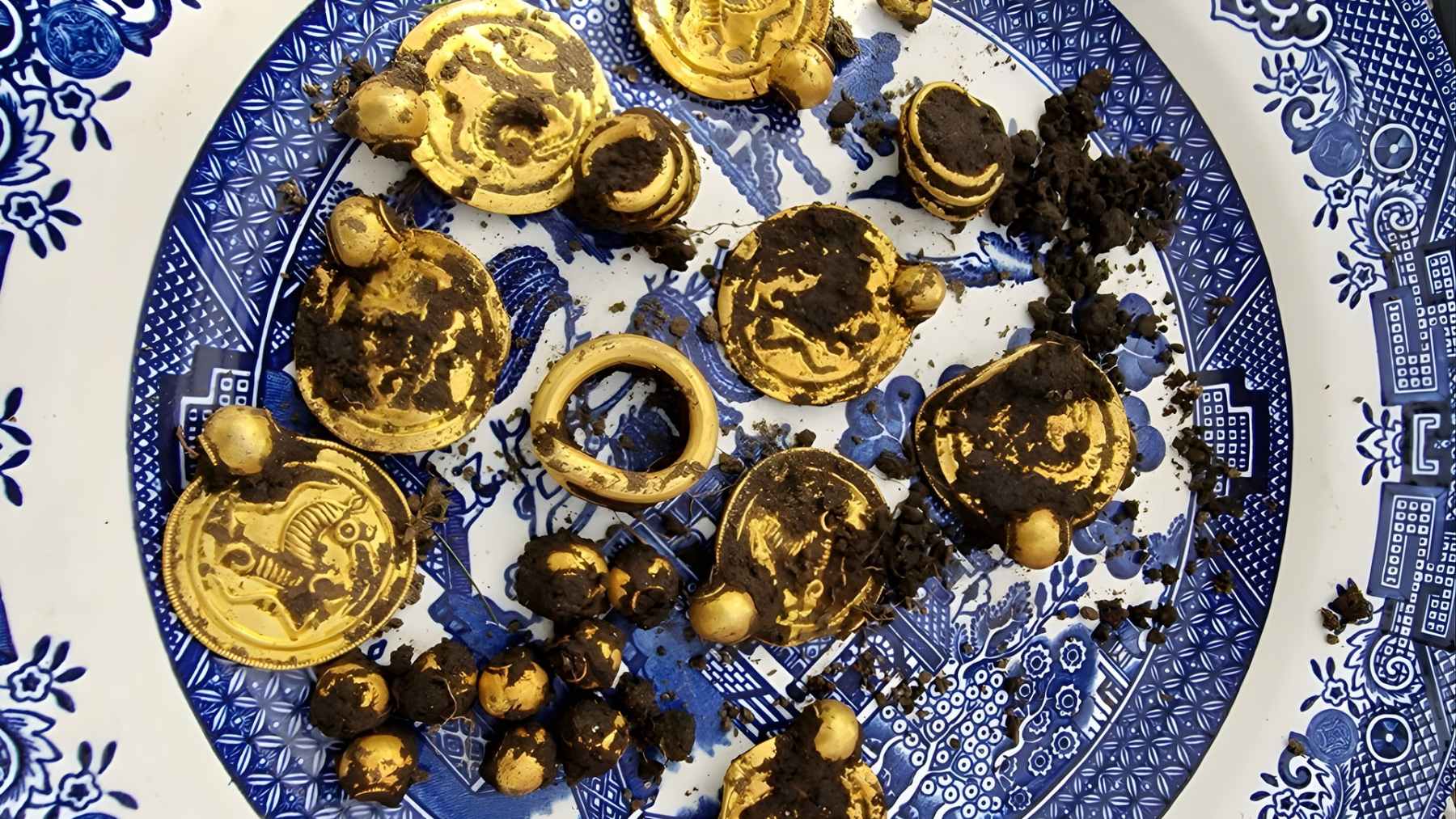
Most of us head out for a walk to clear our heads or close the exercise ring on a smartwatch. In late summer on the Norwegian island of Rennesøy, that simple habit handed 51-year-old Erlend Bore something very different. His new metal detector buzzed over a clump of soil that held nine gold pendants, ten beads and three rings from around the year 500.
Archaeologists at the Museum of Archaeology at the University of Stavanger quickly labeled it “the find of the century in Norway” and noted that uncovering so much gold at once is extremely rare. The hoard weighs just over 100 grams, yet its real weight is historical rather than financial.
A walk that opened a window on the Migration Period
Bore had bought the detector after his doctor told him to get out more instead of sitting on the couch. At first the device found only scrap. Then it started beeping on higher ground. In the dirt he saw what looked like bright coins.
“At first I thought I had found chocolate coins or plastic pirate treasure. It was surreal,” he later recalled.
He did what heritage authorities hope every hobby detectorist will do. He stopped digging, marked the spot and contacted the county cultural heritage office, which brought in archaeologists from the museum.
Their survey uncovered a carefully buried set of jewelry. The round, coin-like pieces are gold bracteates, thin medallions that once hung on an ornate necklace worn by a powerful person in early Scandinavian society.
Specialists estimate that similar objects worldwide number only in the hundreds and that Norway has not seen a comparable bracteate find since the nineteenth century. Some later media reports suggested the commercial value of such a hoard could run into several million dollars, although the pieces will never be sold on the open market.
Gold, gods and a society under stress
Look closely at the pendants and a different story appears. The medallions show a stylized horse with twisted legs and lolling tongue, an image that experts say echoes Norse myths of the god Odin healing an injured animal. The motif held a double meaning. It signaled illness and hardship, but also hope for recovery and new life.
Archaeologists date the Rennesøy treasure to around the 6th century, toward the end of the Migration Period when people across Europe were on the move. In Scandinavia, many bracteate hoards were buried in the mid-500s, a time that tree rings and ice cores reveal as unusually cold after a series of volcanic eruptions dimmed sunlight in the Northern Hemisphere.
Researchers describe this era as one of failing harvests, harsher climate and disease outbreaks. Farmsteads in western Norway were abandoned in large numbers. That context helps explain why someone on Rennesøy might have placed a golden necklace into the ground, either as hidden wealth in troubled times or as an offering to unseen powers.
In other words, a flashy piece of jewelry has become evidence that past societies also wrestled with climate shocks and uncertainty, even if their responses looked more like sacrifice than emissions targets.
Heritage as a non-renewable resource
Under Norway’s Cultural Heritage Act, ownerless objects from before 1537 and coins older than 1650 belong to the state and must be reported. Hobby detectorists are allowed, but they need the landowner’s permission and must avoid protected sites, which include any traces of human activity from before 1537.
The law treats finds like the Rennesøy hoard as shared cultural heritage. Bore and the farmer will receive a reward rather than the physical gold itself, a system meant to keep treasures in public collections and discourage quiet trips to the black market.
For environmental readers, that may sound familiar. Archaeologists often talk about artifacts the way ecologists talk about old-growth forests. Once the context is destroyed by careless digging, construction or erosion, it cannot be restored. You can melt gold and reuse it. You cannot rebuild a sixth century ritual landscape in exactly the same spot.
Norway’s heritage authorities even say they welcome collaboration with responsible detectorists, since plowing and soil erosion can eventually destroy fragile objects in farmed fields. When hobbyists follow the rules, they help rescue pieces of history before weather and agriculture grind them away.
Climate change and the ground beneath our feet
There is another twist. Around the world, climate change is putting archaeological sites under pressure through thawing permafrost, coastal erosion, stronger storms and drought. UNESCO. In the Arctic, melting ice is suddenly revealing ancient hunting gear and organic artifacts, only for them to decay once they are exposed to air and warmer temperatures.
So a story that starts with a man stretching his legs on a Norwegian island ends up touching on a much larger question. How do we care for what lies buried under our fields and shorelines at a time when the climate itself is shifting the ground?
For now, the Rennesøy gold rests in controlled museum storage, far from plows and rising seas, and will soon go on public display.
The official statement was published by the “University of Stavanger“.
Image credit: Anniken Celine Berge – Museum of Archaeology